Introduction
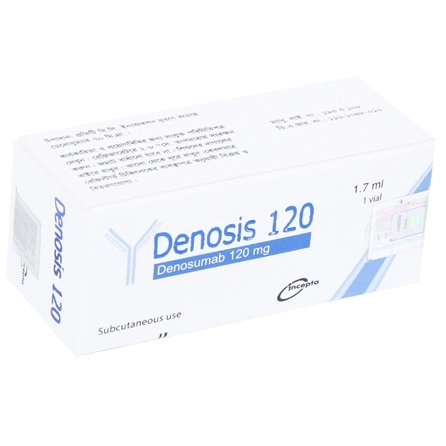
Denosis SC Injection 120 mg/1.7 ml is a novel, fully human IgG2 monoclonal antibody specific to receptor activator of nuclear factor kappa-B ligand (RANKL), suppresses bone resorption markers in patients with a variety of metastatic tumors and is being investigated in multiple clinical trials for the prevention and treatment of bone metastases. Chemically, it consists of 2 heavy and 2 light chains. Each light chain consists of 215 amino acids.
Uses
Denosis SC Injection 120 mg/1.7 ml is a RANK ligand (RANKL) inhibitor used for the management of osteoporosis in patients at high risk for bone fractures.
Prolia is indicated for the treatment of postmenopausal women with osteoporosis at high risk for fracture. It reduces the incidence of vertebral, nonvertebral, and hip fractures. Prolia is also indicated as a treatment to increase bone mass in women at high risk for fracture receiving adjuvant aromatase inhibitor therapy for breast cancer. It can also be used in men with osteoporosis at high risk for fracture or in men receiving androgen deprivation therapy for nonmetastatic prostate cancer to increase bone mass. Xgeva is indicated for the prevention of skeletal-related events in patients with bone metastases from solid tumors.
Associated Conditions
Pharmacodynamics
In clinical studies, treatment with 60 mg of Prolia resulted in reduction in the bone resorption marker serum type 1 C-telopeptide (CTX) by approximately 85% by 3 days. Consistent with the physiological coupling of bone formation and resorption in skeletal remodeling, subsequent reductions in bone formation markers (i.e. osteocalcin and procollagen type 1 N-terminal peptide [PlNP]) were observed starting 1 month after the first dose of Prolia.
Mechanism of Action
Denosis SC Injection 120 mg/1.7 ml is designed to target RANKL (RANK ligand), a protein that acts as the primary signal to promote bone removal/resorption. In many bone loss conditions, RANKL overwhelms the body's natural defense against bone destruction. Denosis SC Injection 120 mg/1.7 ml prevents RANKL from activating its receptor, RANK, on the surface of osteoclasts and their precursors. Prevention of the RANKL/RANK interaction inhibits osteoclast formation, function, and survival, thereby decreasing bone resorption and increasing bone mass and strength in both cortical and trabecular bone.
Absorption
When 60 mg of denosumab was subcutaneously administered to healthy subjects after fasting for 12 hours, the pharmacokinetic parameters are as follows: Cmax = 6.75 mcg/mL; Tmax= 10 days (range of 3 to 21 days); AUC (0-16 weeks) = 316 mcg•day/mL. Denosis SC Injection 120 mg/1.7 ml does not accumulate following multiple doses once every 6 months. The pharmacokinetics of denosumab were not affected by the formation of antibodies.
Half Life
25.4 days
Toxicity
In patients with postmenopausal osteoporosis, the most common adverse reactions (> 5% and more common than placebo) were: back pain, pain in extremity, hypercholesterolemia, musculoskeletal pain, and cystitis. Pancreatitis has been reported in clinical trials. In male patients with osteoporosis, the most common adverse reactions (> 5% and more common than placebo) were: back pain, arthralgia, and nasopharyngitis. In patients experiencing bone loss due to hormone ablation for cancer, the most common adverse reactions (≥ 10% and more common than placebo) were: arthralgia and back pain. Pain in extremity and musculoskeletal pain have also been reported in clinical trials
Food Interactions
- Administer calcium supplement. Calcium supplements should be used as necessary to prevent hypocalcemia.
- Administer vitamin supplements. Vitamin D should be administered as necessary to complement calcium in preventing hypocalcemia.
Dosage
Treatment of Osteoporosis and Bone Loss: Administer 60 mg every 6 months as a subcutaneous injection in the upper arm, upper thigh, or abdomen. Instruct patients to take calcium 1000 mg daily and at least 400 IU vitamin D daily. If a dose of Denosis SC Injection 120 mg/1.7 ml is missed, administer the injection as soon as the patient is available. Thereafter, schedule injections every 6 months from the date of the last injection.
Multiple Myeloma and Bone Metastasis from Solid Tumors: Administer 120 mg every 4 weeks as a subcutaneous injection in the upper arm, upper thigh, or abdomen
Giant Cell Tumor of Bone: Administer 120 mg every 4 weeks with additional 120 mg doses on Days 8 and 15 of the first month of therapy. Administer subcutaneously in the upper arm, upper thigh, or abdomen. Administer calcium and vitamin D as necessary to treat or prevent hypocalcemia.
Hypercalcemia of Malignancy: Administer 120 mg every 4 weeks with additional 120 mg doses on Days 8 and 15 of the first month of therapy. Administer subcutaneously in the upper arm, upper thigh, or abdomen.