Introduction
Vitamin D, in general, is a secosteroid generated in the skin when 7-dehydrocholesterol located there interacts with ultraviolet irradiation - like that commonly found in sunlight . Both the endogenous form of vitamin D (that results from 7-dehydrocholesterol transformation), vitamin D3 (cholecalciferol), and the plant-derived form, vitamin D2 (ergocalciferol), are considered the main forms of vitamin d and are found in various types of food for daily intake . Structurally, ergocalciferol differs from cholecalciferol in that it possesses a double bond between C22 and C23 and has an additional methyl group at C24 . Finally, ergocalciferol is pharmacologically less potent than cholecalciferol, which makes vitamin D3 the preferred agent for medical use .
Appropriate levels of vitamin D must be upheld in the body in order to maintain calcium and phosphorus levels in a healthy physiologic range to sustain a variety of metabolic functions, transcription regulation, and bone metabolism . However, studies are also ongoing to determine whether or not cholecalciferol may also play certain roles in cancer, autoimmune disorders, cardiovascular disease, and other medical conditions that may be associated with vitamin D deficiency .
Uses
Vitamin D3 is a form of Vitamin D used in the treatment of specific medical conditions such as refractory rickets, hypoparathyroidism, and familial hypophosphatemia, as well as osteoporosis and chronic kidney disease.
Cholecalciferol use is indicated for the treatment of specific medical conditions like refractory rickets (or vitamin D resistant rickets), hypoparathyroidism, and familial hypophosphatemia .
Concurrently, as one of the most commonly utilized forms of vitamin D, cholecalciferol is also very frequently used as a supplement in individuals to maintain sufficient vitamin d levels in the body or to treat vitamin D deficiency, as well as various medical conditions that can be associated directly or indirectly with vitamin d insufficiency like osteoporosis and chronic kidney disease, among others .
Associated Conditions
Pharmacodynamics
The in vivo synthesis of the predominant two biologically active metabolites of vitamin D occurs in two steps. The first hydroxylation of vitamin D3 cholecalciferol (or D2) occurs in the liver to yield 25-hydroxyvitamin D while the second hydroxylation happens in the kidneys to give 1, 25-dihydroxyvitamin D . These vitamin D metabolites subsequently facilitate the active absorption of calcium and phosphorus in the small intestine, serving to increase serum calcium and phosphate levels sufficiently to allow bone mineralization . Conversely, these vitamin D metabolites also assist in mobilizing calcium and phosphate from bone and likely increase the reabsorption of calcium and perhaps also of phosphate via the renal tubules . There exists a period of 10 to 24 hours between the administration of cholecalciferol and the initiation of its action in the body due to the necessity of synthesis of the active vitamin D metabolites in the liver and kidneys . It is parathyroid hormone that is responsible for the regulation of such metabolism at the level of the kidneys .
Mechanism of Action
Most individuals naturally generate adequate amounts of vitamin D through ordinary dietary intake of vitamin D (in some foods like eggs, fish, and cheese) and natural photochemical conversion of the vitamin D3 precursor 7-dehydrocholesterol in the skin via exposure to sunlight .
Conversely, vitamin D deficiency can often occur from a combination of insufficient exposure to sunlight, inadequate dietary intake of vitamin D, genetic defects with endogenous vitamin D receptor, or even severe liver or kidney disease . Such deficiency is known for resulting in conditions like rickets or osteomalacia, all of which reflect inadequate mineralization of bone, enhanced compensatory skeletal demineralization, resultant decreased calcium ion blood concentrations, and increases in the production and secretion of parathyroid hormone . Increases in parathyroid hormone stimulate the mobilization of skeletal calcium and the renal excretion of phosphorus . This enhanced mobilization of skeletal calcium leads towards porotic bone conditions .
Ordinarily, while vitamin D3 is made naturally via photochemical processes in the skin, both itself and vitamin D2 can be found in various food and pharmaceutical sources as dietary supplements. The principal biological function of vitamin D is the maintenance of normal levels of serum calcium and phosphorus in the bloodstream by enhancing the efficacy of the small intestine to absorb these minerals from the diet . At the liver, vitamin D3 or D2 is hydroxylated to 25-hydroxyvitamin D and then finally to the primary active metabolite 1,25-dihydroxyvitamin D in the kidney via further hydroxylation . This final metabolite binds to endogenous vitamin d receptors, which results in a variety of regulatory roles - including maintaining calcium balance, the regulation of parathyroid hormone, the promotion of the renal reabsorption of calcium, increased intestinal absorption of calcium and phosphorus, and increased calcium and phosphorus mobilization of calcium and phosphorus from bone to plasma to maintain balanced levels of each in bone and the plasma .
In particular, calcitriol interacts with vitamin D receptors in the small intestine to enhance the efficiency of intestinal calcium and phosphorous absorption from about 10-15% to 30-40% and 60% increased to 80%, respectively . Furthermore, calcitriol binds with vitamin D receptors in osteoblasts to stimulate a receptor activator of nuclear factor kB ligand (or RANKL) which subsequently interacts with receptor activator of nuclear factor kB (NFkB) on immature preosteoclasts, causing them to become mature bone-resorbing osteoclasts . Such mature osteoclasts ultimately function in removing calcium and phosphorus from bone to maintain blood calcium and phosphorus levels . Moreover, calcitriol also stimulates calcium reabsorption from the glomerular filtrate in the kidneys .
Additionally, it is believed that when calcitriol binds with nuclear vitamin D receptors, that this bound complex itself binds to retinoic acid X receptor (RXR) to generate a heterodimeric complex that consequently binds to specific nucleotide sequences in the DNA called vitamin D response elements . When bound, various transcription factors attach to this complex, resulting in either up or down-regulation of the associated gene's activity. It is thought that there may be as much as 200 to 2000 genes that possess vitamin D response elements or that are influenced indirectly to control a multitude of genes across the genome . It is in this way that cholecalciferol is believed to function in regulating gene transcription associated with cancer risk, autoimmune disorders, and cardiovascular disease linked to vitamin D deficiency . In fact, there has been some research to suggest calcitriol may also be able to prevent malignancies by inducing cellular maturation and inducing apoptosis and inhibiting angiogenesis, exhibit anti-inflammatory effects by inhibiting foam cell formation and promoting angiogenesis in endothelial colony-forming cells in vitro, inhibit immune reactions by enhancing the transcription of endogenous antibiotics like cathelicidin and regulate the activity and differentiation of CD4+ T cells, amongst a variety of other proposed actions .
Absorption
Cholecalciferol is readily absorbed from the small intestine if fat absorption is normal . Moreover, bile is necessary for absorption as well .
In particular, recent studies have determined aspects about the absorption of vitamin D, like the fact that a) the 25-hydroxyvitamin D metabolite of cholecalciferol is absorbed to a greater extent than the nonhydroxy form of cholecalciferol, b) the quantity of fat with which cholecalciferol is ingested does not appear to largely affect its bioavailability, and c) age does not apparently effect vitamin D cholecalciferol .
Volume of Distribution
Studies have determined that the mean central volume of distribution of administered cholecalciferol supplementation in a group of 49 kidney transplant patients was approximately 237 L .
Protein Binding
The protein binding documented for cholecalciferol is 50 to 80% . Specifically, in the plasma, vitamin D3 (from either diet or the skin) is bound to vitamin D-binding protein (DBP) produced in the liver, for transport to the liver. Ultimately, the form of vitamin D3 reaching the liver is 25-hydroxylated, and such 25-hydroxycholecalciferol is bound to DBP (α2-globulin) whilst circulating in the plasma .
Route of Elimination
It has been observed that administered cholecalciferol and its metabolites are excreted primarily in the bile and feces .
Half Life
At this time, there have been resources that document the half-life of cholecalciferol as being about 50 days while other sources have noted that the half-life of calcitriol (1,25-dihydroxyvitamin D3) is approximately 15 hours while that of calcidiol (25-hydroxyvitamin D3) is about 15 days .
Moreover, it appears that the half-lives of any particular administration of vitamin d can vary due to variations in vitamin d binding protein concentrations and genotype in particular individuals .
Clearance
Studies have determined that the mean clearance value of administered cholecalciferol supplementation in a group of 49 kidney transplant patients was approximately 2.5 L/day .
Toxicity
Chronic or acute administration of excessive doses of cholecalciferol may lead to hypervitaminosis D, manifested by hypercalcemia and its sequelae . Early symptoms of hypercalcemia may include weakness, fatigue, somnolence, headache, anorexia, dry mouth, metallic taste, nausea, vomiting, vertigo, tinnitus, ataxia, and hypotonia . Later and possibly more serious manifestation include nephrocalcinosis, renal dysfunction, osteoporosis in adults, impaired growth in children, anemia, metastatic calcification, pancreatitis, generalized vascular calcification, and seizures .
Safety of doses in excess of 400 IU (10mcg) of vitamin D3 daily during pregnancy has not been established . Maternal hypercalcemia, possibly caused by excessive vitamin D intake during pregnancy, has been associated with hypercalcemia in neonates, which may lead to supravalvular aortic stenosis syndrome, the features of which may include retinopathy, mental or growth retardation, strabismus, and other effects . Hypercalcemia during pregnancy may also lead to suppression of parathyroid hormone release in the neonate, resulting in hypocalcemia, tetany, and seizures .
Vitamin D is deficient in maternal milk; therefore, breastfed infants may require supplementation. Use of excessive amounts of Vitamin D in nursing mothers may result in hypercalcemia in infants. Doses of Vitamin D3 in excess of 10 µg daily should not be administered daily to nursing women.
Food Interactions
No interactions found.
Dosage
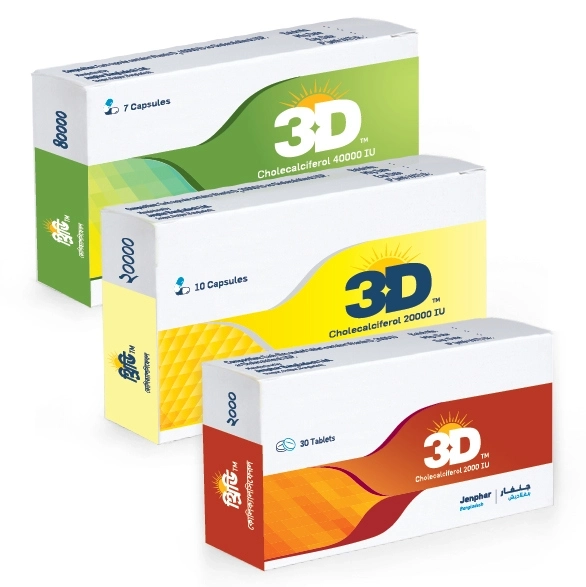
- Treatment of Vitamin D3 deficiency: 40000 IU once weekly for 7 weeks. Doses for maintenance therapy is 1400-2000 IU/day. To confirm the target level of 25 hydroxyvitamin D, measurement of it should be determined 3-4 months after initiating the maintenance therapy.
- Prevention of Vitamin D3 deficiency: 20000 IU every 4 weeks. Higher doses may be required in certain situations.
- Addition to specific therapy for osteoporosis: 20000 IU once a month.
- Treatment of Vitamin D3 deficiency: 20000 IU once every 2 weeks for 6 weeks.
- Prevention of Vitamin D3 deficiency: 20000 IU every 6 weeks.
For oroflash or chewable tablets: 1000 IU to 2000 IU daily, or as directed by physician. Take the medicine with food or within 1 hour after a meal. Place the tablet in mouth swallow after chewing.
For Syrup:
For patients with risk of Cholecalciferol deficiency:
- 0-1 yr: 400 IU/ day (2 ml)
- >1 Yr: 600 lU/ day (3 ml)
- 0-1 yr: 2000 IU/ day (+50000 IU/week ) for 6 weeks
- 1 -18 yrs: 2000 IU/ day for 6 weeks.
- Infants receiving Vitamin D enriched milk: ½ ampoule (0.5 ml) i.e. 1,00000 I.U. every 6 months.
- Nursed infants or infants not receiving Vitamin D enriched milk or young children up to 5 years of age: 1 ampoule (1 ml) i.e. 2,00000 I.U. every 6 months.
- Adolescents: 1 ampoule (1 ml) i.e. 2,00000 I.U. every 6 months during winter.
- Pregnancy: ½ ampoule (0.5 ml) i.e. 1,00000 I.U. from the 6th or 7th month of pregnancy.
- Elderly: ½ ampoule (0.5 ml) i.e. 1,00000 I.U. every 3 months. Digestive disorders, concomitant treatment with antiepileptics & other particular condition not described above; ½ ampoule (0.5 ml) i.e. 1,00000 I.U. or 1 ampoule (1 ml) i.e. 2,00000 I.U. every 3 or 6 months.
- 1 ampoule (1 ml) i.e. 2,00000 I.U. which can be repeated 1 to 6 months later. Or, as directed by the registered physician.