Introduction
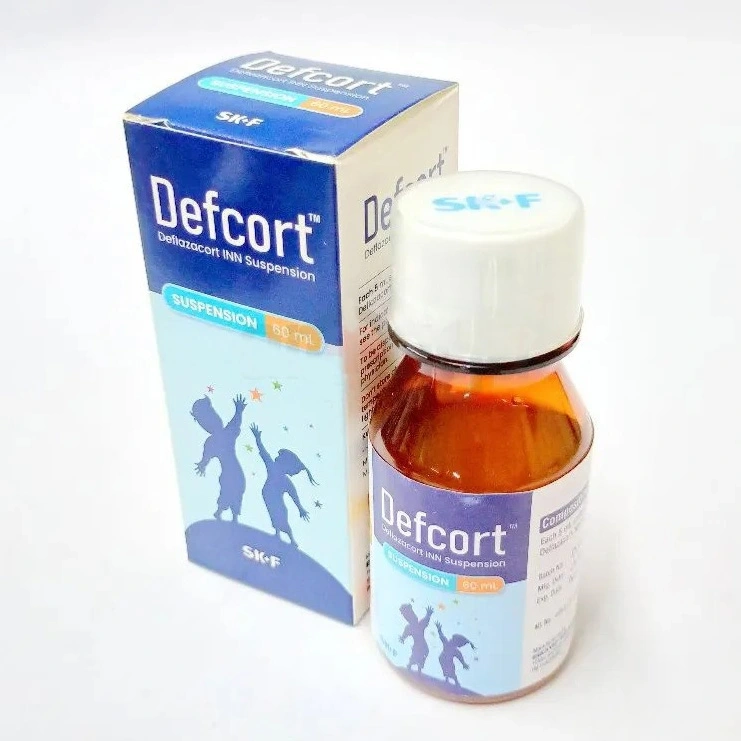
Defcort Oral Suspension 6 mg/5 ml, also known as Emflaza, is a corticosteroid prodrug used as an agent to manage Duchenne Muscular Dystrophy (DMD).
Duchenne Muscular Dystrophy is an inherited disorder resulting from mutations of the dystrophin gene, which is important for muscle function. This disease can cause serious muscle weakness and progressive breathing and cardiovascular disability, severely impacting patient quality of life and survival. This disease usually manifests by muscle weakness in early childhood followed by loss of the ability to walk (ambulation) as early as age 7.
Defcort Oral Suspension 6 mg/5 ml delays the onset of muscle related complications resulting from DMD, prolonging the lives of children diagnosed with this disease and exerting less harmful effects on the bone health and weight than other steroid medications.
Uses
Defcort Oral Suspension 6 mg/5 ml is a corticosteroid used to treat Duchenne muscular dystrophy.
Defcort Oral Suspension 6 mg/5 ml is indicated for the treatment of Duchenne Muscular Dystrophy (DMD) in patients 2 years of age and older.
Associated Conditions
Pharmacodynamics
Defcort Oral Suspension 6 mg/5 ml exerts anti-inflammatory activity in DMD, likely improving various symptoms, including muscle weakness and cardiorespiratory symptoms in addition to delaying their onset. This allows for an increased quality of life and prevents the necessity for surgical procedures, such as those for scoliosis, which is associated with DMD. Studies showed significant preservation of muscle mass in patients generally treated with 0.9 mg/kg/day of deflazacort compared to a control group. The following findings are based on clinical studies using deflazacort on a long term basis:
Effects on muscle strength
At age 16, individuals treated with long-term deflazacort had 63 ± 4% score in muscle strength compared to a mean muscle strength score of 31 ± 3% for control patients. Significant improvements in climbing stairs and rising from a supine position were also seen in patients taking deflazacort.
Effects on ambulation
Ambulation was significantly higher by 12 years of age and 18 years of age in patients taking deflazacort when compared with the control group. The control group showed a mean loss of ambulation of 2 years sooner than with deflazacort treatment.
Effects on cardiac function
Mean left ventricular ejection fraction (a measure of cardiac function) was higher in patients treated with deflazacort over the long term. Preservation of cardiac function was demonstrated by a mean difference in ejection fraction of about 7%, favoring study groups taking deflazacort over control groups.
Effects on spinal alignment
Children treated with deflazacort also significantly lowered the rate and severity of scoliosis and eliminated the need for scoliosis surgery after long-term treatment.
Mechanism of Action
Defcort Oral Suspension 6 mg/5 ml is a corticosteroid prodrug with an active metabolite, 21-deflazacort, which binds to the glucocorticoid receptor to exert anti-inflammatory and immunosuppressive effects on the body. The exact mechanism by which deflazacort exerts its therapeutic effects in patients with DMD is unknown but likely occurs via its anti-inflammatory activities.
Absorption
Defcort Oral Suspension 6 mg/5 ml is rapidly absorbed after oral administration with peak concentration occurring within 1-2 hours. One pharmacokinetic study determined an AUC (area under the curve) of 280 ng/ml · h.
The bioavailability of both the oral suspension and tablet are similar. In clinical studies, coadministration of deflazacort crushed with food or applesauce did not affect absorption or bioavailability.
Volume of Distribution
One study determined the volume of distribution to be 204 ± 84 L.
Protein Binding
The protein binding of the active metabolite of deflazacort is approximately 40%.
Route of Elimination
Urinary excretion is the major route of deflazacort elimination, accounting for about about 70% of the excreted dose. The remainder of the dose (about 30%) is excreted in the feces. Elimination is almost completed by 24 hours post-dose. 21-deflazacort makes up about 18% of the eliminated drug in the urine.
Half Life
The half-life of deflazacort ranges from 1.1 to 1.9 h
Clearance
114 ±27 L/h, according to one noncompartmental pharmacokinetic study.
The clearance of corticosteroids is enhanced in hypothyroid patients and increased in patients with hyperthyroidism. Dosing adjustments may be considered according to thyroid status. A study of corticosteroid clearance was performed in patients with a creatinine clearance of 15 mL/min or less, and determined that the active metabolite of deflazacort, 21-deflazacort was similar to that in patients with normal renal clearance.
Toxicity
The LD50 for the oral dose is 5200 mg/kg (mouse); Oral TDLO (woman): 0.12 mg/kg
A note on altered endocrine function and immunosuppression
Defcort Oral Suspension 6 mg/5 ml, as a steroid prodrug used over a long-term period, can cause hormone imbalance leading to diseases such as Cushing's Syndrome and hypothalamic-pituitary-adrenal axis suppression. It can also predispose to infection, as it promotes immunosuppression. It is important to monitor for hormonal imbalance and infection and provide necessary treatment if they occur.
Mutagenicity/carcinogenicity
Mutagenicity assays were negative in various laboratory and in vivo assays performed on rats. Chronic use in mice for 2 years in one study resulted in a higher rate of osteoma and osteosarcomas in mice receiving 0.06, 0.12, 0.25, 0.50, or 1.0 mg/kg of deflazacort daily.
Use in pregnancy
There are no sufficient data to support the administration of deflazacort during pregnancy. Corticosteroid drugs such as deflazacort should only be used during pregnancy only if the benefits of therapy outweigh the potential risks.
Use in lactation
Corticosteroids, when administered systemically, are excreted in the breastmilk. Exposure may lead to disturbances in bone development and growth and endocrine disturbances in the exposed infant.
Food Interactions
- Avoid grapefruit products. Grapefruit inhibits CYP3A metabolism, which may increase the serum concentration of deflazacort.
- Avoid St. John's Wort. This herb induces CYP3A metabolism and may reduce serum levels of deflazacort.
- Take with or without food. The tablets may be crushed and mixed with applesauce and consumed immediately.
Dosage
- For acute disorders: Up to 120 mg/day Defcort Oral Suspension 6 mg/5 ml may need to be given initially. Maintenance doses in most conditions are within the range of 3-18 mg/day.
- Rheumatoid arthritis: The maintenance dose is usually within the range of 3-18 mg/day. The smallest effective dose should be used and increased if necessary.
- Bronchial asthma: In the treatment of an acute attack, high doses of 48-72 mg/day may be needed depending on severity and gradually reduced once the attack has been controlled. For maintenance in chronic asthma, doses should be titrated to the lowest dose that controls symptoms.
- Other conditions: The dose of Defcort Oral Suspension 6 mg/5 ml depends on clinical need titrated to the lowest effective dose for maintenance. Starting doses may be estimated on the basis of ratio of 5 mg prednisone or prednisolone to 6 mg.
The following ranges provide general guidance:
- Juvenile chronic arthritis: The usual maintenance dose is between 0.25-1.0 mg/kg/day.
- Nephrotic syndrome: Initial dose of usually 1.5 mg/kg/day followed by down titration according to clinical need.
- Bronchial asthma: On the basis of the potency ratio, the initial dose should be between 0.25-1.0 mg/kg on alternate days.