Introduction
One of the catecholamine neurotransmitters in the brain. It is derived from tyrosine and is the precursor to norepinephrine and epinephrine. Dopamine is a major transmitter in the extrapyramidal system of the brain, and important in regulating movement. A family of receptors (receptors, dopamine) mediate its action.
Uses
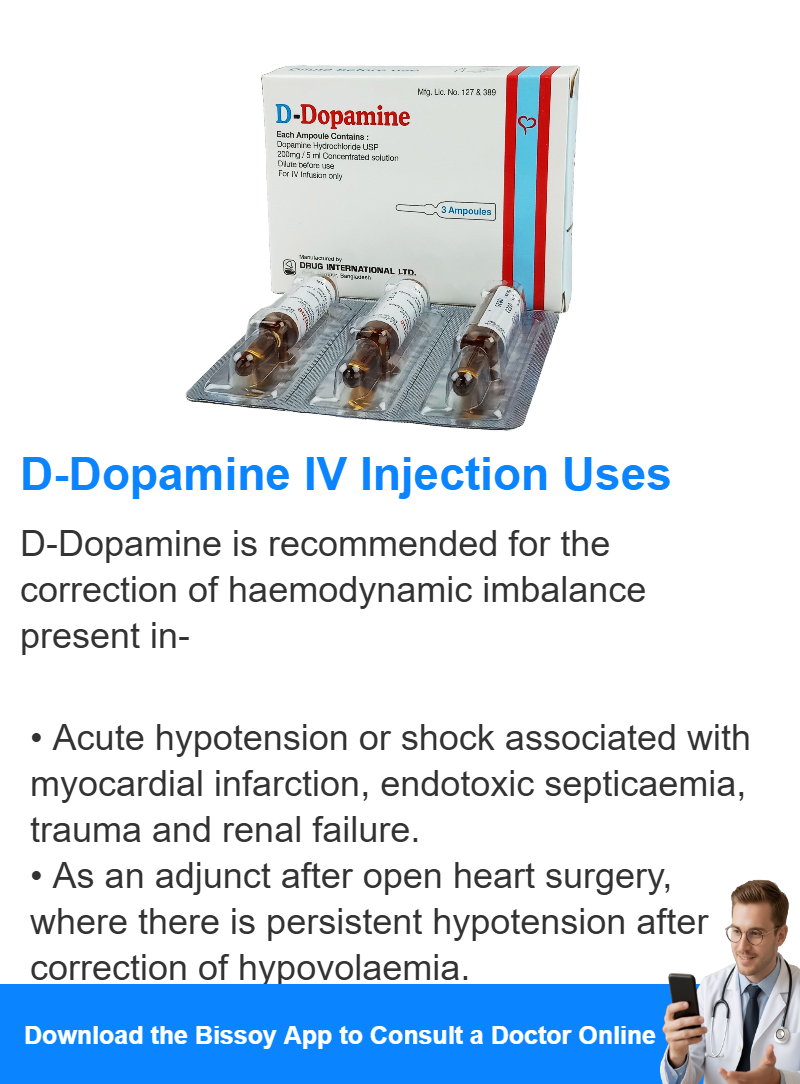
Dopamine is a catecholamine neurotransmitter used to treat hemodynamic imbalances, poor perfusion of vital organs, low cardiac output, and hypotension.
For the correction of hemodynamic imbalances present in the shock syndrome due to myocardial infarction, trauma, endotoxic septicemia, open-heart surgery, renal failure, and chronic cardiac decompensation as in congestive failure
Associated Conditions
Pharmacodynamics
Dopamine is a natural catecholamine formed by the decarboxylation of 3,4-dihydroxyphenylalanine (DOPA). It is a precursor to norepinephrine in noradrenergic nerves and is also a neurotransmitter in certain areas of the central nervous system, especially in the nigrostriatal tract, and in a few peripheral sympathetic nerves. Dopamine produces positive chronotropic and inotropic effects on the myocardium, resulting in increased heart rate and cardiac contractility. This is accomplished directly by exerting an agonist action on beta-adrenoceptors and indirectly by causing release of norepinephrine from storage sites in sympathetic nerve endings.
Mechanism of Action
Dopamine is a precursor to norepinephrine in noradrenergic nerves and is also a neurotransmitter in certain areas of the central nervous system. Dopamine produces positive chronotropic and inotropic effects on the myocardium, resulting in increased heart rate and cardiac contractility. This is accomplished directly by exerting an agonist action on beta-adrenoceptors and indirectly by causing release of norepinephrine from storage sites in sympathetic nerve endings. In the brain, dopamine actas as an agonist to the five dopamine receptor subtypes (D!, D2, D3, D4, D5).
Absorption
Dopamine is rapidly absorbed from the small intestine.
Protein Binding
No information currently available on protein binding.
Route of Elimination
It has been reported that about 80% of the drug is excreted in the urine within 24 hours, primarily as HVA and its sulfate and glucuronide conjugates and as 3,4-dihydroxyphenylacetic acid. A very small portion is excreted unchanged.
Half Life
2 minutes
Toxicity
LD50 oral mice = 1460 mg/kg, LD50 oral rats = 1780 mg/kg. Spasm or closing of eyelids, nausea, vomiting, cardiac arrhythmias, involuntary movements of the body including the face, tongue, arms, hand, head, and upper body; hypotension, haemolytic anaemia, urinary retention, duodenal ulcer, sialorrhea, ataxia, abdominal pain, dry mouth, nightmares, tachypnoea, bruxism, confusion, and insomnia.
Food Interactions
No interactions found.
Dosage
In more seriously ill patients, begin infusion of dopamine hydrochloride solution at dosage of 5 micrograms/kg/min and increase gradually using 5 to 10 micrograms/kg/min increment up to 20 to 50 micrograms/kg/min as needed. If dosage in excess of 50 micrograms/kg/min are required, it is suggested that urine output should be checked frequently. In patients who do not respond to this doses, additional increments of dopamine may be given in an effort to achieve adequent blood pressure, urine flow and perfusion.
For patients with severe, refractory, chronic congestive heart failure doses should be started on 0.5 to 2 micrograms/kg/min, and the dose increased by 1 to 3 micrograms/kg/min as urinary output increases.
ECG, blood pressure and urine output should be monitored. Cardiac output and pulmonary wedge pressure should be monitored if possible.
Children less than 12 years old: The safety and efficacy of dopamine in children under 12 years has not been established.
Geriatric patients: No variation in dosage is suggested for geriatric patients. However, close monitoring is required for blood pressure, urine flow, and peripheral tissue perfusion.