Introduction
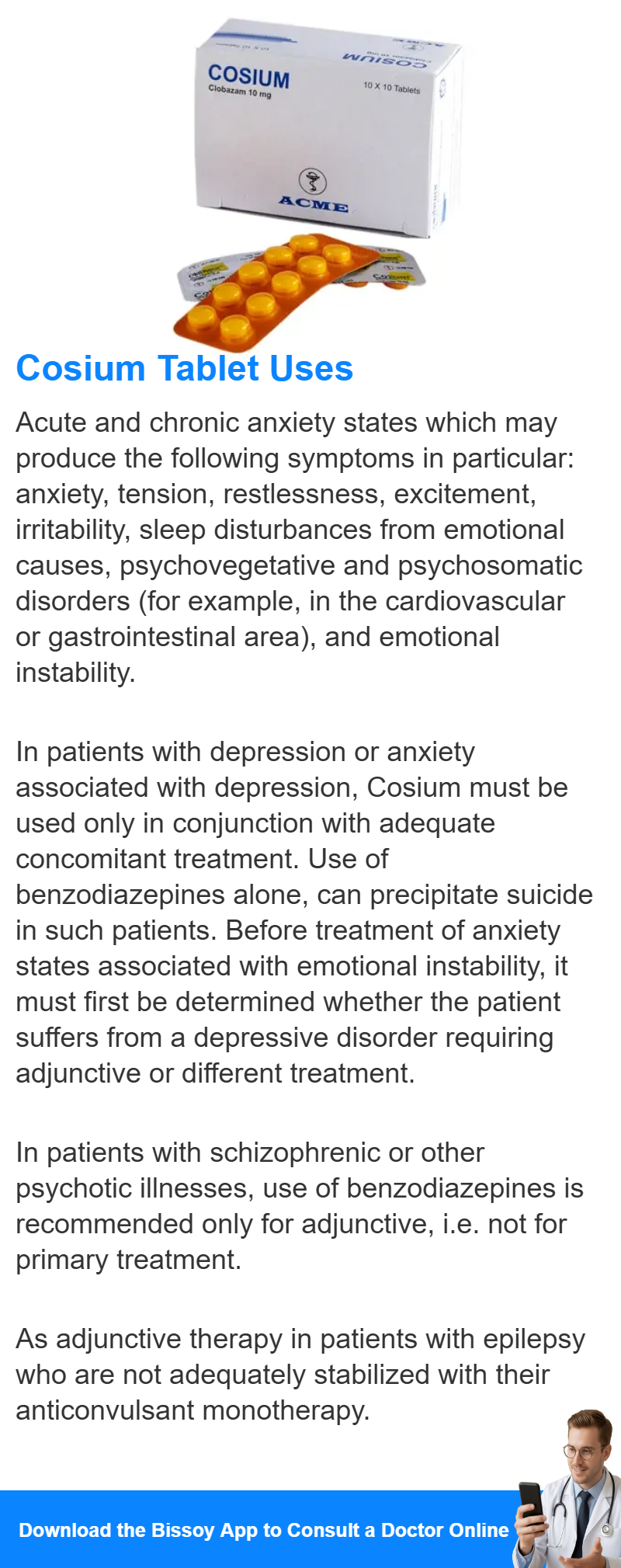
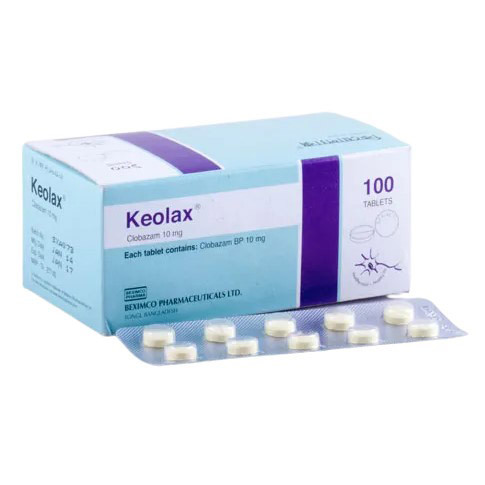
Cosium Tablet 10 mg belongs to the 1,5-benzodiazepine class of drugs and is expected to have a better side-effect profile compared to older 1,4-benzodiazepines.
Uses
Cosium Tablet 10 mg is a benzodiazepine used as adjunct treatment in seizures associated with Lennox-Gastaut syndrome.
For treatment and management of epilepsy and seizures associated with Lennox-Gastaut syndrome, a difficult-to-treat form of childhood epilepsy.
Associated Conditions
Pharmacodynamics
Similar to other benzodiazepines, clobazam binds to the interface of the α and γ2-subunit of the GABA-A receptor. However, it is considered a partial agonist to GABA-A receptors which sets clobazam apart from 1,4-benzodiazepines which are full agonist. The significance of this difference is that one may experience less sedation with clobazam than with other benzodiazepines. Unlike the endogenous GABA ligand, clobazam binds allosterically to the GABA receptor to increase the frequency of the chloride channel opening and membrane permeability to chloride ions. Pharmacodynamic tolerance has been demonstrated in animal models.
Mechanism of Action
Cosium Tablet 10 mg binds at distinct binding sites associated with the chloride ionopore at the post-synaptic GABA receptor. These GABA receptors are in various locations in the CNS (limbic, reticular formation) and clobazam increases the duration of time for which the chloride ionopore is open. As a result, hyper polarization and stabilization of the membrane occur as the post-synaptic inhibitory effect of GABA is enhanced.
Absorption
After oral administration of clobazam, it is almost completely absorbed (87% of dose). Bioavailability relative to solution was almost at 100%. Food does not affect absorption. Tmax = 1-3 hours.
Volume of Distribution
Vdss = 100 L. This high volume of distribution suggests extensive distribution to body tissues.
Protein Binding
Cosium Tablet 10 mg is the primary circulating entity in the serum and is highly protein-bound (80-90%).
Route of Elimination
Cosium Tablet 10 mg is eliminated via the urine (~94%) as metabolites.
Half Life
The mean elimination half life of an oral dose of clobazam 40 mg is 32 hours. It's main metabolite, norclobazam, as a half life of 57 hours. The half life in adult patients with epilepsy are higher than those that are healthy.
Clearance
Median estimated clearance = 2.49 L/h
Toxicity
The most common adverse effects include somnolence, pyrexia, upper respiratory tract infection, and lethargy.
Food Interactions
- Avoid alcohol. Alcohol increases clobazam absorption by 50%.
- Take with or without food. The absorption is unaffected by food.
Dosage
Treatment of anxiety states-
Adults and adolescents over 15 years of age: The initial dose is usually 20 mg clobazam daily. If necessary, the daily dose may be increased. Generally, it is recommended that a total daily dose of 30 mg is not exceeded.Elderly: Increased responsiveness and higher susceptibility to adverse effects may be present in elderly patients and require low initial doses and gradual dose increments under careful observation. A maintenance dose of 10 to 15 mg clobazam daily is frequently sufficient.
Children from 3 to 15 years of age: Increased responsiveness and higher susceptibility to adverse effects may be present in children and require low initial doses and gradual dose increments under careful observation. A daily dose of 5 to 10 mg clobazam is frequently sufficient. Benzodiazepines must not be given to children without careful assessment of the need for their use.
Secondary dosage adjustment: After the improvement of the symptoms, the dose may be reduced.
Timing of doses: If the dose is to be spread throughout the day, it is recommended that the larger portion be taken in the evening.
Duration of treatment: The duration of treatment must be as short as possible. The patient must be reassessed after a period not exceeding 4 weeks and regularly thereafter in order to evaluate the need for continued treatment, especially where the patient is free of symptoms. Generally, the overall duration of treatment (i.e. including tapering-of process) must not exceed 8 to 12 weeks. In certain cases, extension beyond the maximum treatment period may be necessary; treatment must not be extended without a re-evaluation of the patient's status using special expertise. It is strongly recommended that prolonged periods of uninterrupted treatment be avoided, since they may lead to dependence.
Discontinuation of treatment: It is strongly recommended that after prolonged treatment clobazam is not withdrawn suddenly but rather that the dose is reduced gradually under medical supervision; otherwise, withdrawal symptoms may occur.
Treatment of epilepsy in combination with one or more other anticonvulsants-
Adults and adolescents over 15 years of age: It is recommended that administration be started at small doses (5 to 15 mg daily), if necessary, increasing the dose gradually to a maximum daily dose of about 80 mg.Children from 3 to 15 years of age: It is recommended that normally treatment be started at 5 mg daily. A maintenance dose of 0.3 to 1.0 mg/kg body weight daily is usually sufficient. Higher susceptibility to adverse effects may be present in children and require gradual dose increments under careful observation; Benzodiazepines must not be given to children without careful assessment of the need for their use.
Elderly: Higher susceptibility to adverse effects may be present in elderly patients and require low initial doses and gradual dose increments under careful observation.
Timing of doses: If the dose is spread throughout the day, it is recommended that the larger portion be taken in the evening. Doses of up to 30 mg clobazam can also be administered as a single evening dose.
Duration of treatment: The patient must be re-assessed after a period not exceeding 4 weeks and regularly thereafter in order to evaluate the need for continued treatment.
Discontinuation of treatment: At the end of treatment- to include cases in which response to therapy has been poor- it is strongly recommended that clobazam is not withdrawn suddenly but rather that the dose is reduced gradually; otherwise an increased susceptibility to seizures as well as other withdrawal symptoms may occur.