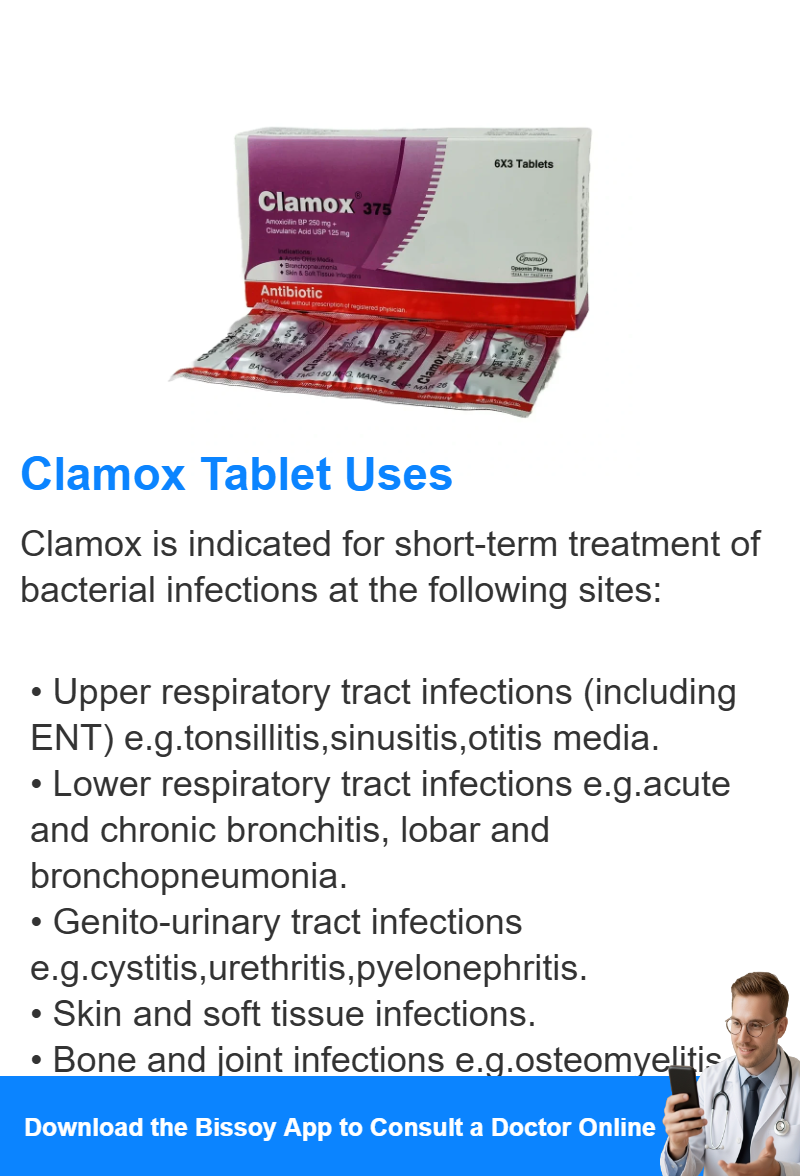
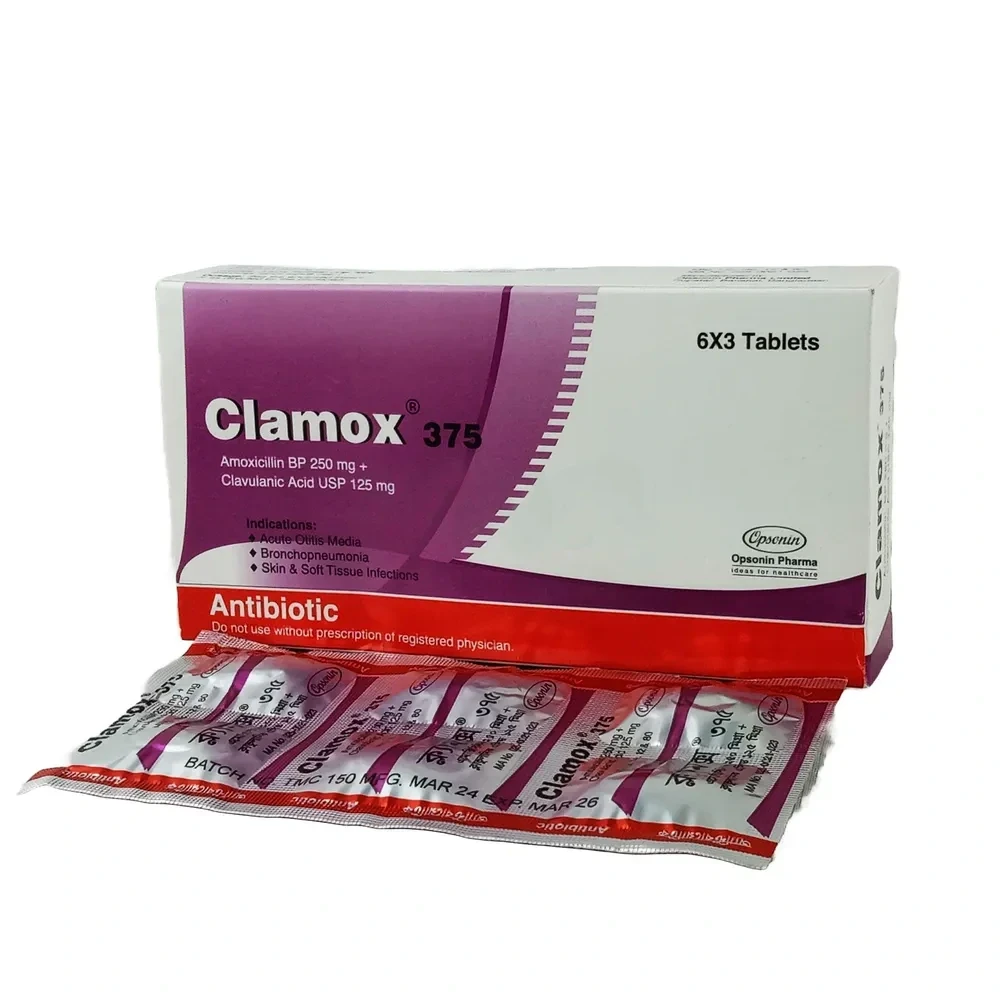
Clamox Tablet
(Opsonin Pharma Ltd.)
is a brand medicine
containing the generic
Amoxicillin + Clavulanic Acid
.
Current listed price in Bangladesh: Unit: ৳ 22.00 (3 x 6: ৳ 396.00) Strip: ৳ 132.00.
Medical information for Clamox Tablet 250 mg+125 mg
Uses, dosage, side effects, and safety details below apply to
Clamox Tablet 250 mg+125 mg
(generic:
Amoxicillin + Clavulanic Acid).
This is general information — consult a doctor before use.
Introduction
Clamox Tablet 250 mg+125 mg, also known as Augmentin, is an antibiotic combination used in the treatment of an array of bacterial infections. The active ingredients in this medication are amoxicillin, a penicillin-type antibiotic, and clavulanic acid, a beta-lactamase inhibitor that helps to prevent antibiotic resistance.
Uses
The primary uses of Clamox Tablet 250 mg+125 mg are to treat bacterial infections caused by susceptible strains of bacteria. These include sinus infections, ear infections, respiratory infections, and urinary tract infections, among others. It may also be used as part of a combination therapy to treat stomach ulcers caused by the Helicobacter pylori bacteria.
Mechanism of Action
Amoxicillin and clavulanic acid work together to inhibit the growth of bacteria and fight the infection. Amoxicillin works by blocking the formation of bacterial cell walls. Clavulanic acid works by preventing bacteria from becoming resistant to amoxicillin, allowing the drug to combat the infection more effectively.
How Long Does It Take To Work?
Most bacteria are usually killed within 48 hours of taking Clamox Tablet 250 mg+125 mg, although this may vary depending on the type and severity of the infection. If symptoms persist, further medical attention should be sought.
Absorption
Clamox Tablet 250 mg+125 mg is rapidly and almost completely absorbed from the gastrointestinal tract after oral administration.
Route of Elimination
Approximately 70% of the administered dose is eliminated via the urine within 6 hours. The remainder is eliminated via the feces.
Dosage
Adults and children over 12 years:
Tablet:
The usual adult dose is one 625 mg Tablet every 12 hours or one 375 mg Tablet every 8 hours.
For more severe infections and infections of the respiratory tract, the dose should be one 1 gm Tablet every 12 hours or one 625 mg Tablet every 8 hours.
Suspension:
Children 6-12 years: 2 teaspoonful every 8 hours.
Children 1-6years: 1 teaspoonful every 8 hours.
Children below 1 year: 25 mg/kg/day in divided doses every 8 hours, for example a 7.5 kg child would require 2 ml suspension t.i.d, Treatment should not be extended beyond 14 days without review.
Forte suspension:
The usual recommended daily dosage: 25/3.6 mg/kg/day in mild to moderate infections (upper respiratory tract infections e.g. recurrent tonsilitis, lower respiratory infections, and skin and soft tissue infections)।
For serious infections: 45/6.4 mg/kg/day for the treatment of more serious infections (upper respiratory tract infections, e.g. otitis media and sinusitis, lower respiratory infections e.g. bronchopneumonia, and urinary tract infections).
Children of 2 to 12 years: Mild to moderate infections:
25/3.6 mg/kg/day (Suspension)
2-6 years (13-21 kg) 2.5 ml suspension b.i.d
7-12years (22-40kg) 5 ml suspension b.i.d
Serious infections:
45/6.4 mg/kg/day (Forte Suspension)
2-6 years (13-21 kg) 5 ml suspension b.i.d
7-12 years (22-40 kg) 10 ml suspension b.i.d
IV Injection
Adults-
Usually, 1.2 gm every 8 hours
Increased in more serious infections to 1.2 gm every 6 hours
For surgical prophylaxis: The usual dose is 1.2 gm at induction, for high risk procedures (eg. colorectal surgery) up to 2-3 gm may be given every 8 hours.
Children-
0 to 3 months: 30 mg/kg every 8 hours. (every 12 hours in the perinatal period and in premature infants.
3 months to 12 years: Usually 30 mg/kg every 8 hours increased in more serious infection to 30 mg/kg every 6 hours.
The usual adult dosage is 250-500 mg every 8 hours or 500-875 mg every 12 hours. Doses may be decreased for patients with kidney problems. As this medicine is available in different formulations, a doctor should be consulted to determine the most appropriate dosage.
Administration
This medication is available in oral, injection, and intravenous forms, and should be taken according to the doctor’s instructions and the directions on the package.
Side Effects
Common side effects include nausea, vomiting, diarrhea, and skin rash. Some patients may also experience dizziness, headache, insomnia, and joint pain.
Toxicity
Clamox Tablet 250 mg+125 mg is generally considered to be well-tolerated. Decisions to alter the dosage or discontinue the medication should be made only after consulting with a doctor.
Precaution
Patients taking Clamox Tablet 250 mg+125 mg should inform their prescribing doctor if they have any known allergies to penicillin antibiotics or clavulanic acid. Patients may also experience allergy symptoms after taking the medication, and should seek immediate medical attention in this case.
Interaction
Clamox Tablet 250 mg+125 mg may interact with other medications, so it is important to inform the doctor of any other drugs being taken.
Disease Interaction
This medication should not be used by patients with a history of liver, kidney, or heart disease.
Drug Interaction
Clamox Tablet 250 mg+125 mg may interact with some drugs such as anticoagulants and oral diabetes medications.
Food Interactions
This medication should not be taken with dairy products as they may interfere with absorption.
Pregnancy Use
Women who are pregnant or breastfeeding should not take Clamox Tablet 250 mg+125 mg without consulting a doctor.
Lactation Use
Clamox Tablet 250 mg+125 mg is excreted in breast milk, and should therefore be avoided by nursing mothers.
Acute Overdose
In the case of an acute overdose, medical attention should be sought immediately. Symptoms may include nausea, vomiting, dizziness, and skin rash.
Contraindication
Clamox Tablet 250 mg+125 mg is contraindicated in patients who are allergic to penicillin antibiotics or clavulanic acid, or who have known liver, kidney, or heart disease.
Usage Directions
Clamox Tablet 250 mg+125 mg should be taken as directed by the doctor and according to the directions on the package.
Storage Conditions
Store at room temperature in a tightly sealed container. Keep away from light and moisture.
Volume of Distribution
The volume of distribution of Clamox Tablet 250 mg+125 mg is approximately 0.25 L/kg.
Half Life
The half-life of Clamox Tablet 250 mg+125 mg is approximately 1 hour.
Clearance
The clearance of Clamox Tablet 250 mg+125 mg is approximately 10 mL/min/kg.