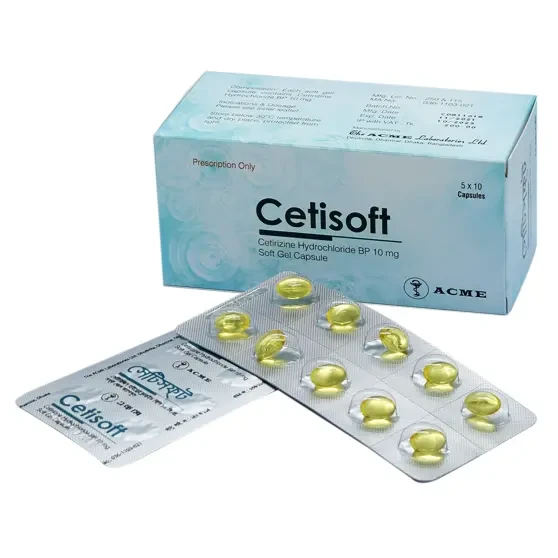
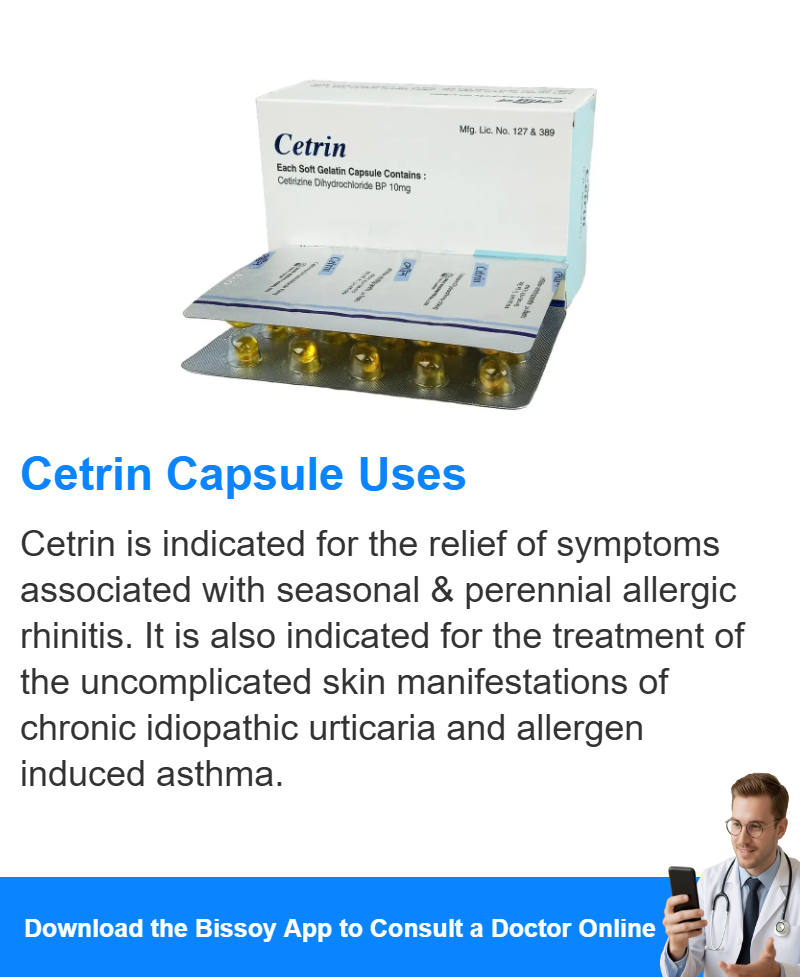
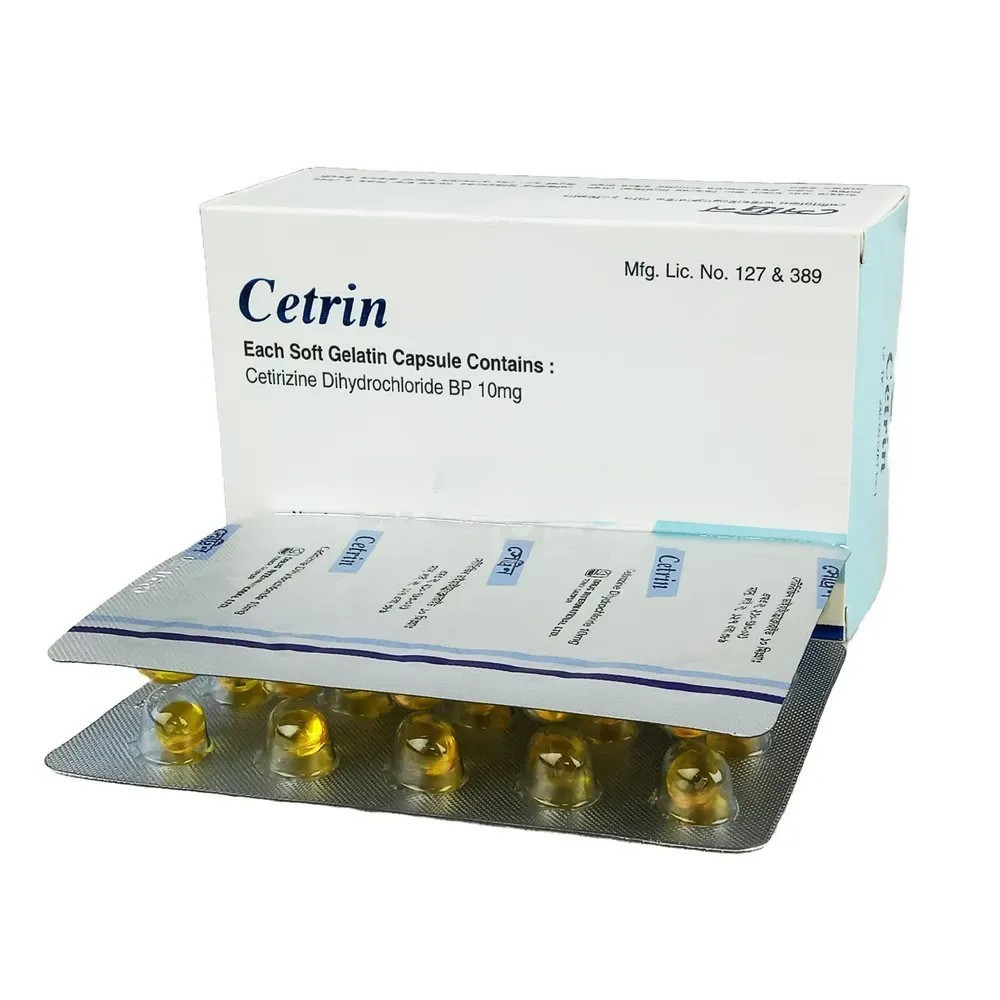
Brand Name Cetrin
Type Capsule
Weight 10 mg
Generic Cetirizine Hydrochloride
Manufacturer Drug International Ltd.
Price (Bangladesh) Unit: ৳ 4.00 (4 x 15: ৳ 240.00) Strip: ৳ 60.00
Available in

About Cetrin Capsule 10 mg

Cetrin Capsule 10 mg is a brand medicine manufactured by Drug International Ltd. containing the generic Cetirizine Hydrochloride (10 mg). Current listed price in Bangladesh: Unit: ৳ 4.00 (4 x 15: ৳ 240.00) Strip: ৳ 60.00.

Medical information for Cetrin Capsule 10 mg

Uses, dosage, side effects, and safety details below apply to Cetrin Capsule 10 mg (generic: Cetirizine Hydrochloride). This is general information — consult a doctor before use.

Introduction

Cetirizine, also commonly known as Zyrtec, is an orally active second-generation histamine H1 antagonist proven effective in the treatment of various allergic symptoms, such as sneezing, coughing, nasal congestion, hives, and other symptoms , .

One of the most common uses for this drug is for a condition called allergic rhinitis. The prevalence of allergic rhinitis in the United States is about 15% according to physician diagnoses, and up to 30%, according to self-reported nasal symptoms. Allergic rhinitis is associated with multiple missed or unproductive days at work and school, problems with sleep, and other difficulties with day to day activities for many individuals . Furthermore, some antihistamine agents that are used to treat this condition cause undesirable, sedating effects .

Cetirizine is one of the first second-generation H1 antihistamines (SGAHs) formulated to selectively inhibit the H1 receptor without sedating effects .

Uses

Cetirizine is a selective Histamine-1 antagonist drug used in allergic rhinitis and chronic urticaria.

Seasonal Allergic Rhinitis: Indicated for the relief of symptoms associated with seasonal allergic rhinitis caused by allergens such as ragweed, grass and tree pollens in adults and children 2 years of age and above. Symptoms treated effectively include sneezing, rhinorrhea, nasal pruritus, ocular pruritus, tearing, and redness of the eyes .

Perennial allergic rhinitis: This drug is indicated for the relief of symptoms associated with perennial allergic rhinitis due to allergens including dust mites, animal dander, and molds in adults and children 6 months of age and older. Symptoms treated effectively include sneezing, rhinorrhea, postnasal discharge, nasal pruritus, ocular pruritus, and tearing .

Chronic urticaria: Cetirizine is indicated for the treatment of the uncomplicated skin manifestations of chronic idiopathic urticaria in adults and children 6 months of age and older. It markedly reduces the occurrence, severity, and duration of hives and significantly reduces pruritus .

Associated Conditions

  • Chronic Idiopathic Urticaria
  • Flu caused by Influenza
  • Perennial Allergic Rhinitis (PAR)
  • Pollen Allergy
  • Respiratory Allergy
  • Seasonal Allergic Rhinitis

Pharmacodynamics

General effects and respiratory effects

Cetirizine, the active metabolite of the piperazine H1-receptor antagonist hydroxyzine, minimizes or eliminates the symptoms of chronic idiopathic urticaria, perennial allergic rhinitis, seasonal allergic rhinitis, allergic asthma, physical urticaria, and atopic dermatitis. The clinical efficacy of cetirizine for allergic respiratory diseases has been well established in numerous trials .

Effects on urticaria/anti-inflammatory effects

It has anti-inflammatory properties that may play a role in asthma management . There is evidence that cetirizine improves symptoms of urticaria. Marked clinical inhibition of a wheal and flare response occurs in infants, children as well as adults within 20 minutes of one oral dose and lasts for 24 h . Concomitant use of cetirizine reduces the duration and dose of topical anti-inflammatory formulas used for the treatment of atopic dermatitis .

Mechanism of Action

Cetirizine, a metabolite of hydroxyzine, is an antihistamine drug. Its main effects are achieved through selective inhibition of peripheral H1 receptors. The antihistamine activity of cetirizine has been shown in a variety of animal and human models. In vivo and ex vivo animal models have shown insignificant anticholinergic and antiserotonergic effects. In clinical studies, however, dry mouth was found to be more frequent with cetirizine than with a placebo. In vitro receptor binding studies have demonstrated no detectable affinity of cetirizine for histamine receptors other than the H1 receptors. Studies with radiolabeled cetirizine administration in the rat have demonstrated insignificant penetration into the brain. Ex vivo studies in the mouse have shown that systemically administered cetirizine does not occupy cerebral H1 receptors significantly .

Absorption

Cetirizine was rapidly absorbed with a time to maximum concentration (Tmax) of about 1 hour after oral administration of tablets or syrup formulation in adult volunteers . Bioavailability was found to be similar between the tablet and syrup dosage forms. When healthy study volunteers were given several doses of cetirizine (10 mg tablets once daily for 10 days), a mean peak plasma concentration (Cmax) of 311 ng/mL was measured .

Effect of food on absorption

Food had no effect on cetirizine exposure (AUC), however, Tmax was delayed by 1.7 hours and Cmax was decreased by 23% in the fed state .

Volume of Distribution

Apparent volume of distribution: 0.44 +/- 0.19 L/kg .

Protein Binding

The mean plasma protein binding of cetirizine is 93% .

Route of Elimination

Mainly eliminated in the urine , .

Between 70 – 85% of an orally administered dose can be found in the urine and 10 – 13% in the feces .

Half Life

Plasma elimination half-life is 8.3 hours .

Clearance

Apparent total body clearance: approximately 53 mL/min .

Cetirizine is mainly eliminated by the kidneys , . Dose adjustment is required for patients with moderate to severe renal impairment and in patients on hemodialysis .

Toxicity

Oral LD50 (rat): 365 mg/kg; Intraperitoneal LDLO (mouse): 138 mg/kg; Oral TDLO (rat): 50 mg/kg; Oral TDLO (mouse): 0.1 mg/kg .

Carcinogenesis and mutagenesis: In a 2-year carcinogenicity study in rats, cetirizine was not shown to be carcinogenic at dietary doses up to 20 mg/kg (approximately 15 times the maximum recommended daily oral dose in adults). In a 2-year carcinogenicity study in mice, cetirizine administration lead to an incidence of benign liver tumors in males at a dietary dose of 16 mg/kg (approximately 6 times the maximum recommended daily oral dose in adults). The clinical significance of these findings during long-term use of cetirizine is unknown at this time .

Cetirizine was not mutagenic in the Ames test, and not clastogenic in the human lymphocyte assay, the mouse lymphoma assay, and in vivo micronucleus test in rats .

Impairment of fertility

In a fertility and reproduction study in mice, cetirizine did not negatively impact fertility at an oral dose of 64 mg/kg (approximately 25 times the maximum recommended daily oral dose in adults) .

Pregnancy Category B:

In mice, rats, and rabbits, cetirizine was not teratogenic at oral doses up to 96, 225, and 135 mg/kg, respectively (approximately 40, 180 and 220 times the maximum recommended daily oral dose in adults). There are no adequate and well-controlled studies in pregnant women. Because animal studies are not always predictive of human response, cetirizine should be used in pregnancy only if clearly needed .

Use in breastfeeding/nursing

Cetirizine has been reported to be excreted in human breast milk. The use of cetirizine in nursing mothers is not recommended .

Food Interactions

  • Avoid alcohol.
  • Take with or without food. The absorption is unaffected by food.

Dosage

Cetirizine oral dosage form:
  • Adults and Children 6 years and older: 1 tablet or 2 teaspoonfuls daily (or 1 teaspoonful twice daily).
  • Children 2-6 years: 1 teaspoonful once daily or 1/2 teaspoonful twice daily.
  • Children 6 months to 2 years : 1/2 teaspoonful once daily. The dose in children 12-23 months of age can be increased to a maximum dose as 1/2 teaspoonful every 12 hours.
Cetirizine injectable dosage form: Cetirizine is a single use injectable product for intravenous administration only. The recommended dosage regimen is once every 24 hours as needed for treatment of acute urticaria. Administer Cetirizine as an intravenous push over a period of 1 to 2 minutes. Cetirizine is not recommended in pediatric patients less than 6 years of age with impaired renal or hepatic function.
  • Adults and adolescents 12 years of age and older: The recommended dosage is 10 mg administered by intravenous injection.
  • Children 6 to 11 years of age: The recommended dosage is 5 mg or 10 mg depending on symptom severity administered by intravenous injection.
  • Children 6 months to 5 years of age: The recommended dosage is 2.5 mg administered by intravenous injection.
Frequently Asked Questions About Cetrin Capsule 10 mg

1. What is Cetrin Capsule 10 mg?

Cetrin Capsule 10 mg is a second-generation antihistamine used to relieve allergy symptoms such as runny nose, sneezing, itchy eyes, and hives. It works by blocking the action of histamine, a substance in the body that causes allergic symptoms.

2. How does Cetrin Capsule 10 mg work?

Cetrin Capsule 10 mg works by blocking histamine receptors in the body, which reduces symptoms like sneezing, itching, and swelling that occur due to allergic reactions.

3. What conditions is Cetrin Capsule 10 mg used to treat?

Cetrin Capsule 10 mg is used to treat symptoms of seasonal allergies (hay fever), perennial allergies, allergic rhinitis, and chronic urticaria (hives). It can also be used for itching and swelling caused by allergic reactions.

4. How should I take Cetrin Capsule 10 mg?

Cetrin Capsule 10 mg is typically taken orally once daily, with or without food. The tablet should be swallowed whole, and the liquid form should be measured carefully using a dose-measuring device.

5. What is the recommended dosage for Cetrin Capsule 10 mg?

The usual adult dose is 10 mg once a day. For children aged 6 to 12 years, the typical dose is 5-10 mg per day. The dosage may vary based on the individual and their response to the medication.

6. Can I take Cetrin Capsule 10 mg with food?

Yes, Cetrin Capsule 10 mg can be taken with or without food. Food does not significantly affect its effectiveness.

7. What should I do if I miss a dose of Cetrin Capsule 10 mg?

If you miss a dose, take it as soon as you remember unless it's almost time for your next dose. In that case, skip the missed dose and resume your regular schedule. Do not take two doses at the same time.

8. How long does it take for Cetrin Capsule 10 mg to start working?

Cetrin Capsule 10 mg typically starts working within 1 hour of taking the medication, with peak effects occurring in about 3 to 4 hours.

9. What are the common side effects of Cetrin Capsule 10 mg?

Common side effects may include:

  • Dry mouth
  • Drowsiness or fatigue
  • Headache
  • Stomach pain or discomfort
  • Dizziness

10. What are the serious side effects of Cetrin Capsule 10 mg?

Serious side effects include:

  • Severe allergic reactions (rash, itching, difficulty breathing)
  • Fast or irregular heartbeat
  • Severe dizziness or fainting

11. Can Cetrin Capsule 10 mg cause drowsiness?

Although Cetirizine is a second-generation antihistamine, it can cause drowsiness in some individuals. This effect is less common than with first-generation antihistamines.

12. Can Cetrin Capsule 10 mg be taken with alcohol?

It is advised to avoid alcohol while taking Cetrin Capsule 10 mg, as alcohol can increase drowsiness and impair your ability to concentrate and perform tasks.

13. Can Cetrin Capsule 10 mg be used in children?

Cetrin Capsule 10 mg is commonly used for children aged 2 years and older, depending on the specific product. The dosage will be lower for younger children, and you should consult a doctor for the proper dosage.

14. Can Cetrin Capsule 10 mg be used during pregnancy?

Cetrin Capsule 10 mg should be used during pregnancy only if clearly needed. Always consult with your healthcare provider before using this medication if you are pregnant.

15. Can I take Cetrin Capsule 10 mg while breastfeeding?

Cetrin Capsule 10 mg is excreted in breast milk, but it is generally considered safe to use while breastfeeding. However, consult your doctor for personalized advice.

16. How should Cetrin Capsule 10 mg be stored?

Store Cetrin Capsule 10 mg at room temperature, away from moisture and heat. Keep it in a tightly sealed container and out of reach of children.

17. What happens if I overdose on Cetrin Capsule 10 mg?

Overdose symptoms may include drowsiness, dry mouth, and an increased heart rate. Seek immediate medical attention if an overdose is suspected.

18. Can Cetrin Capsule 10 mg cause weight gain?

Weight gain is not a common side effect of Cetrin Capsule 10 mg. However, if you experience unusual weight changes, consult your doctor.

19. Can I take Cetrin Capsule 10 mg if I have liver or kidney problems?

If you have liver or kidney problems, your doctor may adjust your dosage or monitor you more closely while using Cetrin Capsule 10 mg. Inform your healthcare provider about any pre-existing conditions.

20. Can Cetrin Capsule 10 mg be used for a stuffy nose?

Cetrin Capsule 10 mg can help with symptoms of nasal congestion associated with allergies but is not specifically designed to treat a stuffy nose. A nasal decongestant may be more effective for this purpose.

21. Can Cetrin Capsule 10 mg be taken long-term?

Yes, Cetrin Capsule 10 mg can be taken long-term for chronic conditions like allergic rhinitis or chronic urticaria, but it’s important to regularly consult your doctor to monitor its effectiveness and side effects.

22. Can Cetrin Capsule 10 mg cause dry mouth?

Yes, dry mouth is a common side effect of Cetrin Capsule 10 mg. Drinking water or using sugar-free gum may help alleviate this symptom.

23. Does Cetrin Capsule 10 mg cause dizziness?

Some individuals may experience dizziness or lightheadedness, especially when standing up quickly. If this occurs, rise slowly to avoid feeling faint.

24. Can Cetrin Capsule 10 mg cause a rash?

Although rare, Cetrin Capsule 10 mg can cause a rash or other signs of an allergic reaction. If you experience a rash, swelling, or difficulty breathing, seek immediate medical attention.

25. Can Cetrin Capsule 10 mg interact with other medications?

Yes, Cetrin Capsule 10 mg may interact with certain medications, especially other sedatives, alcohol, or other antihistamines. Always inform your doctor about any medications you are taking.

26. Is Cetrin Capsule 10 mg safe for elderly patients?

Cetrin Capsule 10 mg is generally safe for elderly patients, but they may be more sensitive to its side effects, such as drowsiness. Dosage adjustments may be necessary.

27. Can Cetrin Capsule 10 mg be taken with a decongestant?

Yes, Cetrin Capsule 10 mg can often be safely combined with a decongestant, but it’s important to follow your doctor’s instructions to avoid possible interactions.

28. Can Cetrin Capsule 10 mg cause headaches?

Headaches can occur as a side effect of Cetrin Capsule 10 mg. If they become frequent or severe, inform your healthcare provider.

29. Is Cetrin Capsule 10 mg addictive?

Cetrin Capsule 10 mg is not addictive and is generally safe when taken as directed. There is no risk of dependence with this medication.

30. Can Cetrin Capsule 10 mg cause nausea?

While nausea is not a common side effect, some people may experience mild stomach discomfort. Taking the medication with food may help alleviate this symptom.

31. Can Cetrin Capsule 10 mg cause trouble sleeping?

Cetrin Capsule 10 mg is less likely to cause sleep disturbances compared to first-generation antihistamines, but in some individuals, it may cause drowsiness that could affect their sleep cycle.

32. How quickly does Cetrin Capsule 10 mg relieve allergy symptoms?

Cetrin Capsule 10 mg starts working within an hour and reaches its peak effect in about 3 to 4 hours. It helps relieve symptoms like sneezing, itchy eyes, and runny nose.

33. Does Cetrin Capsule 10 mg affect driving ability?

Cetrin Capsule 10 mg may cause drowsiness in some individuals, which could impair driving or operating machinery. If you feel drowsy, avoid driving until you know how the medication affects you.

34. Can Cetrin Capsule 10 mg cause blurred vision?

Although blurred vision is rare, some people may experience it as a side effect. If this happens, consult your doctor.

35. Can Cetrin Capsule 10 mg be used for pet allergies?

Cetrin Capsule 10 mg can be effective for treating allergy symptoms related to pets, such as sneezing, itchy eyes, and a runny nose.

36. Is Cetrin Capsule 10 mg effective for hay fever?

Yes, Cetrin Capsule 10 mg is commonly used to relieve symptoms of hay fever, including sneezing, itching, and a runny nose caused by pollen allergies.

37. Can Cetrin Capsule 10 mg be used for insect stings or bites?

Cetrin Capsule 10 mg may help reduce the itching and swelling associated with insect stings or bites, though it is not a specific treatment for these conditions.

38. How long can I safely take Cetrin Capsule 10 mg?

It is generally safe to use Cetrin Capsule 10 mg long-term for chronic conditions. However, it’s essential to consult with your doctor regularly to ensure the medication remains effective and monitor for potential side effects.

39. Can Cetrin Capsule 10 mg cause diarrhea?

Diarrhea is a rare side effect of Cetrin Capsule 10 mg. If you experience persistent or severe diarrhea, consult your doctor.

40. Is Cetrin Capsule 10 mg safe for people with asthma?

Cetrin Capsule 10 mg is generally safe for people with asthma. It may help alleviate allergy symptoms that could worsen asthma. However, consult your doctor before use.

41. Can Cetrin Capsule 10 mg be used to treat eczema?

Cetrin Capsule 10 mg may help relieve itching and discomfort caused by eczema, though it is not a primary treatment for the condition.

42. Does Cetrin Capsule 10 mg increase the risk of infection?

There is no significant evidence suggesting that Cetrin Capsule 10 mg increases the risk of infection. It does not suppress the immune system like some other medications.

43. Can Cetrin Capsule 10 mg be used for seasonal allergies in children?

Yes, Cetrin Capsule 10 mg is often prescribed to children aged 2 years and older to treat seasonal allergies. The dosage for children is typically lower than for adults.

44. Can Cetrin Capsule 10 mg cause an allergic reaction?

Although rare, some individuals may develop an allergic reaction to Cetrin Capsule 10 mg, with symptoms such as swelling, rash, or difficulty breathing. Seek medical help immediately if this occurs.

45. Can Cetrin Capsule 10 mg be taken with other allergy medications?

While Cetrin Capsule 10 mg can be taken with some other allergy medications, such as nasal sprays or decongestants, consult your doctor for specific recommendations to avoid drug interactions.

46. Does Cetrin Capsule 10 mg cause a feeling of being "foggy" or "out of it"?

In some individuals, Cetrin Capsule 10 mg may cause mild drowsiness or a "foggy" feeling. If you experience this, avoid activities that require mental alertness.

47. How is Cetrin Capsule 10 mg different from other antihistamines?

Cetrin Capsule 10 mg is a second-generation antihistamine, which means it has a lower chance of causing sedation or drowsiness compared to first-generation antihistamines like diphenhydramine.

48. Can Cetrin Capsule 10 mg be used to treat pet allergies?

Yes, Cetrin Capsule 10 mg is effective in treating symptoms associated with pet allergies, such as sneezing, itchy eyes, and nasal congestion.

49. Can Cetrin Capsule 10 mg be used to treat hay fever in the summer?

Cetrin Capsule 10 mg is commonly used to treat seasonal allergies, including hay fever during pollen seasons such as spring and summer.

50. Can Cetrin Capsule 10 mg cause palpitations?

Palpitations are a rare side effect of Cetrin Capsule 10 mg. If you experience an irregular or fast heartbeat, contact your healthcare provider immediately.

Medical review

Last reviewed: 24 Jul 2026

Medically reviewed by:

This is general information, not personal medical advice. Consult a doctor before taking any medicine.

Social card

Uses
Taking medicines without doctor's advice can cause long-term problems.
Dr. Faisal Ahmed

Dr. Faisal Ahmed

Orthodontics Specialist

Call Doctor
Dr. Masud Anwar

Dr. Masud Anwar

Brain, Headache, Paralysis, Stroke & Neuromedicine Specialist

Call Doctor
Dr. Shiblee Sadeque Shakil

Dr. Shiblee Sadeque Shakil

Cardiology (Heart Diseases), Hypertension & Rheumatic Fever Specialist

Call Doctor
Related Medicines