Introduction
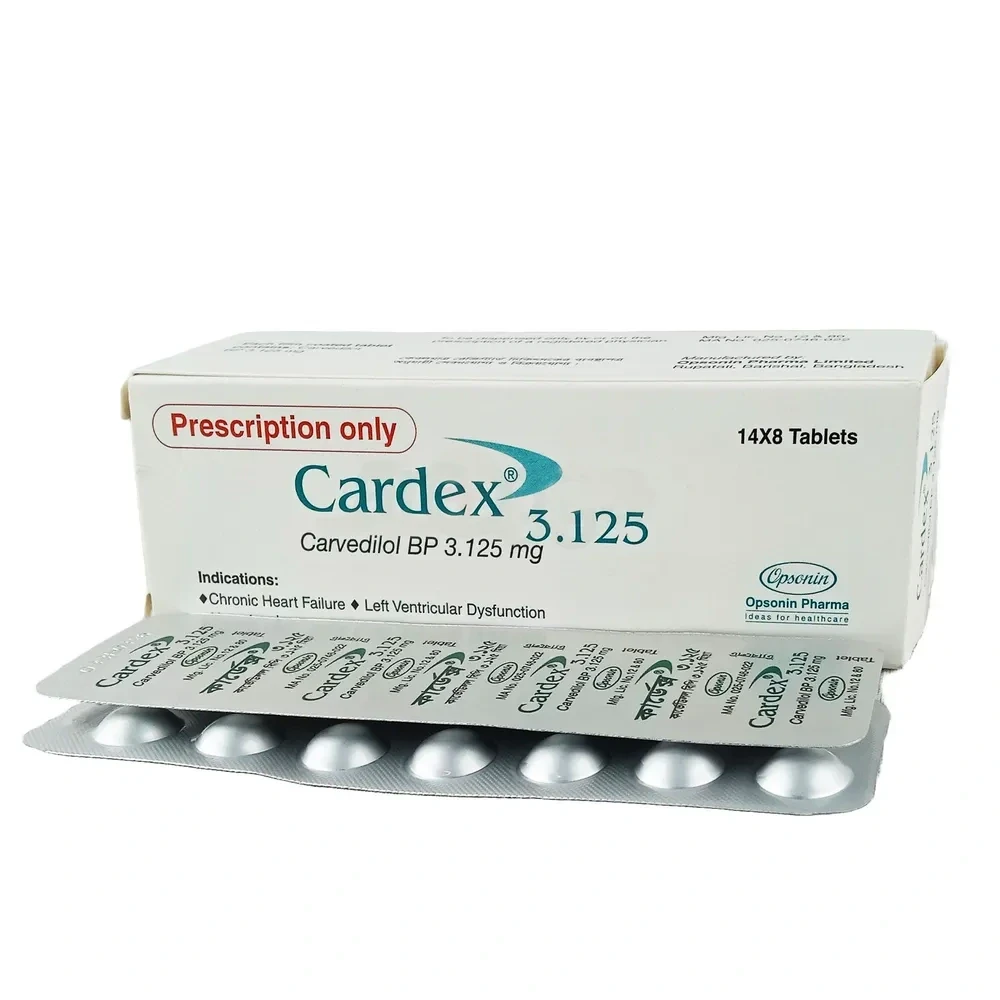
Cardex Tablet 3.125 mg is a racemic mixture where the S(-) enantiomer is a beta adrenoceptor blocker and the R(+) enantiomer is both a beta and alpha-1 adrenoceptor blocker. It is currently used to treat heart failure, left ventricular dysfunction, and hypertension. The dual action of carvedilol is advantageous in combination therapies as moderate doses of 2 drugs have a decreased incidence of adverse effects compared to high dose monotherapy in the treatment of moderate hypertension.
Uses
Cardex Tablet 3.125 mg is a non selective beta-adrenergic antagonist used to treat mild to severe chronic heart failure, hypertension, and left ventricular dysfunction following myocardial infarction in clinically stable patients.
Cardex Tablet 3.125 mg is indicated to treat mild to severe heart failure, left ventricular dysfunction after myocardial infarction with ventricular ejection fraction ≤40%, or hypertension.
Associated Conditions
Pharmacodynamics
Cardex Tablet 3.125 mg reduces tachycardia through beta adrenergic antagonism and lowers blood pressure through alpha-1 adrenergic antagonism. It has a long duration of action as it is generally taken once daily and has a broad therapeutic index as patients generally take 10-80mg daily. Patients taking carvedilol should not abruptly stop taking this medication as this may exacerbate coronary artery disease.
Mechanism of Action
Cardex Tablet 3.125 mg inhibits exercise induce tachycardia through its inhibition of beta adrenoceptors. Cardex Tablet 3.125 mg's action on alpha-1 adrenergic receptors relaxes smooth muscle in vasculature, leading to reduced peripheral vascular resistance and an overall reduction in blood pressure. At higher doses, calcium channel blocking and antioxidant activity can also be seen. The antioxidant activity of carvedilol prevents oxidation of low density lipoprotein and its uptake into coronary circulation.
Absorption
Cardex Tablet 3.125 mg has a bioavailability of 25-35%. Cardex Tablet 3.125 mg has a Tmax of 1 to 2 hours. Taking carvedilol with a meal increases Tmax without increasing AUC. Cardex Tablet 3.125 mg doses of 50mg lead to a Cmax of 122-262µg/L and an AUC of 717-1600µg/L*h. Cardex Tablet 3.125 mg doses of 25mg lead to a Cmax of 24-151µg/L and an AUC of 272-947µg/L*h. Cardex Tablet 3.125 mg doses of 12.5mg lead to a Cmax of 58-69µg/L and an AUC of 208-225µg/L*h.
Volume of Distribution
Cardex Tablet 3.125 mg has a volume of distribution of 1.5-2L/kg or 115L.
Protein Binding
Cardex Tablet 3.125 mg is 98% protein bound in plasma. 95% of carvedilol is bound to serum albumin.
Route of Elimination
16% of carvedilol is excreted in the urine with 4 Cardex Tablet 3.125 mg is primarily excreted in the bile and feces.
Half Life
The half life of carvedilol is between 7-10 hours, though significantly shorter half lives have also been reported.
Clearance
The plasma clearance of carvedilol has been reported as 0.52L/kg or 500-700mL/min.
Toxicity
Patients experiencing an overdose may present with hypotension, bradycardia, cardiac insufficiency, cardiogenic shock, and cardiac arrest. Patients should remain in a supine position and may be given atropine for bradycardia and glucagon followed by sympathomimetics to support cardiovascular function.
Food Interactions
- Take with food. Food slows the absorption and reduces the incidence of adverse effects.
Dosage
In angina pectoris: the recommended dose for initiation of therapy is 12.5 mg twice daily for the first 2 days. Thereafter, the recommended dosage is 25 mg twice daily. For elderly patients, the maximum daily dose is 50 mg daily in divided doses.
In heart failure: initially, 3.125 mg twice daily (with food) may be given, the dose may be increased at intervals of at least 2 weeks to 6.25 mg twice daily, then to 12.5 mg twice daily, then to 25 mg twice daily. The dose may be increased to the highest dose tolerated, maximum 25 mg twice daily in patients less than 85 kg body-weight and 50 mg twice daily in patients over 85 kg.