Introduction
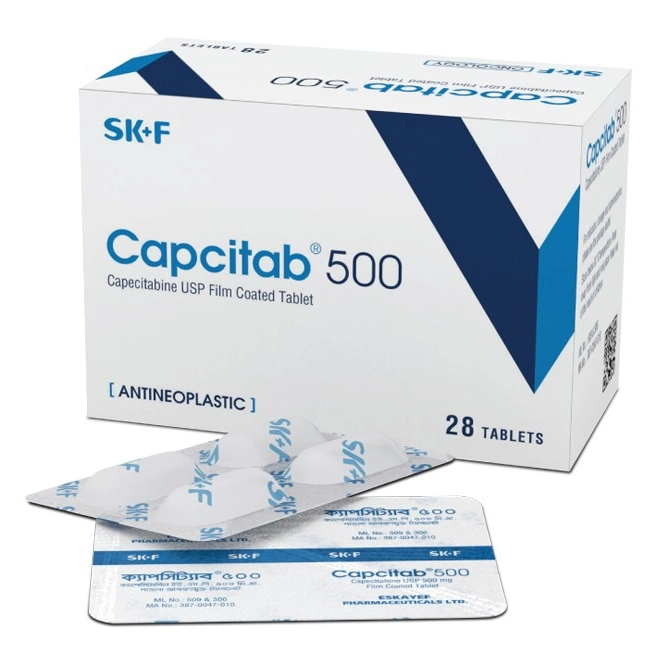
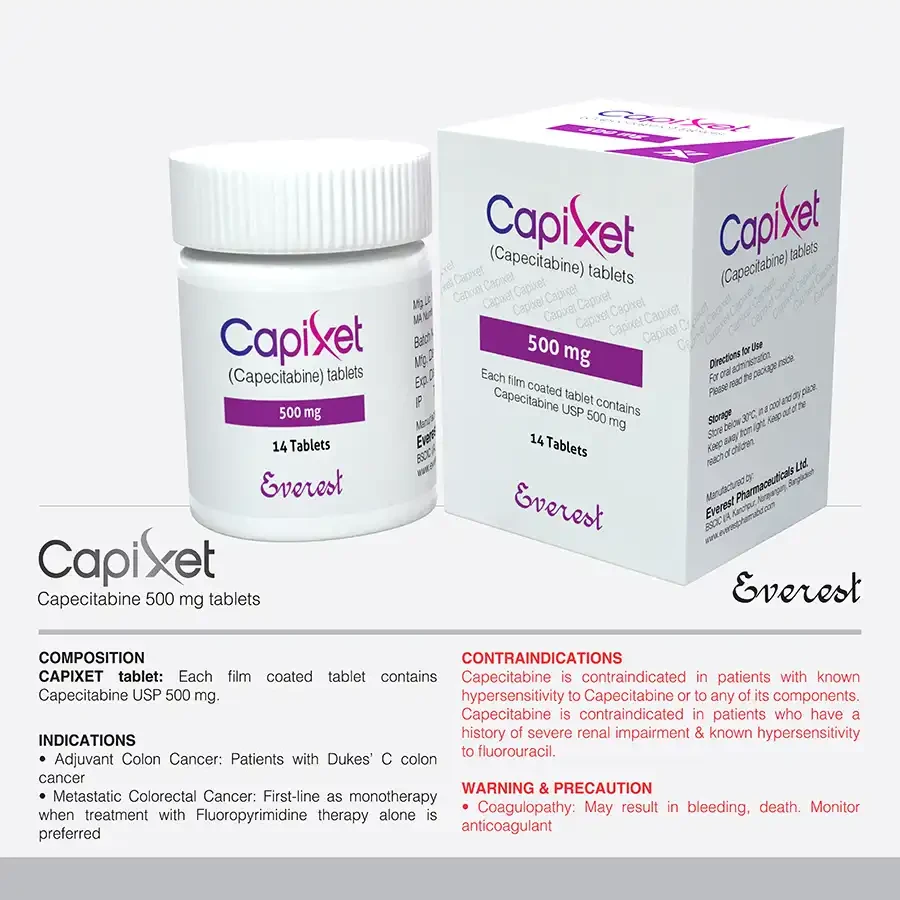
Capecitin Tablet 500 mg is an orally-administered chemotherapeutic agent used in the treatment of metastatic breast and colorectal cancers. Capecitin Tablet 500 mg is a prodrug, that is enzymatically converted to fluorouracil (antimetabolite) in the tumor, where it inhibits DNA synthesis and slows growth of tumor tissue.
Uses
Capecitin Tablet 500 mg is a nucleoside metabolic inhibitor indicated to treat colon, colorectal and breast cancer.
For the treatment of patients with metastatic breast cancer resistant to both paclitaxel and an anthracycline-containing chemotherapy regimen. May also be used in combination with docetaxel for the treatment of metastatic breast cancer in patients who have failed to respond to, or recurred or relasped during or following anthracycline-containing chemotherapy. Capecitin Tablet 500 mg is used alone as an adjuvant therapy following the complete resection of primary tumor in patients with stage III colon cancer when monotherapy with fluroprymidine is preferred. The use or capecitabine in combination regimens for advanced gastric cancer is currently being investigated.
Associated Conditions
Pharmacodynamics
Capecitin Tablet 500 mg is a fluoropyrimidine carbamate with antineoplastic activity indicated for the treatment of metastatic breast cancer and colon cancer. It is an orally administered systemic prodrug that has little pharmacologic activity until it is converted to fluorouracil by enzymes that are expressed in higher concentrations in many tumors. Fluorouracil it then metabolized both normal and tumor cells to 5-fluoro-2′-deoxyuridine 5′-monophosphate (FdUMP) and 5-fluorouridine triphosphate (FUTP).
Mechanism of Action
Capecitin Tablet 500 mg is a prodrug that is selectively tumour-activated to its cytotoxic moiety, fluorouracil, by thymidine phosphorylase, an enzyme found in higher concentrations in many tumors compared to normal tissues or plasma. Fluorouracil is further metabolized to two active metabolites, 5-fluoro-2'-deoxyuridine 5'-monophosphate (FdUMP) and 5-fluorouridine triphosphate (FUTP), within normal and tumour cells. These metabolites cause cell injury by two different mechanisms. First, FdUMP and the folate cofactor, N5-10-methylenetetrahydrofolate, bind to thymidylate synthase (TS) to form a covalently bound ternary complex. This binding inhibits the formation of thymidylate from 2'-deaxyuridylate. Thymidylate is the necessary precursor of thymidine triphosphate, which is essential for the synthesis of DNA, therefore a deficiency of this compound can inhibit cell division. Secondly, nuclear transcriptional enzymes can mistakenly incorporate FUTP in place of uridine triphosphate (UTP) during the synthesis of RNA. This metabolic error can interfere with RNA processing and protein synthesis through the production of fraudulent RNA.
Absorption
Readily absorbed through the GI tract (~70%)
Protein Binding
< 60% (mainly albumin)
Route of Elimination
Capecitin Tablet 500 mg and its metabolites are predominantly excreted in urine; 95.5% of administered capecitabine dose is recovered in urine. Fecal excretion is minimal (2.6%). The major metabolite excreted in urine is FBAL which represents 57% of the administered dose.About 3% of the administered dose is excreted in urine as unchanged drug.
Half Life
45-60 minutes for capecitabine and its metabolites.
Food Interactions
- Take with food. Take within 30 minutes of the end of breakfast and dinner.
Dosage
Adjuvant treatment: Is recommended for a total of 6 months (8 cycles)
In combination with docetaxel: The recommended dose of Capecitin Tablet 500 mg is 1250 mg/m2 twice daily for 2 weeks followed by a 7-day rest period, combined with docetaxel at 75 mg/m2 as a 1-hour IV infusion every 3 weeks. Capecitin Tablet 500 mg dosage may need to be individualized to optimize patient management. Capecitin Tablet 500 mg dosage has to be reduced by 25% in patients with moderate renal impairment.
Example: A person whose body weight is 64 kg and height is 1.64 m has a body surface area of 1.7 m2 and should take 4 tablets of 500 mg and 1 tablet of 150 mg two times daily.
The tablets should be taken in morning and evening as prescribed by doctor. The tablets should be taken within 30 minutes after the end of a meal (breakfast and dinner) and swallowed whole with water. Tablets should not be cut or crushed. Capecitin Tablet 500 mg should only be prescribed by a doctor experienced in the use of anticancer medicines.