Introduction
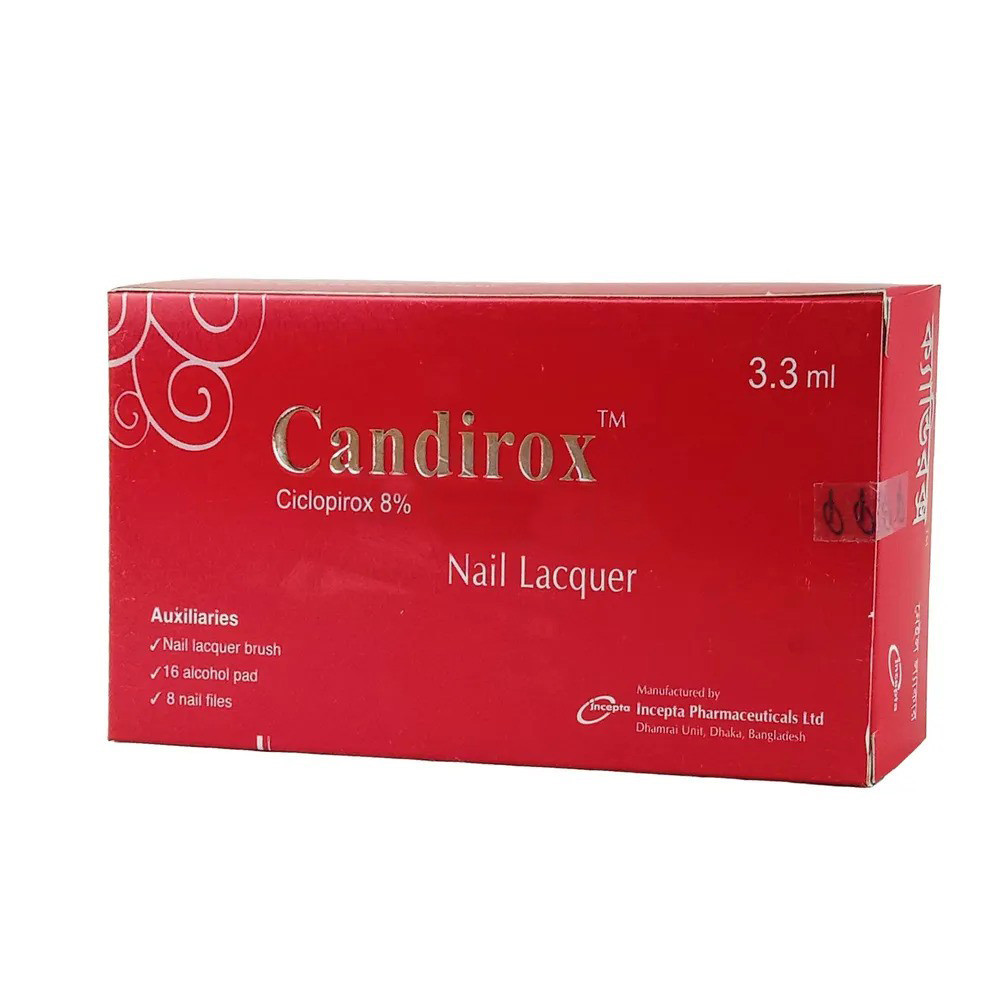
Candirox Nail Lacquer 8% w/v olamine (used in preparations called Batrafen, Loprox, Mycoster, Penlac and Stieprox) is a synthetic antifungal agent for topical dermatologic treatment of superficial mycoses. In particular, the agent is especially effective in treating Tinea versicolor.
Uses
Candirox Nail Lacquer 8% w/v is a broad-spectrum topical antifungal agent used to treat mild to moderate onychomycosis of fingernails and toenails in immunocompetent patients.
Used as a topical treatment in immunocompetent patients with mild to moderate onychomycosis of fingernails and toenails without lunula involvement, due to Trichophyton rubrum.
Associated Conditions
Pharmacodynamics
Candirox Nail Lacquer 8% w/v is a broad-spectrum antifungal medication that also has antibacterial and anti-inflammatory properties. Its main mode of action is thought to be its high affinity for trivalent cations, which inhibit essential co-factors in enzymes. Candirox Nail Lacquer 8% w/v exhibits either fungistatic or fungicidal activity in vitro against a broad spectrum of fungal organisms, such as dermatophytes, yeasts, dimorphic fungi, eumycetes, and actinomycetes. In addition to its broad spectrum of action, ciclopirox also exerts antibacterial activity against many Gram-positive and Gram-negative bacteria. Furthermore, the anti-inflammatory effects of ciclopirox have been demonstrated in human polymorphonuclear cells, where ciclopirox has inhibited the synthesis of prostaglandin and leukotriene. Candirox Nail Lacquer 8% w/v can also exhibit its anti-inflammatory effects by inhibiting the formation of 5-lipoxygenase and cyclooxygenase.
Mechanism of Action
Unlike antifungals such as itraconazole and terbinafine, which affect sterol synthesis, ciclopirox is thought to act through the chelation of polyvalent metal cations, such as Fe3+ and Al3+. These cations inhibit many enzymes, including cytochromes, thus disrupting cellular activities such as mitochondrial electron transport processes and energy production. Candirox Nail Lacquer 8% w/v also appears to modify the plasma membrane of fungi, resulting in the disorganization of internal structures. The anti-inflammatory action of ciclopirox is most likely due to inhibition of 5-lipoxygenase and cyclooxygenase. ciclopirox may exert its effect by disrupting DNA repair, cell division signals and structures (mitotic spindles) as well as some elements of intracellular transport.
Absorption
Rapidly absorbed after oral administration. Mean absorption of ciclopirox after application to nails of all twenty digits and adjacent 5 millimeters of skin once daily for 6 months in patients with dermatophytic onychomycoses was less than 5% of the applied dose. Candirox Nail Lacquer 8% w/v olamine also penetrates into hair and through the epidermis and hair follicles into sebaceous glands and dermis.
Protein Binding
Protein binding is 94-97% following topical administration.
Route of Elimination
Most of the compound is excreted either unchanged or as glucuronide. After oral administration of 10 mg of radiolabeled drug (14C-ciclopirox) to healthy volunteers, approximately 96% of the radioactivity was excreted renally within 12 hours of administration. Ninety-four percent of the renally excreted radioactivity was in the form of glucuronides.
Half Life
1.7 hours for 1% topical solution.
Toxicity
Oral LD50 in rat is >10 ml/kg. Symptoms of overexposure include drowsiness and headache.
Food Interactions
No interactions found.