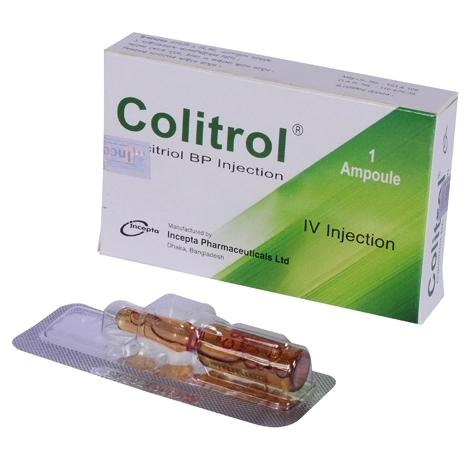
Introduction
Caltrol IV Injection 1 mcg/ml is an active metabolite of vitamin D with 3 hydroxyl (OH) groups and is commonly referred to as 1,25-dihydroxycholecalciferol, or 1alpha,25-dihydroxyvitamin D3, 1,25-dihydroxyvitamin D3. It is produced in the body after series of conversion steps of 7-dehydrocholesterol from exposure to UV light. 7-dehydrocholesterol is converted to Vitamin D3 (vitamin D3) in the skin, which is then converted to Calcifediol in the liver and kidneys. Calcifediol undergoes hydroxylation to form calcitriol via 1α-hydroxylase (CYP27B1) activity . Caltrol IV Injection 1 mcg/ml is considered to be the most potent metabolite of vitamin D in humans . Renal production of calcitriol is stimulated in response to PTH, low calcium and low phosphate . Caltrol IV Injection 1 mcg/ml plays a role in plasma calcium regulation in concert with parathyroid hormone (PTH) by enhancing absorption of dietary calcium and phosphate from the gastrointestinal tract, promoting renal tubular reabsorption of calcium in the kidneys, and stimulating the release of calcium stores from the skeletal system. In addition to promoting fatty acid synthesis and inhibiting lipolysis, calcitriol has been demonstrated to increase energy efficiency by suppressing UCP2 expression, which is modulated by signaling pathways of classical nuclear receptors (nVDR), where calcitriol acts as a natural ligand . There is also evidence that calcitriol modulates the action of cytokines and may regulate immune and inflammatory response, cell turnover, cell differentiation .
Administered orally and intravenously, calcitriol is commonly used as a medication in the treatment of secondary hyperparathyroidism and resultant metabolic bone disease, hypocalcemia in patients undergoing chronic renal dialysis, and osteoporosis. It is also available in topical form for the treatment of mild to moderate plaque psoriasis in adults.
Uses
Caltrol IV Injection 1 mcg/ml is an active metabolite of vitamin D that is used to treat hyperparathyroidism and is also used in dialysis patients to combat hypocalcemia.
Used to treat vitamin D deficiency or insufficiency, refractory rickets (vitamin D resistant rickets), familial hypophosphatemia and hypoparathyroidism, and in the management of hypocalcemia and renal osteodystrophy in patients with chronic renal failure undergoing dialysis. Also used in conjunction with calcium in the management and prevention of primary or corticosteroid-induced osteoporosis.
Associated Conditions
Pharmacodynamics
Caltrol IV Injection 1 mcg/ml is a biologically active calcitrophic hormone with anti-osteoporotic, immunomodulatory, anticarcinogenic, antipsoriatic, antioxidant, and mood-modulatory activities. Its main sites of action are the intestine, bone, kidney and parathyroid hormone . Caltrol IV Injection 1 mcg/ml is a ligand for the vitamin D nuclear receptor, which is expressed in, but not limited to, gastrointestinal (GI) tissues, bones, and kidneys . As an active form of vitamin D3, calcitriol elevates the plasma levels of calcium by stimulating intestinal calcium uptake, increasing reabsorption of calcium by the kidneys, and possibly increasing the release of calcium from skeletal stores. The duration of pharmacologic activity of a single dose of exogenous calcitriol is expected to be about 3 to 5 days .
In addition to its important role in calcium metabolism, other pharmacological effects of calcitriol have been studied in various conditions including cancer models. Various studies demonstrated expression of vitamin D receptors in cancer cell lines, including mouse myeloid leukemia cells . Caltrol IV Injection 1 mcg/ml has been found to induce differentiation and/or inhibit cell proliferation in vitro and in vivo in many cell types, such as malignant cell lines carcinomas of the breast, prostate, colon, skin, and brain, myeloid leukemia cells, and others . In early human prostate cancer trials, administration of 1.5 µg/d calcitriol in male participants resulted in a reduction in the rate of PSA rise in most participants, however it was coincided with dose-limiting hypercalcemia in most participants . Hypercalcemia and hypercalcuria were evident in numerous initial trials, and this may be due to these trials not testing the drug at concentrations that are active in preclinical systems . Findings from preclinical data show an additive or synergistic antineoplastic action of calcitriol when combined with agents including dexamethasone, retinoids, and radiation, as well as several cytotoxic chemotherapy drugs such as platinum compounds .
Vitamin D deficiency has long been suspected to increase the susceptibility to tuberculosis. The active form of calcitriol, 1,25-(OH)2-D3, has been found to enhance the ability of mononuclear phagocytes to suppress the intracellular growth of Mycobacterium tuberculosis. 1,25-(OH)2-D3 has demonstrated beneficial effects in animal models of such autoimmune diseases as rheumatoid arthritis. Vitamin D appears to demonstrate both immune-enhancing and immunosuppressive effects.
Mechanism of Action
The mechanism of action of calcitriol in the treatment of psoriasis is accounted for by their antiproliferative activity for keratinocytes and their stimulation of epidermal cell differentiation. The anticarcinogenic activity of the active form of Caltrol IV Injection 1 mcg/ml appears to be correlated with cellular vitamin D receptor (VDR) levels. Vitamin D receptors belong to the superfamily of steroid-hormone zinc-finger receptors. VDRs selectively bind 1,25-(OH)2-D3 and retinoic acid X receptor (RXR) to form a heterodimeric complex that interacts with specific DNA sequences known as vitamin D-responsive elements. VDRs are ligand-activated transcription factors. The receptors activate or repress the transcription of target genes upon binding their respective ligands. It is thought that the anticarcinogenic effect of Caltrol IV Injection 1 mcg/ml is mediated via VDRs in cancer cells. The immunomodulatory activity of calcitriol is thought to be mediated by vitamin D receptors (VDRs) which are expressed constitutively in monocytes but induced upon activation of T and B lymphocytes. 1,25-(OH)2-D3 has also been found to enhance the activity of some vitamin D-receptor positive immune cells and to enhance the sensitivity of certain target cells to various cytokines secreted by immune cells.
A study suggests that calcitriol plays an immunoregulatry role by suppressing the aryl hydrocarbon receptor (AhR) expression in human Th9, a pro-inflammatory CD4 T cell subset . This suppression subsequently leads to repressed expression of BATF, a transcription factor essential for Th9 . Caltrol IV Injection 1 mcg/ml has also been found to induce monocyte differentiation and to inhibit lymphocyte proliferation and production of cytokines, including interleukin IL-1 and IL-2, as well as to suppress immunoglobulin secretion by B lymphocytes.
Absorption
Upon administration, calcitriol is rapidly absorbed from the intestines. When a single oral dose of 0.5 mcg of calcitriol was administered, the mean serum concentrations of calcitriol rose from a baseline value of 40.0±4.4 (SD) pg/mL to 60.0±4.4 pg/mL at 2 hours, and declined to 53.0±6.9 at 4 hours, 50±7.0 at 8 hours, 44±4.6 at 12 hours and 41.5±5.1 at 24 hours . Following administration of single doses of 0.25 to 1.0 mcg of calcitriol, the peak plasma concentrations were reached within 3 to 6 hours . In a pharmacokinetic study, the oral bioavailability was 70.6±5.8% in healthy male volunteers and 72.2±4.8% in male patients with uraemia .
Volume of Distribution
Upon intravenous administration, the volume of distribution of calcitriol was 0.49±0.14 L/kg in healthy male volunteers and 0.27±0.06 l/kg in uraemic male patients participating in a pharmacokinetic study . There is some evidence that calcitriol is transferred into human milk at low levels (ie, 2.2±0.1 pg/mL) in mothers . Caltrol IV Injection 1 mcg/ml from maternal circulation may also enter the fetal circulation .
Protein Binding
Caltrol IV Injection 1 mcg/ml is approximately 99.9% bound in blood, mostly by an alpha-globulin vitamin D binding protein .
Route of Elimination
In normal subjects, approximately 27% and 7% of the radioactivity appeared in the feces and urine, respectively, within 24 hours . Caltrol IV Injection 1 mcg/ml undergoes enterohepatic recycling and biliary excretion. The metabolites of calcitriol are excreted primarily in feces. Cumulative excretion of radioactivity on the sixth day following intravenous administration of radiolabeled calcitriol averaged 16% in urine and 49% in feces .
Half Life
After administration of single oral doses, the elimination half life was 5-8 hours .
Clearance
The metabolic clearance rate was 23.5±4.34 ml/min in healthy male volunteers and 10.1±1.35 ml/min in male patients with uraemia . In the pediatric patients undergoing peritoneal dialysis receiving dose of 10.2 ng/kg (SD 5.5 ng/kg) for 2 months, the clearance rate was 15.3 mL/hr/kg .
Toxicity
LD50 (oral, rat) = 620 μg/kg; LD50 (intraperitoneal, rat) > 5 mg/kg .
Symptoms of calcitriol toxicity mirrors the early and late signs and symptoms of vitamin D intoxication associated with hypercalcemia . Early signs include weakness, headache, somnolence, nausea, vomiting, dry mouth, constipation, muscle pain, bone pain and metallic taste. Late signs are characterized by polyuria, polydipsia, anorexia, weight loss, nocturia, conjunctivitis (calcific), pancreatitis, photophobia, rhinorrhea, pruritus, hyperthermia, decreased libido, elevated BUN, albuminuria, hypercholesterolemia, elevated SGOT and SGPT, ectopic calcification, hypertension, cardiac arrhythmias and, rarely, overt psychosis .
Food Interactions
No interactions found.
Dosage
In Post-menopausal Osteoporosis: The recommended dose of Caltrol IV Injection 1 mcg/ml capsule is 0.25 mcg twice daily.
In Renal Osteodystrophy (dialysis patients): The initial daily dose is 0.25 mcg of Caltrol IV Injection 1 mcg/ml capsule. In patients with normal or only slightly reduced calcium levels, doses of 0.25 mcg every other day are sufficient.
In Hypoparathyroidism and Rickets: The recommended initial dosage of Caltrol IV Injection 1 mcg/ml capsule is 0.25 mcg/day which given in the morning. If within 2-4 weeks satisfactory response is not observed by usual dose then dose may be increased at 2-4 weeks intervals.
The recommended intravenous initial dose of Caltrol IV Injection 1 mcg/ml injection, depending on the severity of the hypocalcemia and/or secondary hyperparathyroidism, is 1 mcg (0.02 mcg/kg) to 2 mcg administered three times weekly, approximately every other day. Doses as small as 0.5 mcg and as large as 4 mcg three times weekly have been used as an initial dose. If a satisfactory response is not observed, the dose may be increased by 0.5 to 1 mcg at two to four week intervals.