Introduction
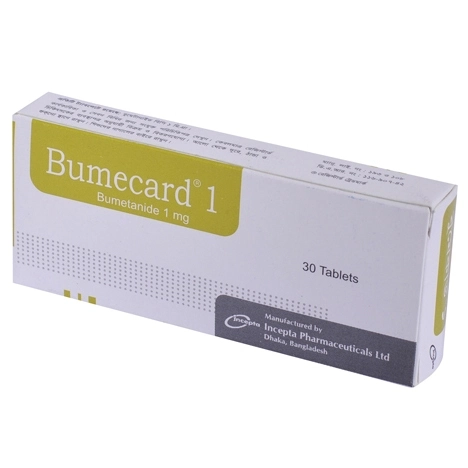
Bumecard Tablet 1 mg is a potent loop diuretic used to treat conditions related to fluid retention and hypertension. It is commonly used in the management of edema associated with congestive heart failure, renal impairment, and liver disease. Bumecard Tablet 1 mg is effective in promoting diuresis and is often considered when other diuretics are inadequate or contraindicated.
Uses
Bumecard Tablet 1 mg is primarily used for:
- Management of edema associated with congestive heart failure, liver cirrhosis, and renal impairment.
- Treatment of hypertension in cases where other antihypertensive therapies are insufficient.
- Reduction of fluid overload in acute and chronic conditions requiring rapid diuresis.
| Brand Name | Bumecard |
|---|---|
| Type | Tablet |
| Weight | 1 mg |
| Generic | Bumetanide |
| Manufacturer | Incepta Pharmaceuticals Ltd. |
| Available in | English বাংলা |
Mechanism of Action
Bumecard Tablet 1 mg acts on the ascending limb of the loop of Henle in the kidneys, where it inhibits the Na-K-2Cl cotransporter. This inhibition prevents the reabsorption of sodium, potassium, and chloride ions, leading to increased diuresis. By reducing sodium and fluid reabsorption, bumetanide effectively reduces fluid overload and lowers blood pressure.
How Long Does It Take to Work?
Bumecard Tablet 1 mg typically begins to exert its diuretic effects within 30 to 60 minutes after oral administration, with peak effects occurring around 1 to 2 hours. The duration of action is generally 4 to 6 hours, although this can vary based on the dose and individual patient response.
Absorption
Bumecard Tablet 1 mg is rapidly and well-absorbed following oral administration. It reaches peak plasma concentrations within 1 to 2 hours. The drug's bioavailability is approximately 80 to 90%, indicating effective absorption from the gastrointestinal tract.
Route of Elimination
Bumecard Tablet 1 mg is primarily excreted through the kidneys. Approximately 80% of the administered dose is excreted in the urine as unchanged drug. The remainder is metabolized in the liver, with a small amount excreted in the bile.
Dosage
Oral: 1 mg in the morning, repeated after 6-8 hours if necessary, In severe cases, 5 mg daily increased by 5 mg every 12-24 hours according to response. Elderly, 500 micrograms daily may be sufficient.By IV Injection: 1-2 mg, repeated after 20 minutes if necessary. Elderly, 500 micrograms (1 ml of Bumecard) daily may be sufficient.
By IV Infusion: 2-5 mg over 30-60 minutes.Elderly, 500 micrograms (1 ml of Bumecard) daily may be sufficient.
By IM Injection: 1 mg initially then adjusted according to response, Elderly 500 micrograms (1 ml of Bumecard) daily may be sufficient.
Paediatric use: Safety and effectiveness in paediatric patients below the age of 18 have not been established.
The usual dosage of bumetanide is:
- For edema: 0.5 to 2 mg taken once or twice daily, depending on the severity of the condition and patient response.
- For hypertension: 1 to 2 mg daily or as prescribed by a healthcare provider.
Administration
Bumecard Tablet 1 mg is administered orally in the form of tablets or as an intravenous injection. Oral tablets should be taken with or without food. For intravenous administration, the dose is typically given slowly over a few minutes. The route of administration depends on the severity of the condition and the patient's clinical status.
Side Effects
Common side effects of bumetanide include:
- Electrolyte imbalances such as hypokalemia, hyponatremia, and hypomagnesemia.
- Dehydration and hypotension.
- Headache, dizziness, and tinnitus.
- Gastrointestinal disturbances such as nausea and vomiting.
Toxicity
Toxicity symptoms may include severe dehydration, profound electrolyte imbalances, and renal impairment. Overdose may result in hypotension, metabolic alkalosis, and severe electrolyte imbalances. Treatment involves supportive care, electrolyte replacement, and discontinuation of the drug.
Precautions
Precautions include:
- Monitoring electrolyte levels regularly to prevent imbalances.
- Adjusting dosage in patients with renal or hepatic impairment.
- Monitoring blood pressure and renal function to avoid complications.
Interaction
Bumecard Tablet 1 mg may interact with other medications, including:
- Other diuretics and antihypertensives, which may enhance the effects and side effects of bumetanide.
- NSAIDs, which may reduce the diuretic effect of bumetanide.
- Medications that affect electrolyte balance, such as corticosteroids or lithium.
Disease Interaction
Use bumetanide with caution in patients with:
- Severe renal or hepatic impairment, which may affect drug metabolism and elimination.
- Gout or a history of gout, as diuretics may exacerbate symptoms.
Drug Interaction
Drug interactions include:
- Potassium-sparing diuretics or potassium supplements, which may counteract the hypokalemic effects of bumetanide.
- Antihypertensives, which may enhance the blood pressure-lowering effect.
- Drugs that affect renal function or electrolyte levels, which may require careful monitoring.
Food Interactions
There are no significant food interactions with bumetanide. The drug can be taken with or without food. However, maintaining a balanced diet and adequate fluid intake is important to support overall health and treatment efficacy.
Pregnancy Use
Bumecard Tablet 1 mg is classified as a Category C drug for pregnancy, indicating that risk cannot be ruled out. It should be used during pregnancy only if the potential benefits justify the potential risks to the fetus. Pregnant women should discuss their condition with their healthcare provider to evaluate the risks and benefits of bumetanide.
Lactation Use
The safety of bumetanide during lactation is not fully established. It is excreted in breast milk, so breastfeeding mothers should weigh the benefits of breastfeeding against the potential risks to the infant. Consult a healthcare provider to determine the best approach for managing fluid retention while breastfeeding.
Acute Overdose
In the event of an acute overdose, symptoms may include severe dehydration, electrolyte imbalances, and hypotension. Treatment involves supportive care, correction of electrolyte disturbances, and hydration. Immediate medical attention should be sought if overdose is suspected.
Contraindication
Bumecard Tablet 1 mg is contraindicated in patients with known hypersensitivity to the drug or any of its components. It should be used cautiously in patients with severe renal impairment or hepatic dysfunction where dose adjustments may be necessary.
Use Direction
Follow the prescribed dosage and administration instructions provided by the healthcare provider. Regular monitoring of blood pressure, electrolyte levels, and renal function is essential for effective management and prevention of side effects.
Storage Conditions
Store bumetanide at room temperature, away from light and moisture. Keep it out of reach of children. Specific storage conditions should be followed according to product labeling or pharmacist advice.
Volume of Distribution
The volume of distribution of bumetanide is approximately 0.2 L/kg, indicating its distribution into body tissues and fluids. This volume is reflective of the drug's pharmacokinetics and helps in understanding its therapeutic and side effect profile.
Half Life
The terminal half-life of bumetanide is approximately 1 to 2 hours. This relatively short half-life supports its dosing regimen, typically involving administration once or twice daily to manage fluid balance effectively.
Clearance
Bumecard Tablet 1 mg is primarily cleared through the kidneys. The renal clearance of bumetanide is approximately 100 L/hour, indicating its effective elimination through the urine. Renal function can significantly impact the clearance rate, requiring dose adjustments in patients with renal impairment.
See in details version Bumecard Tablet 1 mg also Bumecard Tablet 1 mg in bangla
Social card