Introduction
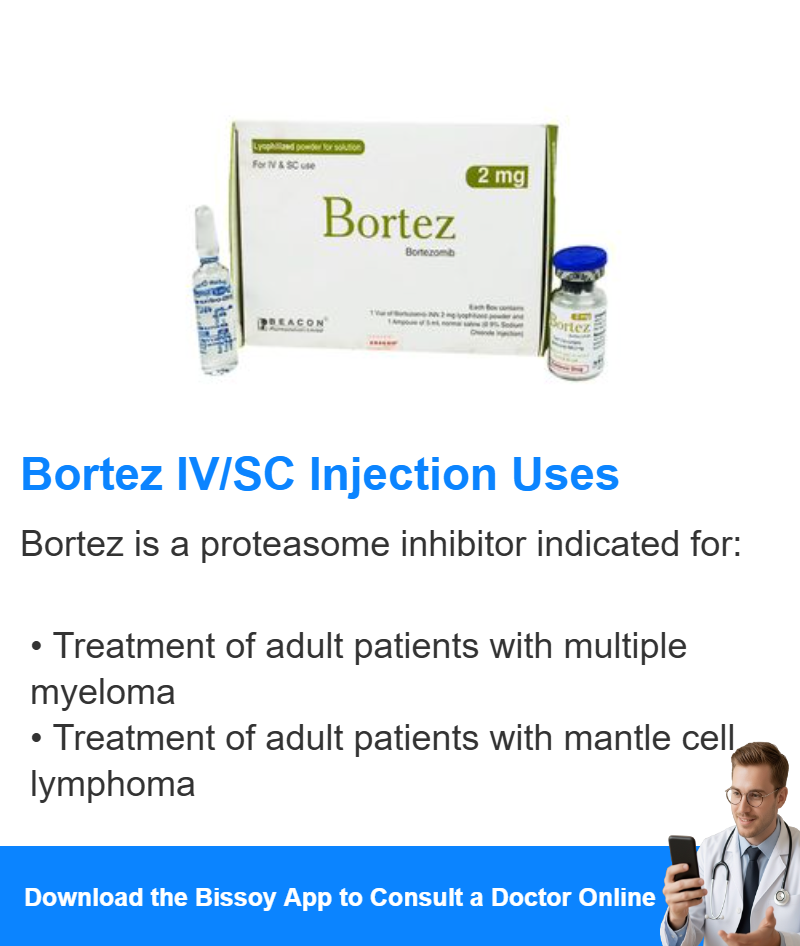
Bortez IV Infusion 1 mg/vial is a proteasome inhibitor used in the treatment of multiple myeloma and mantle cell lymphoma. It works by reversibly inhibiting the 26S proteasome, disrupting the degradation of ubiquitinated proteins, which leads to cell cycle arrest and apoptosis of cancer cells.
Bortez IV Infusion 1 mg/vial is also being investigated for the treatment of other hematologic malignancies, autoimmune disorders, and solid tumors. Its antitumor effects are mediated through multiple cellular pathways in addition to proteasome inhibition.
Uses
Bortez IV Infusion 1 mg/vial is a proteasome inhibitor used to treat multiple myeloma in patients who have not been successfully treated with at least two previous therapies.
Bortez IV Infusion 1 mg/vial is indicated for the treatment of adult patients with multiple myeloma or mantle cell lymphoma.
Associated Conditions
Pharmacodynamics
Bortez IV Infusion 1 mg/vial works to target the ubiquitin-proteasome pathway, an essential molecular pathway that regulates intracellular concentrations of proteins and promotes protein degradation. The ubiquitin-proteasome pathway is often dysregulated in pathological conditions, leading to aberrant pathway signalling and the formation of malignant cells. In one study, patient-derived chronic lymphocytic leukemia (CLL) cells contained 3-fold higher levels of chymotrypsin-like proteasome activity than normal lymphocytes. By reversibly inhibiting proteasome, bortezomib prevents proteasome-mediated proteolysis. Bortez IV Infusion 1 mg/vial exerts a cytotoxic effect on various cancer cell types in vitro and delays tumour growth in vivo in nonclinical tumour models. Bortez IV Infusion 1 mg/vial inhibits the proteasome activity in a dose-dependent manner. In one pharmacodynamic study, more than 75% of proteasome inhibition was observed in whole blood samples within one hour after dosing of bortezomib.
Mechanism of Action
The ubiquitin-proteasome pathway is a homeostatic proteolytic pathway for intracellular protein degradation: proteins marked with a poly-ubiquitin chain are degraded to small peptides and free ubiquitin by the proteasome, which is a large multimeric protease. Aberrant proteasome-dependent proteolysis, as seen in some malignancies, can lead to uncontrolled cell division, leading to tumorigenesis, cancer growth, and spread.
Bortez IV Infusion 1 mg/vial is a reversible inhibitor of the 26S proteasome, which is made up of a 20S core complexed with a 19S regulatory complex. Individual β-subunits allow specific catalytic action of the 20S core. In mammalian cells, bortezomib is a potent inhibitor of the proteasome’s chymotryptic-like activity, which is attributed to the β5-subunit of the 20S core particle. Bortez IV Infusion 1 mg/vial binds to the active site of the threonine hydroxyl group in the β5-subunit. A probing study showed bortezomib also binding to and inhibiting the β1-subunit, which mediates the caspase-like activity of the proteasome, and β1i-subunit, which is an altered subunit that is expressed to form immunoproteasomes in response to cell stress or inflammation. By inhibiting the proteasome-mediated degradation of key proteins that promote cell apoptosis, bortezomib induces a cell cycle arrest during the G2-M phase. It is believed that multiple mechanisms, other than proteasome inhibition, may be involved in the anticancer activity of bortezomib. The anticancer activity of bortezomib was largely associated with suppression of the NF-κB signalling pathway, resulting in the downregulation of anti-apoptotic target genes and expression of anti-apoptic proteins. This may be explained by bortezomib preventing uncontrolled degradation of IκB, which is an inhibitory protein of NF-κB. NOXA, which is a pro-apoptotic factor, induced by bortezomib selectively in cancer cells; thus, it is suggested to be another key mechanism of bortezomib.
Absorption
Following intravenous administration of 1 mg/m2 and 1.3 mg/m2 doses, the mean Cmax of bortezomib were 57 and 112 ng/mL, respectively. In a twice-weekly dosing regimen, the Cmax ranged from 67 to 106 ng/mL at the dose of 1 mg/m2 and 89 to 120 ng/mL for the 1.3 mg/m2 dose. In patients with multiple myeloma, the Cmax of bortezomib followig subcutaneous administration was lower than that of intravenously-administered dose; however, the total systemic exposure of the drug was equivalent for both routes of administration. There is a wide interpatient variability in drug plasma concentrations.
Volume of Distribution
The mean distribution volume of bortezomib ranged from approximately 498 to 1884 L/m2 in patients with multiple myeloma receiving a single- or repeat-dose of 1 mg/m2 or 1.3 mg/m2. Bortez IV Infusion 1 mg/vial distributes into nearly all tissues, except for the adipose and brain tissue.
Protein Binding
Over the concentration range of 100 to 1000 ng/mL, bortezomib is about 83% bound to human plasma proteins.
Route of Elimination
Bortez IV Infusion 1 mg/vial is eliminated by both renal and hepatic routes.
Half Life
The mean elimination half-life of bortezomib ranged from 40 to 193 hours following a multiple dosing regimen at a 1 mg/m2 dose. The half-life ranged from 76 to 108 hours after multiple dosing of 1.3 mg/m2 bortezomib.
Clearance
Following the administration of a first dose of 1 mg/m2 and 1.3 mg/m2, the mean mean total body clearances were 102 and 112 L/h, respectively. The clearances were 15 and 32 L/h after the subsequent dose of 1 and 1.3 mg/m2, respectively.
Toxicity
The Lowest published toxic dose (TD Lo) in mouse was 5 mg/kg/14D following intraperitoneal administration of an intermittent dose and 1.6 mg/kg/12D following subcutaneous administration of a continuous dose.
The therapeutic dose of bortezomib is individualized in each patient to prevent overdose. Fatal outcomes occurred in humans following the administration of more than twice the recommended therapeutic dose of bortezomib. The symptoms from overdose included the acute onset of symptomatic hypotension and thrombocytopenia. As there is no known antidote for bortezomib overdosage, monitoring of vital signs and appropriate supportive care should be initiated when drug overdosage is suspected. In monkeys and dogs, increased heart rate, decreased contractility, hypotension, and death were observed with the intravenous dose as low as two times the recommended clinical dose on a mg/m2 basis. A case of a slight increase in the corrected QT interval leading to death occurred in dog studies.
Food Interactions
- Avoid St. John's Wort. This herb induces CYP3A4 metabolism, which may reduce the serum concentration of bortezomib.
- Exercise caution with grapefruit products. Grapefruit inhibits CYP3A4 metabolism, which may increase the serum concentration of bortezomib.
- Limit foods and supplements high in flavonoids. Flavonoids may interfere with the therapeutic action of this drug. Foods high in flavonoids include green vegetables, fruits, and green tea.
- Limit foods and supplements high in vitamin C. Vitamin C may interfere with the therapeutic action of this drug. Foods high in vitamin C include citrus fruits and beverages.
Dosage
Bortez IV Infusion 1 mg/vial retreatment may be considered for patients with multiple myeloma who has previously responded to treatment with Bortez IV Infusion 1 mg/vial and who has relapsed at least 6 months after completing prior Bortez IV Infusion 1 mg/vial treatment. Treatment may be started at the last tolerated dose. Bortez IV Infusion 1 mg/vial is for intravenous or subcutaneous use only. Bortez IV Infusion 1 mg/vial should not be administered by any other route.