Introduction
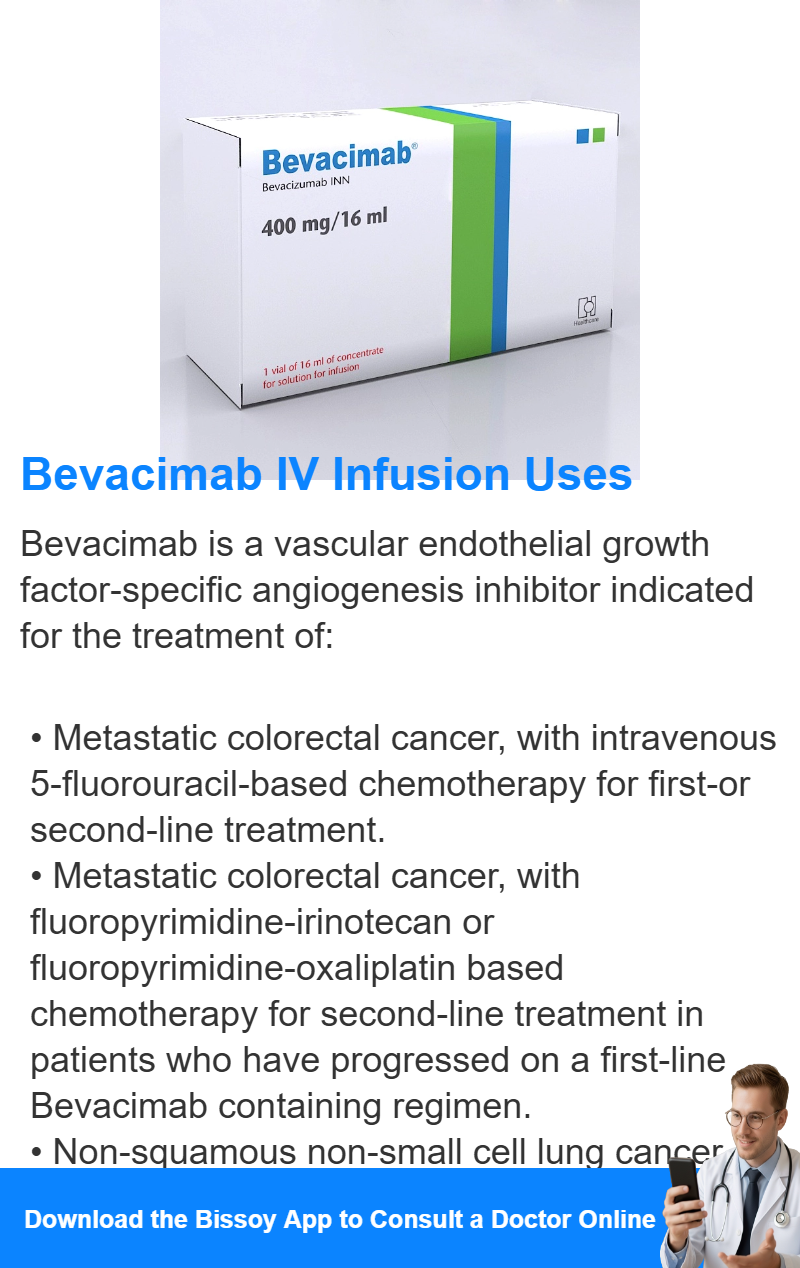
Bevacimab IV Infusion 400 mg/16 ml is a humanized monoclonal IgG antibody that inhibits vascular endothelial growth factor A (VEGF-A), thereby suppressing angiogenesis, the formation of new blood vessels that support tumor growth and metastasis. It is used in combination with chemotherapy for the treatment of various types of cancer.
By blocking VEGF-mediated blood vessel formation, bevacizumab helps slow tumor growth and disease progression. It has also been investigated for the treatment of other conditions associated with abnormal VEGF activity, including severe lung complications.
Uses
Bevacimab IV Infusion 400 mg/16 ml is a monoclonal anti-vascular endothelial growth factor antibody used in combination with antineoplastic agents for the treatment of many types of cancer.
As a vascular endothelial growth factor (VEGF) inhibitor, bevacizumab is used in several chemotherapy regimens to treat metastatic colorectal cancer; metastatic, unresectable, locally advanced or recurrent non-squamous non-small cell lung cancer; metastatic renal cell carcinoma; metastatic, persistent, or recurrent cervical cancer; primary peritoneal cancer; epithelial ovarian cancer; and fallopian tube cancer. It can also be used to treat recurrent glioblastoma.
Interestingly, bevacizumab is currently under investigation for the treatment of COVID-19 complications including acute respiratory distress syndrome (ARDS) and acute lung injury (ALI).
Associated Conditions
Pharmacodynamics
Bevacimab IV Infusion 400 mg/16 ml binds circulating vascular endothelial-derived growth factor (VEGF) and blocks it from binding to its associated receptors, effectively blunting downstream signaling. The effects of bevacizumab have been shown to re-establish normal vasculature at the tumor site resulting in increased nutrient and oxygen supply, while also improving the delivery of chemotherapeutic drugs to the target area. On the other hand, VEGF signaling is a vital component of several processes including angiogenesis, lymphangiogenesis, blood pressure regulation, wound healing, coagulation, and renal filtration. Although blocking VEGF may inhibit metastatic disease progression, it may also result in unintended effects due to the role of VEGF in several other physiologic processes.
Mechanism of Action
Transcription of the VEGF protein is induced by 'hypoxia inducible factor' (HIF) in a hypoxic environment. When circulating VEGF binds to VEGF receptors (VEGFR-1 and VEGFR-2) located on endothelial cells, various downstream effects are initiated. It should be noted that VEGF also binds to the neuropilin co-receptors (NRP-1 and NRP-1), leading to enhanced signaling.
Cancer cells promote tumor angiogenesis by releasing VEGF, resulting in the creation of an immature and disorganized vascular network. The hypoxic microenvironment promoted by cancer cells favors the survival of more aggressive tumor cells, and gives rise to a challenging environment for immune cells to respond appropriately. As a result, VEGF has become a well-known target for anti-cancer drugs like bevacizumab. Bevacimab IV Infusion 400 mg/16 ml is a mAb that exerts its effects by binding and inactivating serum VEGF. When bound to the mAb, VEGF is unable to interact with its cell surface receptors, and proangiogenic signalling is inhibited. This prevents formation of new blood vessels, decreases tumor vasculature, and reduces tumor blood supply.
There is also evidence to suggest that VEGF is upregulated in COVID-19 patients, hence, bevacizumab is being investigated for the treatment of associated complications. Higher levels of VEGF may contribute to pulmonary edema, leading to acute respiratory distress syndrome (ARDS) and acute lung injury (ALI). Researchers are hopeful that by inhibiting VEGF, bevacizumab may effectively treat ARDS and ALI - both common features of severe COVID-19 cases.
Absorption
Monoclonal antibodies (mAbs) are large in size, do not readily cross cell membranes, and are unable to withstand proteolysis in the gastrointestinal tract. Given these characteristics, mAbs are poorly absorbed via the oral route and are instead administered intravenously, intramuscularly or subcutaneously.
In a single dose (1mg/kg) pharmacokinetic study assessing the bioequivalence of bevacizumab and TAB008 (a biosimilar product), the pharmacokinetic parameters of Avastin (bevacizumab) were as follows: Geometric mean Cmax = 17.38 ug/mL Geometric mean AUCinf = 5,358 ugxh/mL Geometric mean Tmax = 2.50 hrs
Volume of Distribution
The volume of distribution of bevacizumab is approximately 3.29 L and 2.39 L for the average male and female, respectively.
Protein Binding
>97% of serum VEGF is bound to bevacizumab.
Route of Elimination
Due to their size, monoclonal antibodies are not renally eliminated under normal physiological conditions. Catabolism or excretion are the primary processes of elimination.
Half Life
The half-life of bevacizumab is estimated to be 20 days (range of 11-50 days).
Clearance
The clearance (CL) of bevacizumab is approximately 0.207 L/day. The CL of bevacizumab can increase or decrease by 30% in patients who weigh >114 kg or 14 Males tend to clear bevacizumab at a faster rate than females (26% faster on average). Other factors including alkaline phosphatase (ALP), serum aspartate aminotransferase (AST), serum albumin, and tumor burden may cause the CL to fluctuate.
Toxicity
Bevacimab IV Infusion 400 mg/16 ml toxicities are distinct from the effects of cytotoxic agents used in chemotherapy, and are normally linked to impaired VEGF function. Common toxicities associated with bevacizumab include hypertension, gastrointestinal perforation, arterial thromboembolism, reversible posterior leukoencephalopathy syndrome (RPLS), venous thromboembolism, proteinuria, bleeding/hemorrhage, and wound-healing complications.
Food Interactions
No interactions found.
Dosage
Metastatic Colorectal Cancer (mCRC): The recommended doses are 5 mg/kg or 10 mg/kg every 2 weeks when used in combination with intravenous 5-FU-based chemotherapy.
- Administer 5 mg/kg when used in combination with bolus-IFL.
- Administer 10 mg/kg when used in combination with FOLFOX4.
- Administer 5 mg/kg every 2 weeks or 7.5 mg/kg every 3 weeks when used in combination with a fluoropyrimidine-irinotecan or fluoropyrimidine-oxaliplatin based chemotherapy regimen in patients who have progressed on a first-line Bevacimab IV Infusion 400 mg/16 ml-containing regimen.
Glioblastoma: The recommended dose is 10 mg/kg every 2 weeks.
Metastatic Renal Cell Carcinoma (mRCC): The recommended dose is 10 mg/kg every 2 weeks in combination with interferon alfa.
Cervical Cancer: The recommended dose of Bevacimab IV Infusion 400 mg/16 ml is 15 mg/kg every 3 weeks as an intravenous infusion administered in combination with one of the following chemotherapy regimens: paclitaxel and cisplatin, or paclitaxel and topotecan.
Platinum-Resistant Recurrent Epithelial Ovarian, Fallopian Tube or Primary Peritoneal Cancer: The recommended dose is 10mg/kg every 2 weeks in combination with one of the following intravenous chemotherapy regimens: paclitaxel, pegylated liposomal doxorubicin, or topotecan (weekly); or 15 mg/kg every 3 weeks in combination with topotecan (every 3 weeks).
Platinum-Sensitive Recurrent Epithelial Ovarian, Fallopian Tube, or Primary Peritoneal Cancer: The recommended dose is 15 mg/kg every 3 weeks when administered in combination with carboplatin and paclitaxel for 6 cycles and up to 8 cycles, followed by continued use of Bevacimab IV Infusion 400 mg/16 ml 15 mg/kg every 3 weeks as a single agent until disease progression. Alternatively, 15 mg/kg every 3 weeks when administrated in combination with carboplatin and gemcitabine for 6 cycles and up to 10 cycles, followed by continued use of Bevacimab IV Infusion 400 mg/16 ml 15 mg/kg every 3 weeks as a single agent until disease progression.