Introduction
Severe acute respiratory syndrome coronavirus 2 (SARS-CoV-2) is the causative agent of coronavirus disease 2019 (COVID-19), which is a respiratory disease that is capable of progressing to viral pneumonia and acute respiratory distress syndrome (ARDS); COVID-19 can be fatal. Like other RNA viruses, SARS-CoV-2 depends on an RNA-dependent RNA polymerase (RdRp) enzyme complex for genomic replication, which can be inhibited by a class of drugs known as nucleoside analogues.
Bemsivir IV Infusion 5 mg/ml (GS-5734) is an adenosine triphosphate analogue first described in the literature in 2016 as a potential treatment for Ebola. Broad antiviral activity of remdesivir is suggested by its mechanism of action, and to date, it has demonstrated in vitro activity against the Arenaviridae, Flaviviridae, Filoviridae, Paramyxoviridae, Pneumoviridae, and Coronaviridae viral families. Bemsivir IV Infusion 5 mg/ml activity against the Coronaviridae family was first demonstrated in 2017, leading to considerable interest in remdesivir as a possible treatment for COVID-19. Bemsivir IV Infusion 5 mg/ml was confirmed as a non-obligate chain terminator of RdRp from SARS-CoV-2 and the related SARS-CoV and MERS-CoV, and has been investigated in multiple COVID-19 clinical trials.
Uses
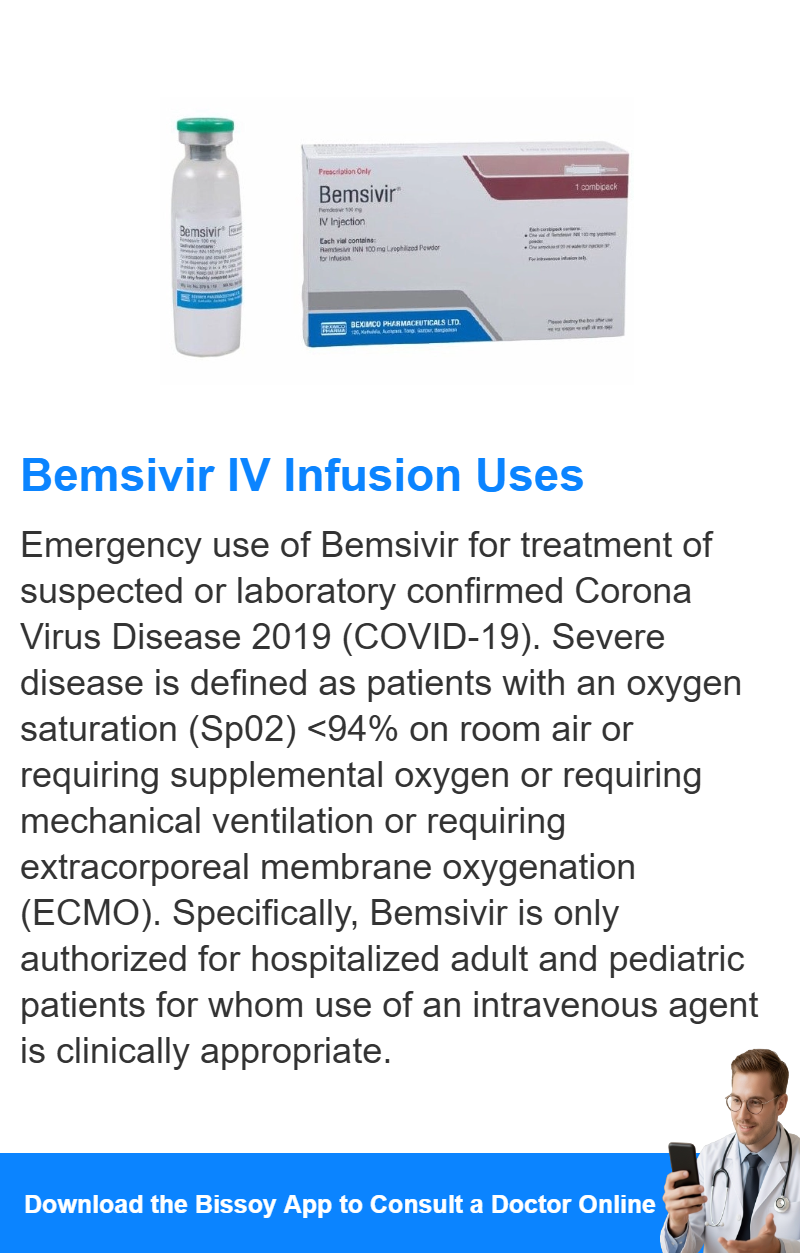
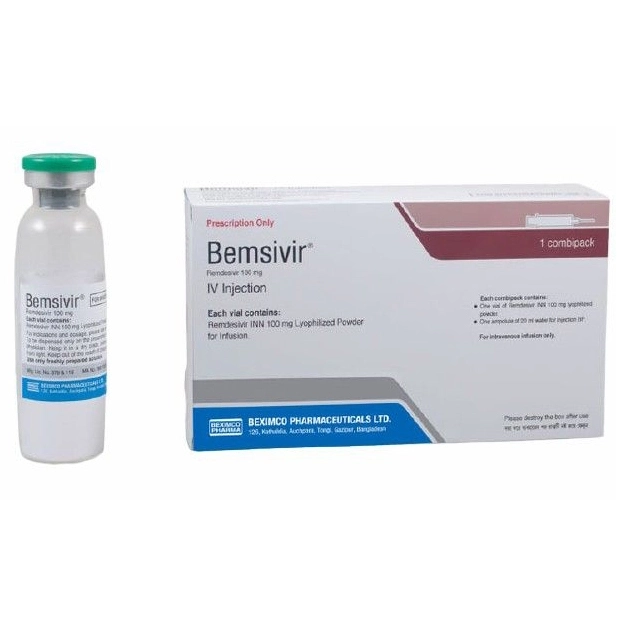
Bemsivir IV Infusion 5 mg/ml is a nucleoside analog used to treat RNA virus infections including COVID-19.
Bemsivir IV Infusion 5 mg/ml is indicated for the treatment of adult and pediatric patients aged 12 years and over weighing at least 40 kg for coronavirus disease 2019 (COVID-19) infection requiring hospitalization. Under this indication, remdesivir should only be administered in a hospital or other healthcare setting capable of providing acute care comparable to an inpatient hospital setting.
Bemsivir IV Infusion 5 mg/ml was originally granted FDA Emergency Use Authorization (EUA) on May 1, 2020, for use in adults and children with suspected or confirmed COVID-19 in a hospital setting with an SpO2 ≤94%. Following FDA approval, this EUA was revised to cover hospitalized pediatric patients between 3.5 and 40 kg, as well as those under 12 years of age that weigh at least 3.5 kg, with suspected or laboratory-confirmed COVID-19.
Under both the on-label and EUA indications, patients not needing invasive mechanical ventilation or extracorporeal membrane oxygenation (ECMO) should be treated for 5 days (including the loading dose on day 1) and may be extended up to 10 days if they do not show improvement. Patients requiring invasive mechanical ventilation or ECMO should be treated for 10 days.
Associated Conditions
Pharmacodynamics
Bemsivir IV Infusion 5 mg/ml is a nucleoside analog used to inhibit the action of RNA polymerase. The duration of action is moderate, as it is given once daily. Due to much higher selectivity of mammalian DNA and RNA polymerases, including human mitochondrial RNA polymerase, for ATP over remdesivir triphosphate, remdesivir is not a significant inhibitor of these enzymes, which contributes to its overall tolerability and safety profile. Despite this, remdesivir carries risks for hypersensitivity reactions, including anaphylaxis and other infusion-related reactions, elevated transaminase levels, and potential decreased efficacy when combined with hydroxychloroquine or chloroquine.
Mechanism of Action
COVID-19 is caused by the positive-sense RNA virus severe acute respiratory syndrome coronavirus 2 (SARS-CoV-2). Replication of the viral genome is a key step in the infectious cycle of RNA viruses, including those of the Filoviridae, Paramyxoviridae, Pneumoviridae, and Coronaviridae families, and is carried out by viral RNA-dependent RNA polymerase (RdRp) enzymes or enzyme complexes. For both SARS-CoV and SARS-CoV-2, the RdRp comprises nsp7, nsp8, and nsp12 subunits under physiological conditions, although functional RdRp complexes can be reassembled in vitro that incorporate only the nsp8 and nsp12 subunits, similar to the Middle East respiratory syndrome coronavirus (MERS-CoV).
Bemsivir IV Infusion 5 mg/ml is a phosphoramidite prodrug of a 1'-cyano-substituted adenosine nucleotide analogue that competes with ATP for incorporation into newly synthesized viral RNA by the corresponding RdRp complex. Bemsivir IV Infusion 5 mg/ml enters cells before being cleaved to its monophosphate form through the action of either carboxylesterase 1 or cathepsin A; it is subsequently phosphorylated by undescribed kinases to yield its active triphosphate form remdesivir triphosphate (RDV-TP or GS-443902). RDV-TP is efficiently incorporated by the SARS-CoV-2 RdRp complex, with a 3.65-fold selectivity for RDV-TP over endogenous ATP. Unlike some nucleoside analogues, remdesivir provides a free 3'-hydroxyl group that allows for continued chain elongation. However, modelling and in vitro experiments suggest that at i + 4 (corresponding to the position for the incorporation of the fourth nucleotide following RDV-TP incorporation), the 1'-cyano group of remdesivir sterically clashes with Ser-861 of the RdRp, preventing further enzyme translocation and terminating replication at position i + 3. This mechanism was essentially identical between SARS-CoV, SARS-CoV-2, and MERS-CoV, and genomic comparisons reveal that Ser-861 is conserved across alpha-, beta-, and deltacoronaviruses, suggesting remdesivir may possess broad antiviral activity.
Considerations for the use of nucleotide analogues like remdesivir include the possible accumulation of resistance mutations. Excision of analogues through the 3'-5' exonuclease (ExoN) activity of replication complexes, mediated in SARS-CoV by the nsp14 subunit, is of possible concern. Murine hepatitis viruses (MHVs) engineered to lack ExoN activity are approximately 4-fold more susceptible to remdesivir, supporting the proposed mechanism of action. However, the relatively mild benefit of ExoN activity to remdesivir resistance is proposed to involve its delayed chain termination mechanism, whereby additional endogenous nucleotides are incorporated following RDV-TP. In addition, serial passage of MHV in increasing concentrations of the remdesivir parent molecule GS-441524 led to the development of resistance mutations F476L and V553L, which maintain activity when transferred to SARS-CoV. However, these mutant viruses are less fit than wild-type in both competition assays and in vivo in the absence of selective pressure. To date, no clinical data on SARS-CoV-2 resistance to remdesivir have been described.
Absorption
Bemsivir IV Infusion 5 mg/ml is absorbed quickly; maximal plasma concentrations following a single 30-minute intravenous infusion are reached within 0.67-0.68 hours (Tmax). Repeated dosing yields a Cmax (coefficient of variation as a percent) of 2229 (19.2) ng/mL and an AUCtau of 1585 (16.6) ng*h/mL.
Bemsivir IV Infusion 5 mg/ml metabolite GS-441524 has measured values: Tmax 1.51-2.00 hours, Cmax 145 (19.3) ng/mL, AUCtau 2229 (18.4) ng*h/mL, and Ctrough 69.2 (18.2) ng/mL. Another metabolite, GS-704277, has measured values: Tmax 0.75 hours, Cmax 246 (33.9) ng/mL, AUCtau 462 (31.4) ng*h/mL, and an undetermined Ctrough.
A 10mg/kg intravenous dose given to cynomolgus monkeys distributes to the testes, epididymis, eyes, and brain within 4h.
Volume of Distribution
Data regarding the volume of distribution of remdesivir is not readily available.
Protein Binding
Bemsivir IV Infusion 5 mg/ml is 88-93.6% bound to human plasma proteins while its metabolites GS-441524 and GS-704277 are 2% and 1% bound, respectively.
Route of Elimination
Bemsivir IV Infusion 5 mg/ml is 74% eliminated in the urine and 18% eliminated in the feces. 49% of the recovered dose is in the form of the metabolite GS-441524, and 10% is recovered as the unmetabolized parent compound. A small amount (0.5%) of the GS-441524 metabolite is found in feces.
Half Life
Bemsivir IV Infusion 5 mg/ml has an elimination half-life of 1 hour following a single 30-minute intravenous infusion. Under the same conditions, the elimination half-lives of the remdesivir metabolites GS-441524 and GS-704277 are 27 hours and 1.3 hours, respectively.
A 10mg/kg intravenous dose in non-human primates has a plasma half-life of 0.39h. The nucleoside triphosphate metabolite has a half-life of 14h in non-human primates. The nucleoside triphosphate metabolite has a half-life of approximately 20 hours in humans.
Clearance
Data regarding the clearance of remdesivir is not readily available.
Toxicity
Data regarding overdoses of remdesivir are not readily available. Overdoses of other nucleoside analogs like acyclovir can be managed with symptomatic and supportive treatment.
Food Interactions
No interactions found.
Dosage
- Adult and pediatric patients (>28 days and old) must have an eGFR determined and full-term neonates (≥7 days to ≤28 days old) must have serum creatinine determined before dosing of Bemsivir IV Infusion 5 mg/ml.
- Hepatic laboratory testing should be performed in all patients prior to starting Bemsivir IV Infusion 5 mg/ml and daily while receiving Bemsivir IV Infusion 5 mg/ml.
- Bemsivir IV Infusion 5 mg/ml should be administered via intravenous infusion only. Do not administer as intramuscular injection.
- The recommended dosage in adults requiring invasive mechanical ventilation and/or ECMO is a single loading dose of Bemsivir IV Infusion 5 mg/ml 200 mg on day 1 followed by once daily maintenance dose of Bemsivir IV Infusion 5 mg/ml 100 mg for 9 days.
- The recommended dose in adults not requiring invasive mechanical ventilation and/or ECMO is a single dose of Bemsivir IV Infusion 5 mg/ml 200 mg on day 1 followed by once daily maintenance dose of Bemsivir IV Infusion 5 mg/ml 100 mg for 4 days. If a patient dose not demonstrate clinical improvement, treatment may be extended for up to 5 additional days (i.e. up to a total of 10 days)
- Bemsivir IV Infusion 5 mg/ml is to be administered via intravenous infusion in a total volume of up to 250 ml 0.9% saline over 30 to 120 minutes.
- The recommended pediatric dose for pediatric patients weighing between 3.5 kg <40 kg should be calculated using the mg/kg dose according to the patient’s weight.
- For pediatric patients with body weight between 3.5 kg <40 kg use Bemsivir IV Infusion 5 mg/ml for injection 100 mg lyophilized powder only. Administer a body weight-based dosing regimen of one loading dose of Bemsivir IV Infusion 5 mg/ml 5 mg/kg IV (infused over 30 to 120 minutes) on day 1 followed by Bemsivir IV Infusion 5 mg/ml 2.5 mg/kg IV (infused over 30 to 120 minutes) once daily for 9 days (for pediatric patients requiring invasive mechanical ventilation and/or ECMO, days 2 through 5). If a patient dose not demonstrate clinical improvement, treatment may be extended for up to 5 additional days (i.e. up to a total of 10 days)
- For pediatric patients with body weight ≥40 kg requiring invasive mechanical ventilation and/or ECMO, the adult dosage regimen of one loading dose of Bemsivir IV Infusion 5 mg/ml 200 mg IV (infused over 30 to 120 minutes) on day 1 followed by Bemsivir IV Infusion 5 mg/ml 100 mg IV (infused over 30 to 120 minutes) once daily for 9 days will be administered.
- For pediatric patients with body weight ≥40 kg requiring invasive mechanical ventilation and/or ECMO, the adult dosage regimen of one loading dose of Bemsivir IV Infusion 5 mg/ml 200 mg IV (infused over 30 to 120 minutes) on day 1 followed by Bemsivir IV Infusion 5 mg/ml 100 mg IV (infused over 30 to 120 minutes) once daily for 4 days (days 2 through 5) will be administered. If a patient does not demonstrate clinical improvement, treatment may be extended for up to 5 additional days (i.e. up to a total of 10 days).