Introduction
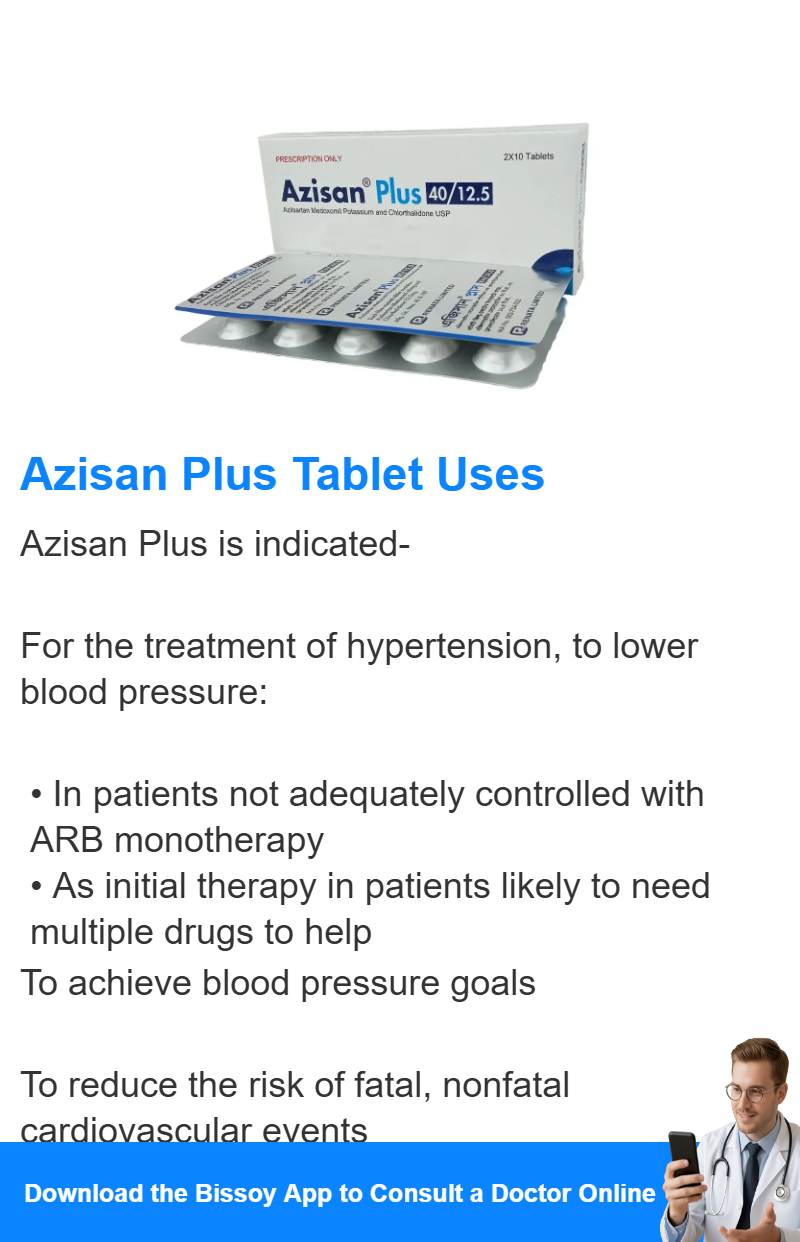
Azisan Plus Tablet 40 mg+12.5 mg is a fixed-dose combination medication used to treat hypertension (high blood pressure). Azilsartan is an angiotensin II receptor blocker (ARB) that relaxes blood vessels, making it easier for blood to flow. Chlorthalidone is a thiazide-like diuretic that helps reduce excess fluid in the body, lowering blood pressure and decreasing the risk of heart complications such as stroke and heart attack.
Uses
This combination is primarily used for the treatment of:
- Hypertension (high blood pressure)
- Reduction of the risk of cardiovascular events, such as stroke and heart attack, in patients with hypertension
Mechanism of Action
Azilsartan Medoxomil is an ARB that blocks the action of angiotensin II, a hormone that constricts blood vessels and increases blood pressure. By blocking its effect, azilsartan helps relax blood vessels, which lowers blood pressure. Chlorthalidone works by inhibiting sodium and chloride reabsorption in the kidneys, leading to increased urine output (diuresis). This reduces blood volume and lowers blood pressure.
How Long Does It Take to Work?
The blood pressure-lowering effects of Azisan Plus Tablet 40 mg+12.5 mg can begin within 1-2 hours after oral administration. Maximum blood pressure reduction typically occurs within 2-4 weeks of regular use.
Absorption
Azilsartan Medoxomil is rapidly absorbed and converted to its active form, azilsartan, in the gastrointestinal tract. The bioavailability of azilsartan is approximately 60%. Chlorthalidone is also well absorbed from the gastrointestinal tract, with bioavailability of approximately 65%. Both drugs reach peak plasma concentrations within 1-2 hours of ingestion.
Route of Elimination
Azilsartan is eliminated primarily through the urine and feces, with approximately 55% of the dose excreted unchanged in the feces and 42% excreted in the urine. Chlorthalidone is excreted mainly through the kidneys, with approximately 50-60% of the drug eliminated unchanged in the urine.
Dosage
The recommended starting dose is 40/12.5 mg taken orally once daily. Most of the antihypertensive effect is apparent within 1 to 2 weeks. This combination may be used to provide additional blood pressure lowering for patients not adequately controlled on ARB or diuretic monotherapy treatment. Patients not controlled with azilsartan medoxomil 80 mg may have an additional systolic/diastolic clinic blood pressure reduction of 13/6 mm Hg when switched to this combination 40/12.5 mg.This combination may be used as initial therapy if a patient is likely to need multiple drugs to achieve blood pressure goals. Patients titrated to the individual components (azilsartan medoxomil and chlorthalidone) may instead receive the corresponding dose of this combination. This may be taken with or without food.
The recommended dosage for Azisan Plus Tablet 40 mg+12.5 mg is:
- One tablet daily, taken orally
- Strengths may vary depending on the patient’s blood pressure control, typically starting with 40 mg of azilsartan and 12.5 mg of chlorthalidone
- The dosage may be adjusted based on response and tolerability, with a maximum dose of 40 mg azilsartan and 25 mg chlorthalidone once daily
Administration
This medication should be taken by mouth once daily, with or without food. It is important to take it consistently at the same time each day. If a dose is missed, it should be taken as soon as possible unless it is almost time for the next dose, in which case the missed dose should be skipped.
Side Effects
Common side effects of Azisan Plus Tablet 40 mg+12.5 mg include:
- Dizziness or lightheadedness
- Fatigue
- Increased urination
- Electrolyte imbalances (low potassium or sodium levels)
- Dehydration
- Muscle cramps
Serious side effects may include hypotension, kidney dysfunction, or hyperkalemia (elevated potassium levels).
Toxicity
Overdose of Azisan Plus Tablet 40 mg+12.5 mg can lead to excessive lowering of blood pressure (hypotension), dehydration, electrolyte imbalances (especially low potassium or sodium), and kidney failure. In the case of overdose, supportive measures such as intravenous fluids and electrolyte correction may be necessary.
Precautions
Patients should take precautions if they have:
- Kidney impairment or kidney disease
- Electrolyte imbalances, such as low potassium or sodium levels
- Liver impairment
- Heart conditions such as congestive heart failure
- Dehydration
- A history of gout
Interaction
Azisan Plus Tablet 40 mg+12.5 mg may interact with:
- Potassium-sparing diuretics: Increased risk of hyperkalemia
- Nonsteroidal anti-inflammatory drugs (NSAIDs): Reduced antihypertensive effect and risk of kidney dysfunction
- Lithium: Increased risk of lithium toxicity
- Other antihypertensive agents: Additive blood pressure-lowering effects
Disease Interaction
This medication should be used with caution in patients with:
- Renal impairment or renal artery stenosis
- Electrolyte disturbances such as hypokalemia or hyperkalemia
- Liver disease
- Congestive heart failure
- Gout
Drug Interaction
Drug interactions may occur with:
- NSAIDs (e.g., ibuprofen, naproxen): Reduced antihypertensive effect and risk of renal impairment
- Potassium-sparing diuretics or supplements: Increased risk of hyperkalemia
- Digoxin: Increased risk of toxicity due to electrolyte imbalances
- Lithium: Risk of increased lithium toxicity
Food Interactions
There are no significant food interactions known with Azisan Plus Tablet 40 mg+12.5 mg. However, patients should be cautious with high potassium foods (e.g., bananas, oranges) when taking this combination due to the potential for hyperkalemia, especially in patients on potassium supplements or other potassium-sparing agents.
Pregnancy Use
Azisan Plus Tablet 40 mg+12.5 mg should not be used during pregnancy, particularly in the second and third trimesters, as it can cause injury and death to the developing fetus. If pregnancy is detected, the medication should be discontinued as soon as possible.
Lactation Use
It is not known whether azilsartan or chlorthalidone is excreted in human breast milk. Due to potential risks to the infant, breastfeeding is not recommended while taking this combination, and an alternative medication should be considered if antihypertensive treatment is necessary during lactation.
Acute Overdose
In the case of an acute overdose of Azisan Plus Tablet 40 mg+12.5 mg, symptoms such as hypotension, dizziness, dehydration, and electrolyte disturbances may occur. Treatment should involve supportive care, including intravenous fluids, monitoring of vital signs, and correction of electrolyte imbalances.
Contraindication
Azisan Plus Tablet 40 mg+12.5 mg is contraindicated in patients with:
- Hypersensitivity to azilsartan, chlorthalidone, or any component of the formulation
- Severe renal impairment or anuria
- Pregnancy (due to the risk of fetal toxicity)
Use Direction
The recommended use direction for Azisan Plus Tablet 40 mg+12.5 mg is one tablet taken orally once daily, with or without food. Patients should be instructed to take the medication at the same time each day and not to double up doses if a dose is missed.
Storage Conditions
This medication should be stored at room temperature, between 20°C and 25°C (68°F and 77°F), and protected from light and moisture. It should be kept in its original container and out of reach of children.
Volume of Distribution
The volume of distribution for azilsartan is approximately 16 L, indicating moderate distribution in body tissues. Chlorthalidone has a larger volume of distribution (approximately 3.5 L/kg) due to its extensive binding to red blood cells and tissues.
Half-Life
The half-life of azilsartan is approximately 11 hours, allowing for once-daily dosing. Chlorthalidone has a longer half-life of about 40-60 hours, contributing to its prolonged diuretic effect and allowing for once-daily administration.
Clearance
Azilsartan is cleared primarily via renal excretion, with about 55% eliminated unchanged in the feces and 42% in the urine. Chlorthalidone is also cleared predominantly via renal excretion, with about 50-60% eliminated unchanged in the urine.