Introduction
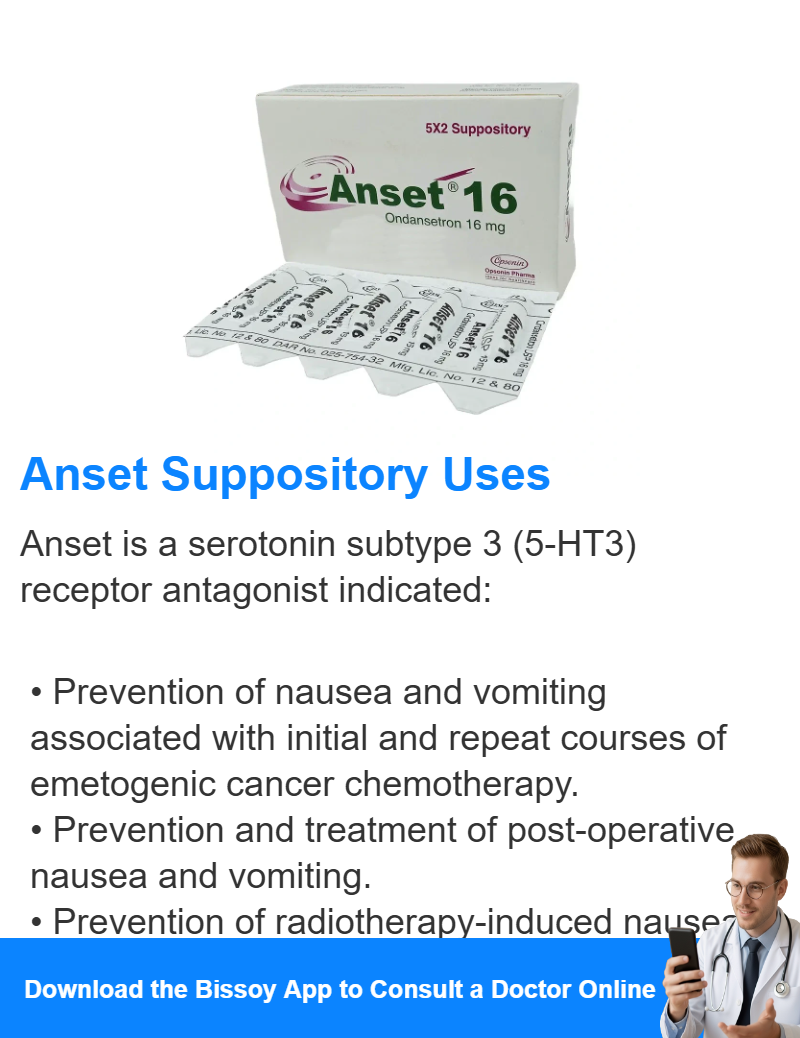
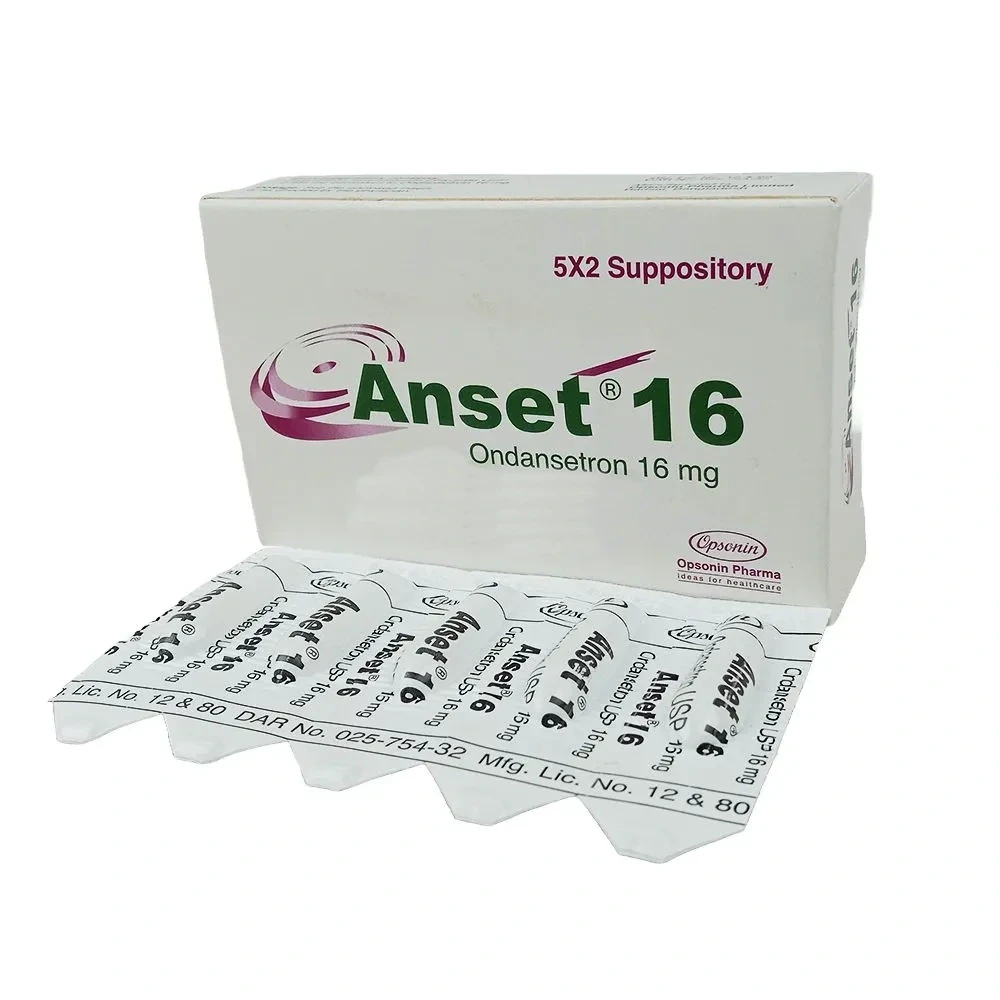
Anset Suppository 16 mg is a selective serotonin 5-HT3 receptor antagonist used to prevent and treat nausea and vomiting associated with chemotherapy, radiotherapy, surgery, and other medical conditions. It works by blocking 5-HT3 receptors in the central nervous system and gastrointestinal tract, thereby suppressing the vomiting reflex.
Anset Suppository 16 mg is available in oral tablets, orally disintegrating tablets, oral films, and injectable formulations. It is generally well tolerated and is widely used as an effective antiemetic in both adults and children.
Uses
Anset Suppository 16 mg is a serotonin 5-HT3 receptor antagonist used to prevent nausea and vomiting in cancer chemotherapy and postoperatively.
In the adult patient population: i) orally administered ondansetron tablets and orally disintegrating tablets (ODT) are indicated for: - the prevention of nausea and vomiting associated with emetogenic cancer chemotherapy, including high dose (ie. greater than or equal to 50 mg/m2) cisplatin therapy, and radiotherapy, and - the prevention and treatment of postoperative nausea and vomiting
ii) intravenously administered ondansetron injection formulations are indicated for: - the prevention of nausea and vomiting associated with emetogenic cancer chemotherapy, including high dose (ie. greater than or equal to 50 mg/m2) cisplatin therapy, and - the prevention and treatment of postoperative nausea and vomiting
In the pediatric (4-18 years of age) patient population: i) ondansetron was effective and well tolerated when given to children 4-12 years of age for the treatment of post-chemotherapy induced nausea and vomiting, ii) ondansetron tablets, ondansetron ODT, ondansetron injection are not indicated for the treatment of children 3 years of age or younger, iii) ondansetron tablets, ondansetron ODT, ondansetron injection are not indicated for use in any age group of the pediatric population for the treatment of post-radiotherapy induced nausea and vomiting, and iV) ondansetron tablets, ondansetron ODT, ondansetron injection are not indicated for use in any age group of the pediatric population for the treatment of postoperative nausea and vomiting
In the geriatric (>65 years of age) patient population: i) efficacy and tolerance of ondansetron were similar to that observed in younger adults for the treatment of post-chemotherapy and radiotherapy-induced nausea and vomiting, and ii) clinical experience in the use of ondansetron in the prevention and treatment of postoperative nausea and vomiting is limited and is not indicated for use in the geriatric patient population
Associated Conditions
Pharmacodynamics
Anset Suppository 16 mg is a highly specific and selective serotonin 5-HT3 receptor antagonist, not shown to have activity at other known serotonin receptors and with low affinity for dopamine receptors , . The serotonin 5-HT3 receptors are located on the nerve terminals of the vagus in the periphery, and centrally in the chemoreceptor trigger zone of the area postrema , . The temporal relationship between the emetogenic action of emetogenic drugs and the release of serotonin, as well as the efficacy of antiemetic agents, suggest that chemotherapeutic agents release serotonin from the enterochromaffin cells of the small intestine by causing degenerative changes in the GI tract , . The serotonin then stimulates the vagal and splanchnic nerve receptors that project to the medullary vomiting center, as well as the 5-HT3 receptors in the area postrema, thus initiating the vomiting reflex, causing nausea and vomiting , .
Moreover, the effect of ondansetron on the QTc interval was evaluated in a double-blind, randomized, placebo and positive (moxifloxacin) controlled, crossover study in 58 healthy adult men and women . Anset Suppository 16 mg was tested at single doses of 8 mg and 32 mg infused intravenously over 15 minutes . At the highest tested dose of 32 mg, prolongation of the Fridericia-corrected QTc interval (QT/RR0.33=QTcF) was observed from 15 min to 4 h after the start of the 15 min infusion, with a maximum mean (upper limit of 90% CI) difference in QTcF from placebo after baseline-correction of 19.6 (21.5) msec at 20 min . At the lower tested dose of 8 mg, QTc prolongation was observed from 15 min to 1 h after the start of the 15-minute infusion, with a maximum mean (upper limit of 90% CI) difference in QTcF from placebo after baseline-correction of 5.8 (7.8) msec at 15 min . The magnitude of QTc prolongation with ondansetron is expected to be greater if the infusion rate is faster than 15 minutes . The 32 mg intravenous dose of ondansetron must not be administered . No treatment-related effects on the QRS duration or the PR interval were observed at either the 8 or 32 mg dose .
An ECG assessment study has not been performed for orally administered ondansetron . On the basis of pharmacokinetic-pharmacodynamic modelling, an 8 mg oral dose of ondansetron is predicted to cause a mean QTcF increase of 0.7 ms (90% CI -2.1, 3.3) at steady-state, assuming a mean maximal plasma concentration of 24.7 ng/mL (95% CI 21.1, 29.0) . The magnitude of QTc prolongation at the recommended 5 mg/m2 dose in pediatrics has not been studied, but pharmacokinetic-pharmacodynamic modeling predicts a mean increase of 6.6 ms (90% CI 2.8, 10.7) at maximal plasma concentrations .
In healthy subjects, single intravenous doses of 0.15 mg/kg of ondansetron had no effect on esophageal motility, gastric motility, lower esophageal sphincter pressure, or small intestinal transit time . Multiday administration of ondansetron has been shown to slow colonic transit in healthy subjects . Anset Suppository 16 mg has no effect on plasma prolactin concentrations .
Mechanism of Action
Anset Suppository 16 mg is a selective antagonist of the serotonin receptor subtype, 5-HT3 .
Cytotoxic chemotherapy and radiotherapy are associated with the release of serotonin (5-HT) from enterochromaffin cells of the small intestine, presumably initiating a vomiting reflex through stimulation of 5-HT3 receptors located on vagal afferents . Anset Suppository 16 mg may block the initiation of this reflex. Activation of vagal afferents may also cause a central release of serotonin from the chemoreceptor trigger zone of the area postrema, located on the floor of the fourth ventricle . Thus, the antiemetic effect of ondansetron is probably due to the selective antagonism of 5-HT3 receptors on neurons located in either the peripheral or central nervous systems, or both .
Although the mechanisms of action of ondansetron in treating postoperative nausea and vomiting and cytotoxic induced nausea and vomiting may share similar pathways, the role of ondansetron in opiate-induced emesis has not yet been formally established .
Absorption
Anset Suppository 16 mg is absorbed from the gastrointestinal tract and undergoes some limited first-pass metabolism . Mean bioavailability in healthy subjects, following administration of a single 8-mg tablet, was recorded as being approximately 56% to 60% . Bioavailability is also slightly enhanced by the presence of food .
Anset Suppository 16 mg systemic exposure does not increase proportionately to dose . The AUC from a 16-mg tablet was 24% greater than predicted from an 8-mg tablet dose . This may reflect some reduction of first-pass metabolism at higher oral doses .
Volume of Distribution
The volume of distribution of ondansetron has been recorded as being approximately 160L .
Protein Binding
The plasma protein binding associated with ondansetron was documented as approximately 73% .
Route of Elimination
Following oral or IV administration, ondansetron is extensively metabolised and excreted in the urine and faeces .
Half Life
The half-life of ondansetron after either an 8 mg oral dose or intravenous dose was approximately 3-4 hours and could be extended to 6-8 hours in the elderly .
Clearance
The clearance values determined for ondansetron in various patient age groups were recorded as approximately 0.38 L/h/kg in normal adult volunteers aged 19-40 yrs, 0.32 L/h/kg in normal adult volunteers aged 61-74 yrs, 0.26 L/h/kg in normal adult volunteers aged >=75 yrs .
Toxicity
At present, there is little information concerning overdosage with ondansetron . Nevertheless, there have been certain cases of somewhat idiosyncratic adverse effects associated with particular dosages of ondansetron used .
“Sudden blindness” (amaurosis) of 2 to 3 minutes duration plus severe constipation occurred in one patient that was administered 72 mg of ondansetron intravenously as a single dose . Hypotension (and faintness) occurred in another patient that took 48 mg of oral ondansetron . Following infusion of 32 mg over only a 4-minute period, a vasovagal episode with transient second-degree heart block was observed . Neuromuscular abnormalities, autonomic instability, somnolence, and a brief generalized tonic-clonic seizure (which resolved after a dose of benzodiazepine) were observed in a 12-month-old infant who ingested seven or eight 8-mg ondansetron tablets (approximately forty times the recommended 0.1-0.15 mg/kg dose for a pediatric patient) . In all instances, however, the events resolved completely .
The safety of ondansetron for use in human pregnancy has not been established . Anset Suppository 16 mg is not teratogenic in animals . However, as animal studies are not always predictive of human response, the use of ondansetron in pregnancy is not recommended .
Anset Suppository 16 mg is excreted in the milk of lactating rats . It is not known if it is excreted in human milk, however, nursing is not recommended during treatment with ondansetron .
Insufficient information is available to provide dosage recommendations for children 3 years of age or younger .
Food Interactions
- Take with or without food. The absorption is unaffected by food.
Dosage
Adults, Pediatric patients (6 months to 18 years):
- 8 mg tablet/orodispersible tablet: Three 0.15 mg/kg doses, up to a maximum of 16 mg per dose.
- 4 mg orodispersible tablet: Three 0.15 mg/kg doses, up to a maximum of 16 mg per dose.
- Injection: Three 0.15 mg/kg doses, up to a maximum of 16 mg per dose, infused intravenously over 15 minutes.
Adults:
- 8 mg tablet/orodispersible tablet: Initial Dose: 8 mg orally 1 to 2 hours before radiotherapy. Post Radiotherapy: 8 mg orally every 8 hours for up to 5 days after a course of treatment.
- 4 mg orodispersible tablet: Three 0.15 mg/kg doses, up to a maximum of 16 mg per dose.
- Injection: Three 0.15 mg/kg doses, up to a maximum of 16 mg per dose, infused intravenously over 15 minutes.
Adults:
- 8 mg tablet/orodispersible tablet: 16 mg given as two 8 mg tablets
- 4 mg orodispersible tablet: 16 mg
- Injection: 4 mg
Pediatrics (40 kg): Injection: 0.1 mg/kg
Chemotherapy-induced Nausea and Vomiting-
Adults/Geriatric/Child of 12 years or over:
- Highly emetogenic cancer chemotherapy: 30 ml (24 mg) Anset Suppository 16 mg Oral Solution administered 30 minutes before start of emetogenic chemotherapy.
- Moderate emetogenic cancer chemotherapy: 10 ml (8 mg) Anset Suppository 16 mg Oral Solution administered 30 minutes before start of emetogenic chemotherapy. A further 10 ml dose should be administered after 8 hours of the first dose. One 10 ml dose should be administered twice a day (every 12 hours) for 1-2 days after completion of chemotherapy.
Oral solution:
Radiotherapy induced Nausea and Vomiting (Adults/Geriatric/Child of 12 years or over):- The recommended oral dosage: 10 ml (8 mg) Anset Suppository 16 mg Oral Solution 3 times daily.
- For total body irradiation: 10 ml (8-mg) Anset Suppository 16 mg Oral Solution should be administered 1 to 2 hours before each fraction of radiotherapy administered each day.
- For single high-dose fraction radiotherapy to the abdomen: one 10 ml Anset Suppository 16 mg Oral Solution should be administered 1 to 2 hours before radiotherapy, with subsequent doses every 8 hours after the first dose for 1 to 2 days after completion of radiotherapy.
- For daily fractionated radiotherapy to the abdomen: 10 ml (8-mg) Anset Suppository 16 mg Oral Solution should be administered 1 to 2 hours before radiotherapy, with subsequent doses every 8 hours after the first dose for each day radiotherapy is given.
- 20 ml (16 mg) Anset Suppository 16 mg Oral Solution 1 hour before induction of anesthesia
Oral Soluble Film:
Prevention of nausea and vomiting associated with highly emetogenic cancer chemotherapy:- Adult oral dose: 24 mg given successively as three 8 mg films 30 minutes before the start of chemotherapy.
- Adults and pediatric patients 12 years of age and older: One 8 mg film 30 minutes before chemotherapy followed by an 8 mg dose 8 hours later. Administer one 8 mg film twice a day (every 12 hours) for 1 to 2 days after completion of chemotherapy.
- Pediatric patients 4 through 11 years of age: One 4 mg film three times a day. Administer the first dose 30 minutes before chemotherapy, with subsequent doses 4 and 8 hours later. Administer one 4 mg film three times a day (every 8 hours) for 1 to 2 days after completion of chemotherapy.
- Prevention of nausea and vomiting associated with radiotherapy: The adult dosage is one 8 mg film three times a day.
- Postoperative nausea and vomiting: The adult dose is 16 mg given successively as two 8 mg films 1 hour before anesthesia.