Introduction
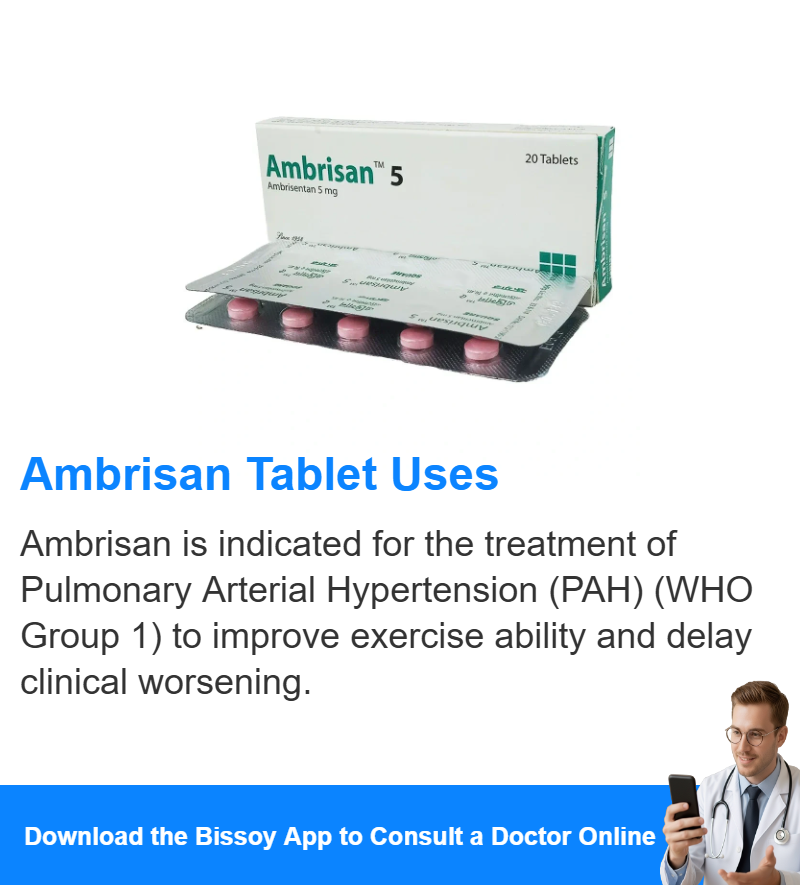
Ambrisan Tablet 5 mg is an orally active selective type A endothelin receptor antagonist indicated for the treatment of pulmonary arterial hypertension. It is approved in Europe, Canada and the United States for use as a single agent to improve exercise ability and delay clinical worsening. In addition, it is approved in the United States for use in combination with tadalafil to reduce the risks of disease progression, hospitalization and to improve exercise ability. Studies establishing the efficacy of Ambrisan Tablet 5 mg included patients with both idiopathic or heritable pulmonary arterial hypertension and those with pulmonary arterial hypertension associated with connective tissue diseases. Patients studied displayed symptoms and etiologies predominantly of WHO Functional Class II-III. As an endothelin receptor antagonist, Ambrisan Tablet 5 mg prevents endogenous endothelin peptide from constricting the muscles in blood vessels, allowing them to relax and permit a reduction in blood pressure.
Uses
Ambrisan Tablet 5 mg is a selective type A endothelin receptor antagonist used to treat primary pulmonary arterial hypertension and pulmonary arterial hypertension based on diagnostic classifications.
Ambrisan Tablet 5 mg is indicated for treatment of idiopathic (‘primary’) pulmonary arterial hypertension (IPAH) and pulmonary arterial hypertension (PAH) associated with connective tissue disease in patients with WHO functional class II or III symptoms. In the United States of America, ambrisentan is also indicated in combination with tadalafil to reduce the risks of disease progression and hospitalization for worsening PAH, and to improve exercise ability.
Associated Conditions
Pharmacodynamics
Ambrisan Tablet 5 mg 10 mg daily had no significant effect on the QTc interval, whereas a 40 mg daily dose of ambrisentan increased mean QTc at tmax by 5 ms with an upper 95% confidence limit of 9 ms. Significant QTc prolongation is not expected in patients taking ambrisentan without concomitant metabolic inhibitors. Plasma concentrations of B-type natriuretic peptide (BNP) in patients who received ambrisentan for 12 weeks were significantly decreased. Two Phase III placebo-controlled studies demonstrated a decrease in BNP plasma concentrations by 29% in the 2.5 mg group, 30% in the 5 mg group, and 45% in the 10 mg group (p < 0.001 for each dose group) and an increase by 11% in the placebo group.
Mechanism of Action
Endothelin-1 (ET-1) is an endogenous peptide that acts on the endothelin type A (ETA) and endothelin type B (ETB) receptors in vascular smooth muscle and endothelium. ETA-mediated actions include vasoconstriction and cell proliferation, whereas ETB predominantly mediates vasodilation, anti-proliferation, and ET-1 clearance. In patients with pulmonary arterial hypertension, ET-1 levels are increased and correlate with increased right arterial pressure and severity of disease. Ambrisan Tablet 5 mg is one of several newly developed vasodilator drugs that selectively target the endothelin type A (ETA) receptor, inhibiting its action and preventing vasoconstriction. Selective inhibition of the ETA receptor prevents phospholipase C-mediated vasoconstriction and protein kinase C-mediated cell proliferation. Endothelin type B (ETB) receptor function is not significantly inhibited, and nitric oxide and prostacyclin production, cyclic GMP- and cyclic AMP-mediated vasodilation, and endothelin-1 (ET-1) clearance is preserved.
Absorption
Ambrisan Tablet 5 mg is rapidly absorbed with peak plasma concentrations occuring around 2 hours after oral administration. Cmax and AUC increase proportionally with dose across the therapeutic dosing range. Absolute oral bioavailability of ambrisentan is unknown. Absorption is not affected by food.
Volume of Distribution
Ambrisan Tablet 5 mg has a low distribution into red blow cells, with a mean blood:plasma ratio of 0.57 and 0.61 in males and females, respectively.
Protein Binding
Ambrisan Tablet 5 mg is 99% plasma protein bound, primarily to albumin (96.5%) and to a lesser degree alpha1-acid glycoprotein.
Route of Elimination
Ambrisan Tablet 5 mg is primarily cleared by non-renal pathways. Along with its metabolites, ambrisentan is primarily found in the feces following hepatic and/or extra-hepatic metabolism. Approximately 22% of the administered dose is recovered in the urine following oral administration with 3.3% being unchanged ambrisentan.
Half Life
Ambrisan Tablet 5 mg has a terminal half-life of 15 hours. It is thought that steady state is achieved after around 4 days of repeat-dosing.
Clearance
The mean oral clearance of ambrisentan was found to be 38 mL/min in healthy subjects and 19 mL/min in patients with pulmonary artery hypertension.
Toxicity
Ambrisan Tablet 5 mg is teratogenic and has a high risk of embryo-fetal toxicity. LD50 was found to be greater than or equal to 3160 mg/kg when studied in rats. There was no evidence of carcinogenic potential in 2 year oral daily dosing studies in rats and mice.
Food Interactions
No interactions found.
Dosage
Pediatric patients: The safety and effectiveness of Ambrisan Tablet 5 mg in pediatric patients have not been established.