Introduction
Benign prostatic hyperplasia (BPH) refers to a benign growth or hyperplasia of the prostate and leads to lower urinary tract symptoms in men, such as urgency, frequency and changes to urine flow. The prevalence of BPH is as high as 50%-60% for males in their 60's, and this prevalence increases to 80%-90% of those over 70. Alfuzosin is an alpha-1 adrenergic blocker used in the symptomatic treatment of BPH that works by relaxing the muscles in the prostate and bladder neck.
Uses
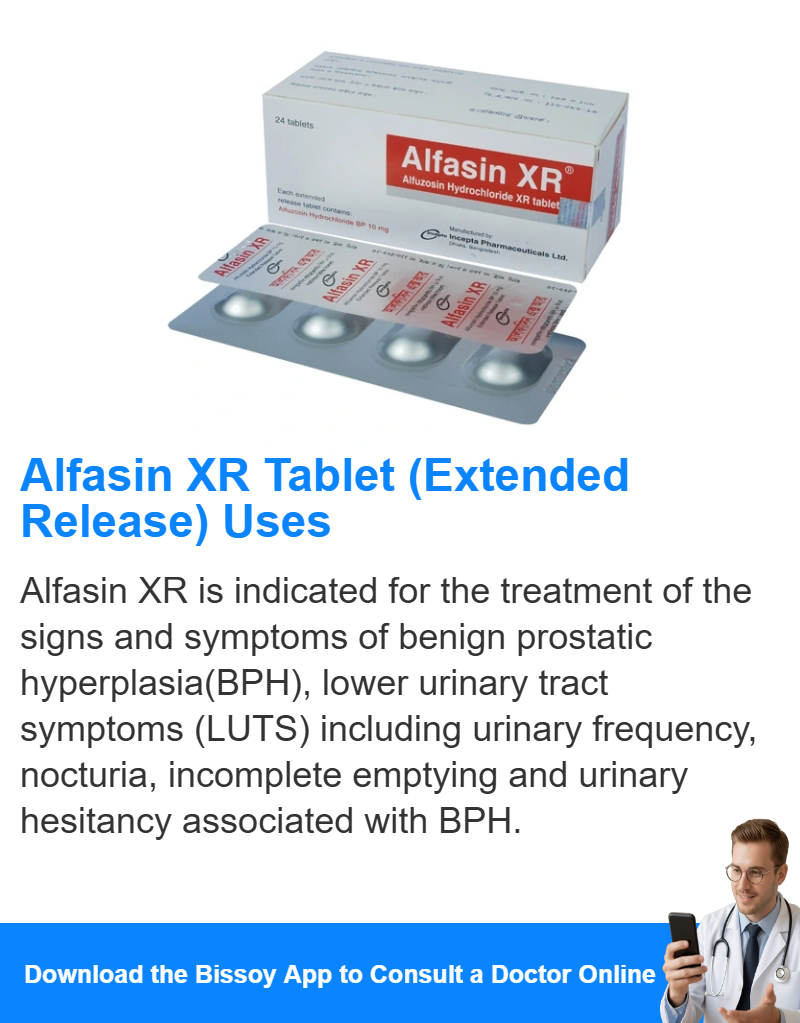
Alfuzosin is an alpha-1 adrenergic antagonist used in the symptomatic management of benign prostatic hypertrophy (BPH).
Alfuzosin is used to treat the signs and symptoms of benign prostatic hyperplasia (BPH).
Associated Conditions
Pharmacodynamics
By selectively inhibiting alpha adrenergic receptors in the lower urinary tract, alfuzosin causes smooth muscle relaxation in the bladder neck and prostate, improving urine flow, thereby reducing BPH symptoms. Additionally, alfuzosin reduces the vasoconstrictor effect of catecholamines (epinephrine and norepinephrine), leading to peripheral vasodilation. This leads to a risk of postural hypotension/syncope, and prescribing information warns that caution should be exercised in patients who take nitrates, antihypertensives, or have experienced decreased blood pressure after using other medications.
Mechanism of Action
Alpha(1)-adrenoreceptors are found in the prostate, bladder base, bladder neck, prostatic capsule, and prostatic urethra; their activation may lead to contraction of smooth muscle and urinary symptoms in patients with BPH. Alfuzosin selectively binds to and inhibits alpha(1)-adrenergic receptors in the lower urinary tract. This leads to the relaxation of smooth muscle in both the prostate and bladder neck, resulting in the improvement in urine flow and a reduction of urinary symptoms.
Absorption
Alfuzosin is readily absorbed in the gastrointestinal tract and the absolute bioavailability under fed conditions is 49%. In patients over 75 years of age, alfuzosin is absorbed more rapidly and peak plasma levels are higher. One source mentions a bioavailability of 64%. After multiple doses under fed conditions, Cmax is achieved in 8 hours. Cmax and AUC0-24 values are about 13.6 ng/mL and 194 ng·h/mL, respectively. Steady-state plasma concentrations are achieved after the second dose and are 1.2 to 1.6 times higher than after a single dose. With the extended-release formulation, alfuzosin release is sustained over 20 hours with a rate of dissolution ranging between 2 and 12 hours.
Volume of Distribution
The volume of distribution of alfuzosin after intravenous administration in healthy volunteers is about 3.2 L/kg. Alfuzosin distributes heavily to the tissues of the prostate.
Protein Binding
The protein biding of alfuzosin is moderate and ranges from 82% to 90%. Alfuzosin is 68.2% bound to human serum albumin and 52.5% bound to human serum alpha-glycoprotein.
Route of Elimination
It is partially metabolised and excreted mainly in the bile and faeces. Following oral administration of a radiolabeled alfuzosin solution, the detection of radioactivity after one week was 69% in the feces and 24% in the urine.
Half Life
The apparent elimination half-life of alfuzosin after oral administration is about 10 hours. The terminal half-life is 3-5 hours.
Clearance
Exercise caution if renal clearance is < 30 mL/min. The clearance of alfuzosin is increased in renal insufficiency (with or without dialysis), due to an increase in the free fraction.
Toxicity
The oral LD50 of alfuzosin is 2300 mg/kg in male mice and 1950 mg/kg in female mice. An overdose of alfuzosin can cause hypotension. Cardiovascular support should be initiated immediately. The patient should be kept in the supine position to aid in restoring pressure and managing heart rate. Fluid resuscitation should also be considered in severe cases; sometimes, vasopressors are required. Renal function should be monitored frequently. Dialysis may not be of benefit to alfuzosin protein binding of up to 90%.
Food Interactions
- Take after a meal. Take alfuzosin after the same meal everyday. Do not take on an empty stomach.
Dosage
Acute urinary retention (AUR): In patients 65 years and older, 10 mg daily after a meal to be taken from the first day of catheterisation. The treatment should be administered for 3-4 days, 2-3 days during catheterisation and 1 day after its removal. In this indication no benefit has been established in patients under 65 years of age or if treatment is extended beyond 4 days.