Introduction

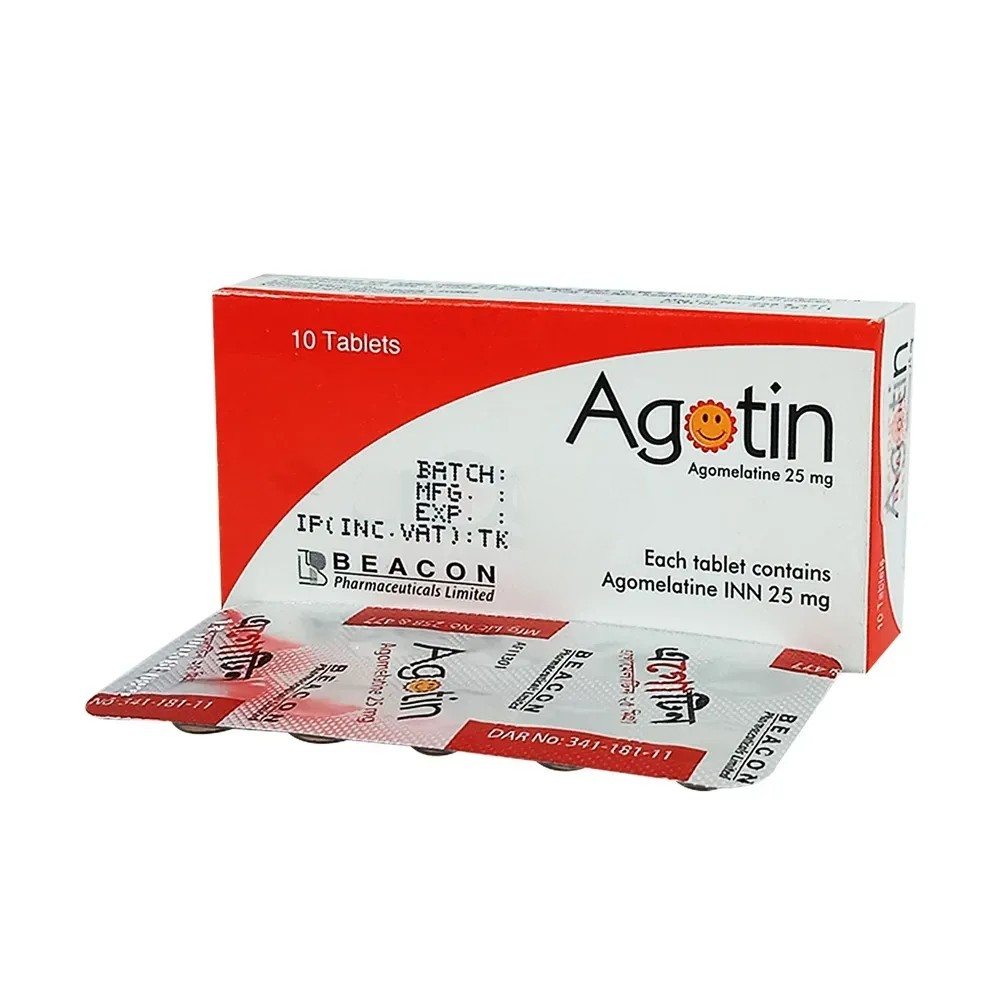
Agorest Tablet 25 mg is an antidepressant medication primarily used for the treatment of major depressive disorder (MDD). It acts as a melatonergic agonist and a selective serotonin receptor antagonist, which distinguishes it from many other commonly used antidepressants. Agorest Tablet 25 mg is known for its ability to regulate circadian rhythms, making it particularly useful for patients with sleep disturbances associated with depression.

Uses

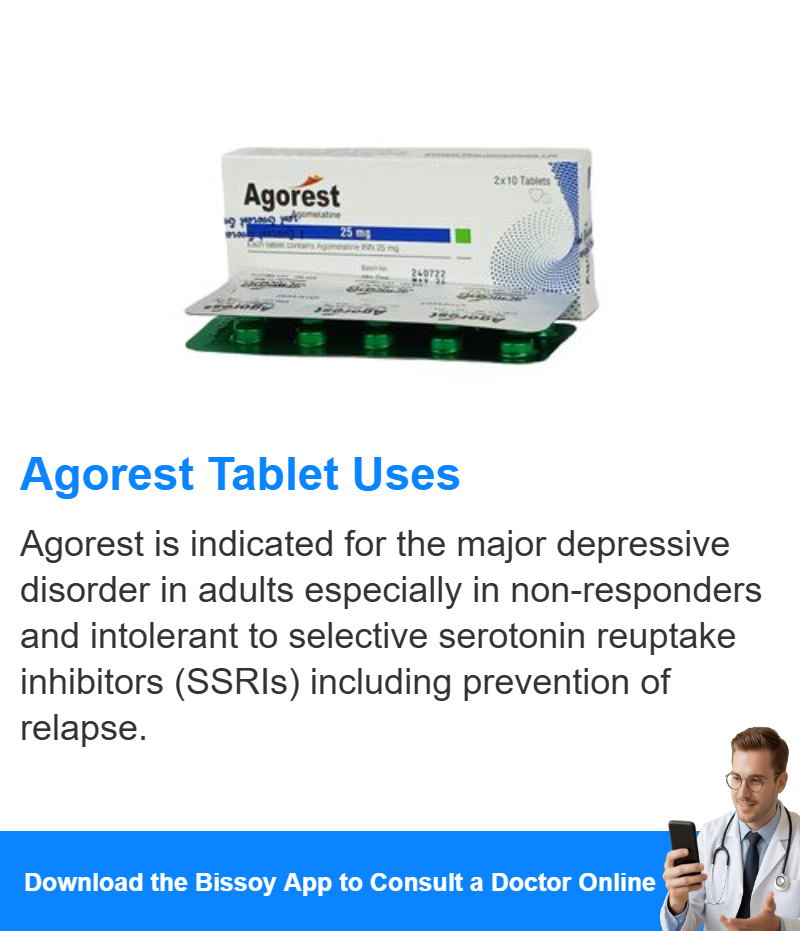
Agorest Tablet 25 mg is indicated for the treatment of major depressive episodes in adults. It may be particularly beneficial for patients with depression who experience sleep disturbances, such as difficulty falling asleep or maintaining sleep, and those with mood fluctuations related to circadian rhythm disruptions.

Brand Name Agorest
Type Tablet
Weight 25 mg
Generic Agomelatine
Manufacturer Everest Pharmaceuticals Ltd.
Available in English বাংলা

Mechanism of Action

Agorest Tablet 25 mg acts as an agonist at melatonin MT1 and MT2 receptors, which are involved in the regulation of circadian rhythms and sleep-wake cycles. It also acts as an antagonist at the serotonin 5-HT2C receptor, which helps increase the release of dopamine and norepinephrine in the frontal cortex, contributing to its antidepressant effects. Unlike traditional SSRIs, it does not affect serotonin reuptake directly.

How Long Does It Take to Work?

The antidepressant effects of Agorest Tablet 25 mg typically begin to manifest within 1-2 weeks of starting treatment, with full therapeutic effects generally seen after 4-6 weeks. Improvements in sleep patterns may be observed earlier in treatment, often within the first week.

Absorption

Agorest Tablet 25 mg is rapidly absorbed following oral administration, with peak plasma concentrations reached within 1-2 hours. However, its absolute bioavailability is low (around 4%) due to extensive first-pass metabolism in the liver. Food intake can decrease the absorption slightly but not significantly enough to warrant specific timing around meals.

Route of Elimination

Agorest Tablet 25 mg is primarily metabolized by the liver via cytochrome P450 enzymes (CYP1A2, with minor contributions from CYP2C9 and CYP2C19). The metabolites are mainly excreted in the urine, with less than 1% of the dose excreted unchanged.

Dosage

The effective dose of agomelatine is 25 mg per day given once at bed time for two weeks and can be increased to 50 mg per day in patients with inadequate response. Night time dosing is recommended because agomelatine improves the quality of sleep without day time sedation. For oral administration with or without food. Most adult patients should take a dosage of 25 mg (one tablet) daily. It is usually taking prior to bed time. If no improvement is noticed after two weeks, the dosage can be increased to 50 mg (two tablets) daily.

Children under 18 years: Should be given only on medical advice.

Use in children and adolescents: Agomelatine is not recommended in the treatment of depression in patients <18 years since safety and efficacy of agomelatine have not been established in this age group. In clinical trials among children and adolescents treated with other antidepressants, suicide-related behavior (suicide attempt and suicidal thoughts), and hostility (predominantly aggression, oppositional behavior and anger) were more frequently observed compared to those treated with placebo.

Use in the elderly: The efficacy and safety of agomelatine (25 to 50 mg/day) have been established in elderly patients with MDD (aged <75 years). As  efficacy has not been established in every elder patients aged >75 years agomelatine should not be used in this patient group.
The recommended starting dose of Agorest Tablet 25 mg is 25 mg taken orally once daily at bedtime. If no improvement is observed after two weeks, the dose may be increased to 50 mg once daily at bedtime. Dose adjustments should be made based on the patient's response and tolerability. Liver function tests should be performed before starting treatment and periodically thereafter.

Administration

Agorest Tablet 25 mg is administered orally, typically at bedtime to align with its sleep-promoting effects. It can be taken with or without food. Patients should be advised to follow a regular schedule and take the medication as prescribed by their healthcare provider.

Side Effects

Common side effects of Agorest Tablet 25 mg include:

  • Headache
  • Dizziness
  • Nausea
  • Fatigue
  • Insomnia or abnormal dreams
Less common but more serious side effects may include hepatotoxicity, elevated liver enzymes, and, in rare cases, liver failure. Regular monitoring of liver function is required during treatment.

Toxicity

Overdose with Agorest Tablet 25 mg is rare but can cause symptoms such as drowsiness, upper abdominal pain, nausea, anxiety, or mild agitation. There is no specific antidote for Agorest Tablet 25 mg overdose, and treatment is primarily supportive, with close monitoring of liver function and vital signs.

Precautions

Patients with liver impairment or a history of hepatic disease should avoid Agorest Tablet 25 mg due to the risk of hepatotoxicity. Liver function tests should be performed before starting treatment and regularly during therapy. Patients should also be monitored for symptoms of liver damage, such as jaundice, dark urine, or persistent fatigue. Caution is advised in patients who consume excessive alcohol or use other hepatotoxic medications.

Interaction

Agorest Tablet 25 mg is metabolized primarily by CYP1A2, and concurrent use of inhibitors or inducers of this enzyme can affect its metabolism. Strong CYP1A2 inhibitors (such as fluvoxamine or ciprofloxacin) may increase Agorest Tablet 25 mg levels and the risk of toxicity. Inducers of CYP1A2 (such as smoking) may reduce its efficacy. Combining Agorest Tablet 25 mg with other central nervous system depressants should be done with caution due to the potential for additive effects.

Disease Interaction

Agorest Tablet 25 mg should be used cautiously in patients with hepatic impairment or a history of liver disease due to its potential to cause liver injury. It is also contraindicated in patients with severe hepatic impairment.

Drug Interaction

Notable drug interactions with Agorest Tablet 25 mg include:

  • Fluvoxamine: Strong CYP1A2 inhibitor that significantly increases Agorest Tablet 25 mg levels, increasing the risk of adverse effects.
  • Ciprofloxacin: Another CYP1A2 inhibitor that can increase Agorest Tablet 25 mg levels.
  • Estrogens: Can increase plasma concentrations of Agorest Tablet 25 mg by inhibiting CYP1A2.
  • Smoking: Cigarette smoke induces CYP1A2 and can reduce the effectiveness of Agorest Tablet 25 mg.

Food Interactions

Food has a minimal effect on the absorption of Agorest Tablet 25 mg, though it may slightly delay the time to peak plasma concentration. It can be taken with or without food.

Pregnancy Use

There is limited data on the use of Agorest Tablet 25 mg in pregnancy. Animal studies have not shown significant risk to the fetus, but adequate human studies are lacking. Agorest Tablet 25 mg should be used during pregnancy only if the potential benefits outweigh the risks, and it should be closely monitored.

Lactation Use

It is unknown whether Agorest Tablet 25 mg is excreted in human breast milk. Given the lack of data, caution is advised when prescribing Agorest Tablet 25 mg to breastfeeding mothers. A risk-benefit assessment should be conducted before use during lactation.

Acute Overdose

In cases of acute overdose, supportive treatment should be initiated, with close monitoring of vital signs and liver function. Symptoms of overdose may include drowsiness, dizziness, and gastrointestinal symptoms such as nausea and abdominal pain. There is no specific antidote for Agorest Tablet 25 mg overdose.

Contraindication

Agorest Tablet 25 mg is contraindicated in patients with known hypersensitivity to the drug or any of its components. It is also contraindicated in patients with active liver disease or transaminase elevations more than three times the upper limit of normal. Additionally, Agorest Tablet 25 mg should not be used in combination with potent CYP1A2 inhibitors.

Use Direction

Patients should take Agorest Tablet 25 mg as directed by their healthcare provider, typically at bedtime. They should be instructed to adhere to regular liver function monitoring and report any symptoms of liver injury, such as jaundice or persistent fatigue, immediately. Patients should also be informed of potential drug interactions and advised to avoid excessive alcohol consumption during treatment.

Storage Conditions

Agorest Tablet 25 mg should be stored at room temperature, between 15°C and 30°C (59°F and 86°F), away from moisture and heat. It should be kept out of reach of children and should not be used after the expiration date.

Volume of Distribution

Agorest Tablet 25 mg has a volume of distribution of approximately 35 L, indicating moderate distribution into tissues. It is lipophilic and can cross the blood-brain barrier, allowing it to exert effects within the central nervous system.

Half-Life

The elimination half-life of Agorest Tablet 25 mg is relatively short, approximately 1-2 hours. Despite its short half-life, its therapeutic effects are sustained due to its action on melatonin receptors and the serotonin system.

Clearance

Agorest Tablet 25 mg is rapidly cleared from the systemic circulation, with a clearance rate of approximately 1,100 mL/min. Its clearance is primarily hepatic, with metabolism via the CYP1A2 pathway.

See in details version Agorest Tablet 25 mg also Agorest Tablet 25 mg in bangla

Social card

Uses

Some Frequently Asked Questions About Agorest Tablet 25 mg

*** Taking medicines without doctor's advice can cause long-term problems.
Dr. Md. Moshrekul Islam Moni

Dr. Md. Moshrekul Islam Moni

General, Colorectal, Breast & Orthopedic Surgeon

Call Doctor
Dr. Tanveen Kamal

Dr. Tanveen Kamal

Brain, Nerve & Spine Specialist Surgeon

Call Doctor
Dr. Suman Kumar Roy

Dr. Suman Kumar Roy

Hip, Knee, Joint Replacement, Hand & Pediatric Orthopedic Surgeon

Call Doctor
Related Medicines