Introduction
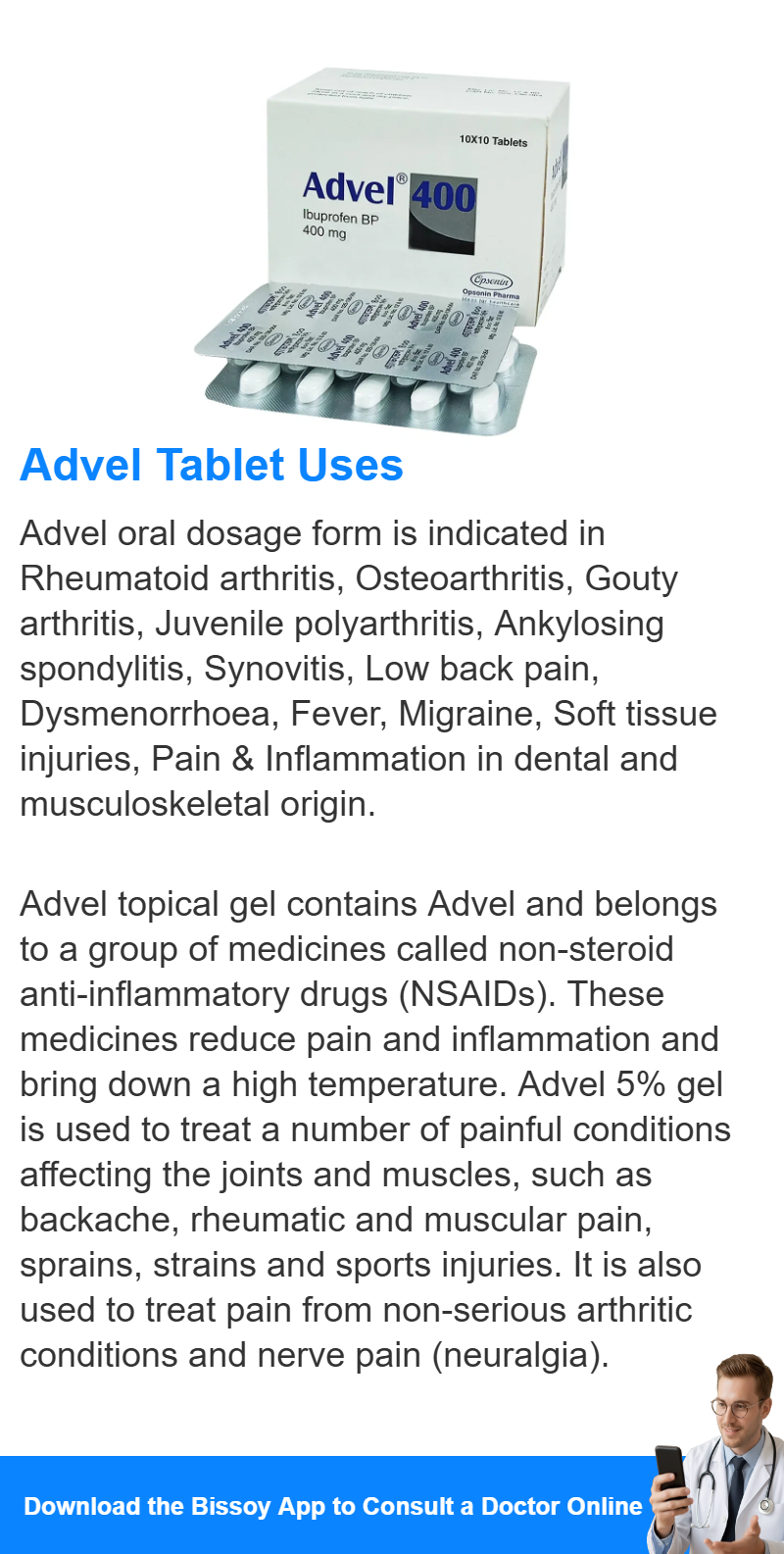
Advel Tablet 400 mg is a non-steroidal anti-inflammatory drug (NSAID) derived from propionic acid and it is considered the first of the propionics. The formula of ibuprofen is 2-(4-isobutylphenyl) propionic acid and its initial development was in 1960 while researching for a safer alternative for aspirin. Advel Tablet 400 mg was finally patented in 1961 and this drug was first launched against rheumatoid arthritis in the UK in 1969 and USA in 1974. It was the first available over-the-counter NSAID.
On the available products, ibuprofen is administered as a racemic mixture. Once administered, the R-enantiomer undergoes extensive interconversion to the S-enantiomer in vivo by the activity of the alpha-methylacyl-CoA racemase. In particular, it is generally proposed that the S-enantiomer is capable of eliciting stronger pharmacological activity than the R-enantiomer.
Uses
Advel Tablet 400 mg is an NSAID and non-selective COX inhibitor used to treat mild-moderate pain, fever, and inflammation.
Advel Tablet 400 mg is the most commonly used and prescribed NSAID. It is very common over the counter medication widely used as an analgesic, anti-inflammatory and antipyretic.
The use of ibuprofen and its enantiomer Dexibuprofen in a racemic mix is common for the management of mild to moderate pain related to dysmenorrhea, headache, migraine, postoperative dental pain, spondylitis, osteoarthritis, rheumatoid arthritis, and soft tissue disorder.
Due to its activity against prostaglandin and thromboxane synthesis, ibuprofen has been attributed to alteration of platelet function and prolongation of gestation and labor.
As ibuprofen is a widely used medication, the main therapeutic indications are:
Patent Ductus Arteriosus - it is a neonatal condition wherein the ductus arteriosus (blood vessel that connects the main pulmonary artery to the proximal descending aorta) fails to close after birth causing severe risk of heart failure. The prostaglandin inhibition of ibuprofen has been studied for the treatment of this condition as it is known that prostaglandin E2 is responsible for keeping the ductus arteriosus open.
Rheumatoid- and osteo-arthritis - ibuprofen is very commonly used in the symptomatic treatment of inflammatory, musculoskeletal and rheumatic disorders.
Cystic fibrosis - the use of high dosages of ibuprofen has been proven to decrease inflammation and decreasing polymorphonuclear cell influx in the lungs.
Orthostatic hypotension - ibuprofen can induce sodium retention and antagonize the effect of diuretics which has been reported to be beneficial for patients with severe orthostatic hypotension.
Dental pain - ibuprofen is used to manage acute and chronic orofacial pain.
Minor pain - ibuprofen is widely used to reduce minor aches and pains as well as to reduce fever and manage dysmenorrhea. It is very commonly used for the relief of acute indications such as fever and tension headaches.
Investigational uses - efforts have been put into developing ibuprofen for the prophylaxis of Alzheimer's disease, Parkinson disease, and breast cancer.
Associated Conditions
Pharmacodynamics
Advel Tablet 400 mg has multiple actions in different inflammatory pathways involved in acute and chronic inflammation. The main effects reported in ibuprofen are related to the control of pain, fever and acute inflammation by the inhibition of the synthesis of prostanoids by COX-1 and COX-2. Pain relief is attributed to peripheral affected regions and central nervous system effects in the pain transmission mediated by the dorsal horn and higher spinothalamic tract. Some reports have tried to link the pain regulation with a possible enhancement on the synthesis of endogenous cannabinoids and action on the NMDA receptors. The effect on pain has been shown to be related to the cortically evoked potentials.
The antipyretic effect is reported to be linked to the effect on the prostanoid synthesis due to the fact that the prostanoids are the main signaling mediator of pyresis in the hypothalamic-preoptic region.
The use of ibuprofen in dental procedures is attributed to the local inhibition of prostanoid production as well as to anti-oedemic activity and an increase of plasma beta-endorphins. Some reports have suggested a rapid local reduction of the expression of COX-2 in dental pulp derived by the administration of ibuprofen.
The administration of ibuprofen in patients with rheumatic diseases has shown to control joint symptoms.
Advel Tablet 400 mg is largely used in OTC products such as an agent for the management of dysmenorrhea which has been proven to reduce the amount of menstrual prostanoids and to produce a reduction in the uterine hypercontractility. As well, it has been reported to reduce significantly the fever and the pain caused by migraines. This effect is thought to be related to the effect on platelet activation and thromboxane A2 production which produces local vascular effects in the affected regions. This effect is viable as ibuprofen can enter in the central nervous system.
In the investigational uses of ibuprofen, it has been reported to reduce neurodegeneration when given in low doses over a long time. On the other hand, its use in Parkinson disease is related to the importance of inflammation and oxidative stress in the pathology of this condition. The use of ibuprofen for breast cancer is related to a study that shows a decrease of 50% in the rate of breast cancer.
Mechanism of Action
The exact mechanism of action of ibuprofen is unknown. However, ibuprofen is considered an NSAID and thus it is a non-selective inhibitor of cyclooxygenase, which is an enzyme involved in prostaglandin (mediators of pain and fever) and thromboxane (stimulators of blood clotting) synthesis via the arachidonic acid pathway.
Advel Tablet 400 mg is a non-selective COX inhibitor and hence, it inhibits the activity of both COX-1 and COX-2. The inhibition of COX-2 activity decreases the synthesis of prostaglandins involved in mediating inflammation, pain, fever, and swelling while the inhibition of COX-1 is thought to cause some of the side effects of ibuprofen including GI ulceration.
Absorption
It is very well absorbed orally and the peak serum concentration can be attained in 1 to 2 hours after extravascular administration. When ibuprofen is administered immediately after a meal there is a slight reduction in the absorption rate but there is no change in the extent of the absorption.
When orally administered, the absorption of ibuprofen in adults is very rapidly done in the upper GI tract. The average Cmax, Tmax and AUC ranges around 20 mcg/ml, 2 h and 70 mcg.h/ml. These parameters can vary depending on the enantiomer form, route, and dose of administration.
Volume of Distribution
The apparent volume of distribution of ibuprofen is of 0.1 L/kg.
Protein Binding
Advel Tablet 400 mg dosage is more than 99% bound to plasma proteins and site II of purified albumin, binding appears to be saturable and becomes non-linear at concentrations exceeding 20 mcg/ml.
Route of Elimination
Advel Tablet 400 mg is rapidly metabolized and eliminated in the urine thus, this via accounts for more than 90% of the administered dose. It is completely eliminated in 24 hours after the last dose and almost all the administered dose goes through metabolism, representing about 99% of the eliminated dose. The biliary excretion of unchanged drug and active phase II metabolites represents 1% of the administered dose.
In summary, ibuprofen is excreted as metabolites or their conjugates. The elimination of ibuprofen is not impaired by old age or the presence of renal impairment.
Half Life
The serum half-life of ibuprofen is 1.2-2 hours. In patients with a compromised liver function, the half-life can be prolonged to 3.1-3.4 hours.
Clearance
The clearance rate ranges between 3-13 L/h depending on the route of administration, enantiomer type and dosage.
Toxicity
The symptoms of overdose are presented in individuals that consumed more than 99 mg/kg. Most common symptoms of overdose are abdominal pain, nausea, vomiting, lethargy, vertigo, drowsiness (somnolence), dizziness and insomnia. Other symptoms of overdose include headache, loss of consciousness, tinnitus, CNS depression, convulsions and seizures. May rarely cause metabolic acidosis, abnormal hepatic function, hyperkalemia, renal failure, dyspnea, respiratory depression, coma, acute renal failure, and apnea (primarily in very young pediatric patients).
The reported LD50 of ibuprofen is of 636 mg/kg in rat, 740 mg/kg in mouse and 495 mg/kg in guinea pig.
Food Interactions
- Avoid alcohol.
- Take with food. Food reduces irritation.
Dosage
Adults: The dose is initially, 400 mg 3 times daily. A dose of 2400 mg daily should not be exceeded.
Children:
- 3-6 months (body-weight over 5 kg): ½ tsp (2.5 ml) 3 times daily; max. 30 mg/kg daily in 3-4 divided doses.
- 6 months-1 year: ½ tsp (2.5 ml) 3-4 times daily; max. 30 mg/kg daily in 3-4 divided doses.
- 1-4 years: 1 tsp (5 ml) 3 times daily; max. 30 mg/kg daily in 3-4 divided doses.
- 4-7 years: 1½ tsp (7.5 ml) 3 times daily; max. 30 mg/kg daily in 3-4 divided doses.
- 7-10 years: 2 tsp (10 ml) 3 times daily; upto 30 mg/kg (max. 2.4 gm) daily in 3-4 divided doses.
- 10-12 years: 3 tsp (15 ml) 3 times daily; upto 30 mg/kg (max. 2.4 gm) daily in 3-4 divided doses.
In juvenile rheumatoid arthritis: up to 30-40 mg/kg of body weight daily in 3-4 divided doses may be taken or as directed by the physician.
Topical gel:
Adults: Squeeze 4 to 10cm (i.e. 1.6 to 4 inches) of gel from the tube on affected area. Massage until absorbed. This dose should not be repeated more frequently than every four hours and no more than four times a day in any 24 hour period. The amount of gel squeezed would be equivalent to 50 to 125 mg of ibuprofen. Advel Tablet 400 mg 5% gel should only be used on healthy, unbroken skin. Do not use it on or near cuts or grazes or under dressings such as plasters. Also, do not use it on the genital area. Do not let any gel come in contact with your eyes. If it does, rinse your eyes with cold water and consult your doctor. Hands should be washed after applying Advel Tablet 400 mg 5% gel, unless they are the site of treatment. If the condition does not improve after two weeks use, or becomes worse at any time, speak to your doctor or pharmacist.
Use in children: Advel Tablet 400 mg 5% gel is not recommended for use in children under 12 years.