Introduction
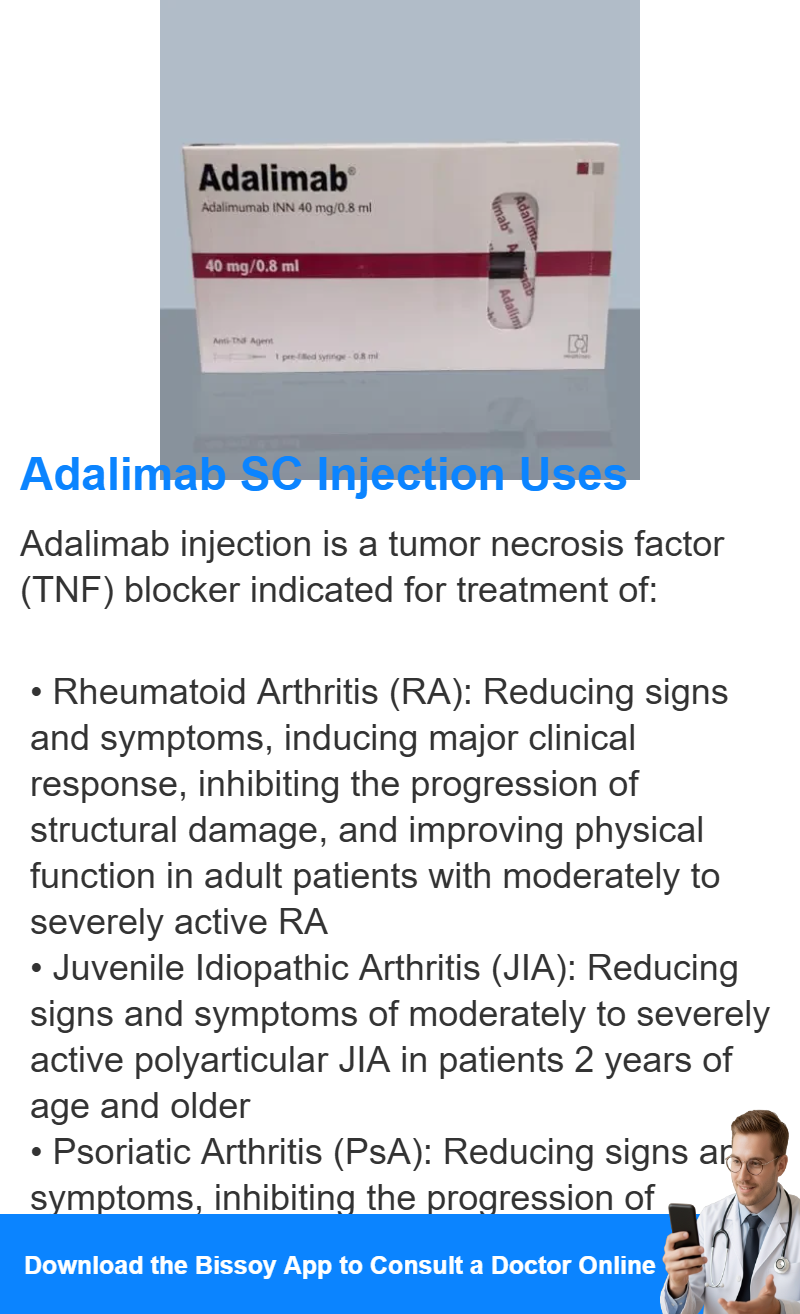
Adalimab SC Injection 40 mg/0.8 ml is a subcutaneously administered biological disease modifier for the treatment of rheumatoid arthritis and other chronic debilitating diseases mediated by tumor necrosis factor. This drug is frequently known as Humira. It is produced by recombinant DNA technology using a mammalian cell expression system. This drug is available in a prefilled syringe form and convenient pen form for subcutaneous self-administered doses.
Uses
Adalimab SC Injection 40 mg/0.8 ml is a monoclonal anti-tumor necrosis factor alpha antibody used in the treatment of a wide variety of inflammatory conditions such as rheumatoid arthritis, Crohn's disease, and ankylosing spondylitis.
The following are conditions for which adalimumab has been indicated , , , , , .
Rheumatoid Arthritis (Moderate to Severe)
Juvenile Idiopathic Arthritis (Moderately to Severely Active)
Psoriatic Arthritis (Active)
Ankylosing Spondylitis (Active)
Crohn’s Disease (Moderately to Severely Active)
Ulcerative Colitis (Moderately to Severely Active)
Plaque Psoriasis (Moderate to Severe Chronic)
Non-infectious Intermediate, Posterior and Panuveitis
Hidradenitis Suppurativa (Moderate to Severe)
Pyoderma Gangrenosum (off-label)
Associated Conditions
Pharmacodynamics
After treatment with adalimumab, a decrease in levels of acute phase reactant proteins of inflammation (C reactive protein [CRP] and erythrocyte sedimentation rate [ESR]) and serum cytokines (IL-6) was measured compared to baseline in patients diagnosed with rheumatoid arthritis. A decrease in CRP levels was also observed in patients diagnosed with Crohn’s disease. Serum levels of matrix metalloproteinases (MMP-1 and MMP-3) that lead to the tissue remodeling responsible for cartilage destruction were also found to be decreased after administration of adalimumab , . A reduction in signs and symptoms of disease, the induction of a clinical response, an inhibition of structural damage, and improvements in physical function in adult and pediatric patients with various inflammatory conditions have been demonstrated , , .
Mechanism of Action
Adalimab SC Injection 40 mg/0.8 ml binds with specificity to tumor necrosis factor-alpha (TNF-alpha) , and inhibits its interaction with the p55 and p75 cell surface TNF receptors. Adalimab SC Injection 40 mg/0.8 ml also lyses surface tumor necrosis factor expressing cells in vitro when in the presence of complement. Adalimab SC Injection 40 mg/0.8 ml does not bind or inactivate lymphotoxin (Tumor necrosis factor-beta). TNF is a naturally occurring cytokine that plays a role in normal inflammatory and immune responses . Increased levels of TNF are found in the joint synovial fluid of rheumatoid arthritis, psoriatic arthritis, and ankylosing spondylitis patients, and play an imperative role in pathologic inflammation and the joint destruction that are major complications of these diseases. Increased levels of TNF are also measured in psoriasis plaques. In plaque psoriasis, treatment with adalimumab may decrease the epidermal thickness and inflammatory cell infiltration. The relationship between these pharmacodynamics and the mechanism(s) by which adalimumab achieves its clinical effects is not known. Additionally, adalimumab alters biological responses that are induced/regulated by TNF, including changes in the levels of adhesion molecules responsible for leukocyte migration during inflammation (ELAM-1, VCAM-1, and ICAM-1 with an IC50 of 1-2 X 10⁻¹⁰M) .
Absorption
The maximum serum concentration (Cmax) and the time to reach the maximum concentration (Tmax) were 4.7 ± 1.6 μg/mL and 131 ± 56 hours respectively, following a single 40 mg subcutaneous administration of adalimumab to healthy adult subjects. The average absolute bioavailability of adalimumab estimated from three clinical studies after a single 40 mg subcutaneous dose of adalimumab was 64%. The pharmacokinetics of adalimumab showed a linear pattern over the dose range of 0.5 to 10.0 mg/kg following a single intravenous dose .
Volume of Distribution
The distribution volume (Vss) ranged from 4.7-6.0 L . Adalimab SC Injection 40 mg/0.8 ml concentrations in the synovial fluid from five rheumatoid arthritis patients ranged from 31-96% of those in serum .
Half Life
The mean terminal half-life was approximately 2 weeks, ranging from 10 to 20 days across studies .
Clearance
12 mL/hr [RA patients with dose 0.25-10 mg/kg] . Population pharmacokinetic analyses in patients with rheumatoid arthritis showed a trend toward a higher apparent clearance of adalimumab in the presence of anti-adalimumab antibodies, and a lower clearance with increasing age in patients aged 40 years old to greater than 75 years old .
Toxicity
Carcinogenesis, Mutagenesis, Impairment of Fertility
Long-term animal studies of adalimumab products have not been performed to study the carcinogenic potential or the drug's effect on fertility .
Refer to the "Adverse Effects" section for more information on adverse effects and "Blackbox Warnings" section for important black box information/warnings.
Rare side effects include: worsening or initiation of congestive heart failure, a lupus-like syndrome, lymphoma, medically significant cytopenias, and worsening or initiation of multiple sclerosis/neurological diseases. There has been reported pancytopenia and increased liver transaminases with the use of adalimumab, which suggests that laboratory value monitoring blood counts and liver function, at least intermittently, are important .
Food Interactions
No interactions found.
Dosage
Juvenile Idiopathic Arthritis:
- 10 kg to <15 kg: 10 mg every other week
- 15 kg to < 30 kg: 20 mg every other week
- ≥ 30 kg: 40 mg every other week
- Initial dose (Day 1): 160 mg (four 40 mg injections in one day or two 40 mg injections per day for two consecutive days).
- Second dose two weeks later (Day 15): 80 mg.
- Two weeks later (Day 29): Maintenance dose of 40 mg every other week.
- For patients with Ulcerative Colitis only: Adalimab SC Injection 40 mg/0.8 ml should only be continued in patients who have shown evidence of clinical remission by eight weeks (Day 57) of therapy.
- 17 kg to < 40 kg: Initial dose (Day 1): 80 mg (two 40 mg injections in one day) , Second dose two weeks later (Day 15): 40 mg , Two weeks later (Day 29): Maintenance dose of 20 mg every other week.
- ≥ 40 kg: Initial dose (Day 1): 160 mg (four 40 mg injections in one day or two 40 mg injections per day for two consecutive days) , Second dose two weeks later (Day 15): 80 mg (two 40 mg injections in one day) , Two weeks later (Day 29): Maintenance dose of 40 mg every other week.
- 80 mg initial dose, followed by 40 mg every other week starting one week after initial dose.
- Hidradenitis Suppurativa: Initial dose (Day 1): 160 mg (given as four 40 mg injection on Day 1 or as two 40 mg injections per day on Days 1 and 2, Second dose two weeks later (Day 15): 80 mg (two 40 mg injections in one day), Third (Day 29) and subsequent doses: 40 mg every week.