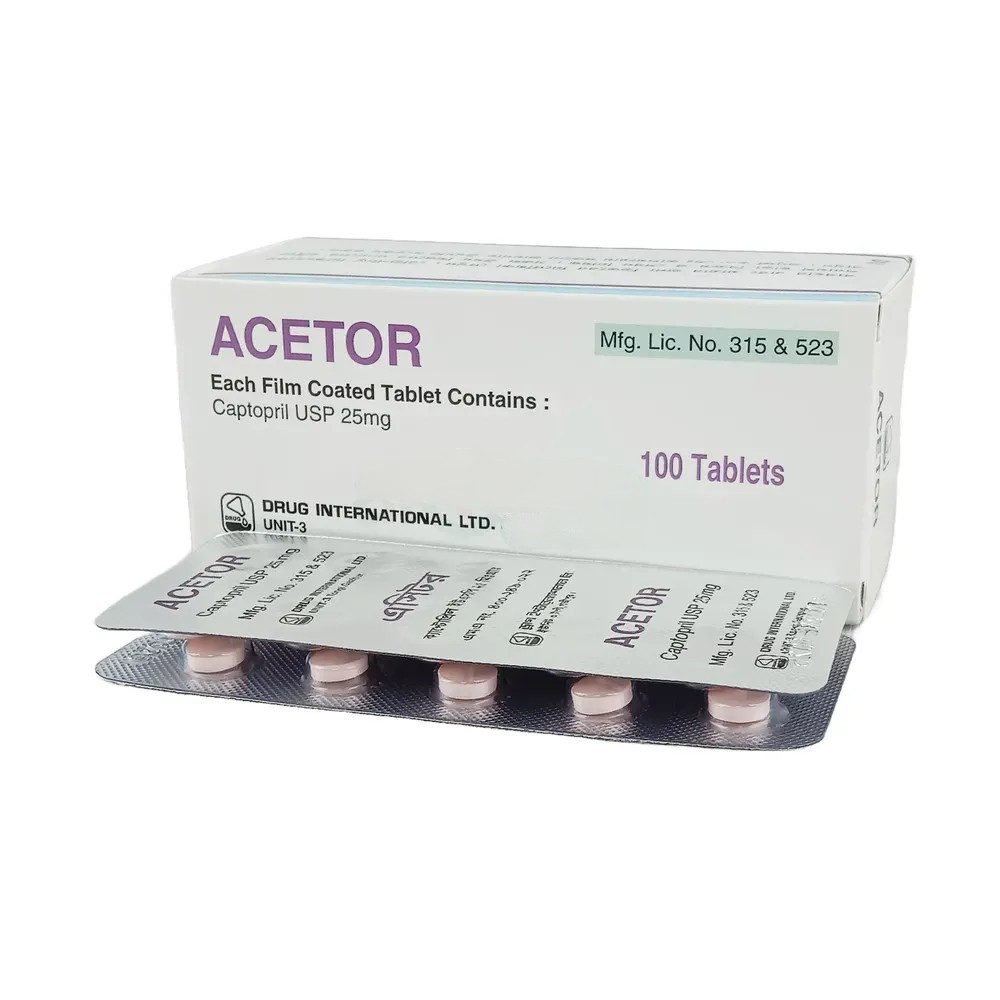
Acetor Tablet 25 mg Introduction

Acetor Tablet 25 mg is a prescription medication used to treat high blood pressure (also referred to as hypertension). It works by preventing certain enzymes that produce hormones from activating, thus helping to lower blood pressure. It can also be used to treat heart failure and kidney disorders in some cases.

Uses For Acetor Tablet 25 mg

Acetor Tablet 25 mg is most commonly used to treat high blood pressure (hypertension), but it can also be used for other conditions such as heart failure, kidney problems, and certain other types of hypertension.

Brand Name Acetor
Type Tablet
Weight 25 mg
Generic Captopril
Manufacturer Drug International Ltd.
Available in English বাংলা

Mechanism of Action

Acetor Tablet 25 mg works by blocking certain enzymes that are responsible for activating hormones, such as angiotensin II. This helps to lower blood pressure and helps to reduce the risk of heart attack or stroke in those with high blood pressure.

How Long Does It Take to Work?

Acetor Tablet 25 mg typically takes 2 to 4 weeks to fully take effect and is usually most effective after 8 to 12 weeks of use. It is important to continue taking the medication even if you start to feel better, as conditions can worsen without ongoing treatment.

Absorption

Acetor Tablet 25 mg is readily absorbed from the gastrointestinal tract, and peak blood concentrations are achieved in approximately 4 hours after administration.

Route of Elimination

Acetor Tablet 25 mg is primarily excreted unchanged in the urine. A small amount of the medication is metabolized in the liver.

Dosage

Adults:
Mild-to-moderate hypertension: The initial dose is 12.5 mg twice daily. The usual maintenance dose is 25mg twice daily which can be increased incrementally, at two to four week intervals, until a satisfactory response is achieved, to a maximum of 50 mg twice daily.

Severe hypertension: In severe hypertension the starting dose is 12.5 mg b.d. The dosage may be increased incrementally to a maximum of 50 mg t.d.s.

Heart failure: A starting dose of 6.25mg or 12.5mg may minimise a transient hypotensive effect. The usual maintenance dose is 25mg three times a day. The usual maximum dose is 150 mg daily.

Captopril must be taken 1 hour before meals to ensure maximum absorption.

Use in Child: Safety and effectiveness in pediatric patients have not been established.

The recommended starting dose of Acetor Tablet 25 mg is 12.5 mg to 25 mg orally once a day. Dosage should be adjusted based on the patient's response and tolerance. The typical daily dose ranges from 12.5 mg to 50 mg orally once a day. The maximum daily dose should not exceed 300 mg.

Administration

Acetor Tablet 25 mg should be taken with or immediately after a meal. The tablet should be swallowed whole. Do not crush or chew the tablets. It can be taken with or without food.

Side Effect

Common side effects of Acetor Tablet 25 mg include dizziness, headache, fatigue, dry cough, diarrhea, and blurred vision. Other potential side effects include rash, nausea, and increased potassium levels.

Toxicity

The most common side effects of Acetor Tablet 25 mg are generally mild and can be easily controlled with proper monitoring and use. However, overdosing on Acetor Tablet 25 mg can cause severe blood pressure reduction and in some cases can even be fatal.

Precaution

Acetor Tablet 25 mg should only be taken by patients with a confirmed diagnosis of hypertension or heart failure. Also, it should not be taken by patients with certain conditions, such as disease of the kidney or liver, allergies to sulfa drugs, pregnancy, or breastfeeding. Before taking Acetor Tablet 25 mg, let your doctor know about any other medications you are taking, as well as any medical conditions you may have.

Interaction

Acetor Tablet 25 mg may interact with other medications, including diuretics, ACE inhibitors, and potassium-sparing diuretics. It may also interact with certain supplements and herbal products. Therefore, it is important to talk to your doctor or pharmacist before taking Acetor Tablet 25 mg or any other medications, supplements, or herbs.

Disease Interaction

Acetor Tablet 25 mg should not be taken by patients with certain conditions, such as disease of the kidney or liver, allergies to sulfa drugs, high levels of potassium in the blood, narrowing of the arteries, or if you are pregnant or breastfeeding. Talk to your doctor before taking Acetor Tablet 25 mg if you have any of these conditions.

Drug Interaction

Acetor Tablet 25 mg may interact with other medications, including diuretics, ACE inhibitors, and potassium-sparing diuretics. It can also interact with certain supplements and herbal products. Therefore, it is important to talk to your doctor or pharmacist before taking Acetor Tablet 25 mg or any other medications, supplements, or herbs.

Food Interactions

Acetor Tablet 25 mg should be taken with or without food. Certain foods may decrease the effectiveness or absorption of Acetor Tablet 25 mg. Talk to your doctor if you have any questions regarding food and medication interactions.

Pregnancy Use

Acetor Tablet 25 mg should not be taken by pregnant women. It can cause serious birth defects. Talk to your doctor if you are pregnant or plan to become pregnant before taking Acetor Tablet 25 mg.

Lactation Use

Acetor Tablet 25 mg should not be taken by breastfeeding women. It can pass into breast milk, so talk to your doctor if you are breastfeeding before taking Acetor Tablet 25 mg.

Acute Overdose

Signs of an acute overdose of Acetor Tablet 25 mg include low blood pressure, irregular heartbeat, and confusion. Seek medical attention immediately if you take too much Acetor Tablet 25 mg.

Contraindication

Acetor Tablet 25 mg should not be taken by patients with certain conditions, such as disease of the kidney or liver, allergies to sulfa drugs, high levels of potassium in the blood, narrowing of the arteries, or if you are pregnant or breastfeeding. Talk to your doctor before taking Acetor Tablet 25 mg if you have any of these conditions.

Use Direction

The recommended starting dose of Acetor Tablet 25 mg is 12.5 mg to 25 mg orally once a day. Dosage should be adjusted based on the patient's response and tolerance. The typical daily dose ranges from 12.5 mg to 50 mg orally once a day. The maximum daily dose should not exceed 300 mg. Acetor Tablet 25 mg should be taken with or immediately after a meal. The tablet should be swallowed whole. Do not crush or chew the tablets. It can be taken with or without food.

Storage Condition

Acetor Tablet 25 mg should be stored at room temperature, away from moisture, heat, and light. Keep the medicine in its original packaging and make sure the cap is on tightly when not in use. It is important to keep the medication away from children and pets.

Volume of Distribution

Acetor Tablet 25 mg has an estimated volume of distribution of 0.11 L/kg. This means that the medication is distributed rapidly throughout the body when taken in therapeutic doses.

Half-Life

The elimination half-life of Acetor Tablet 25 mg is approximately 1.25 hours. This means that half of the medication is typically eliminated from the body within 1.25 hours.

Clearance

The clearance of Acetor Tablet 25 mg is approximately 1.35 L/h. This means that the drug is cleared from the body at a relatively fast rate.

See in details version Acetor Tablet 25 mg also Acetor Tablet 25 mg in bangla

Social card

Uses

Some Frequently Asked Questions About Acetor Tablet 25 mg

1. What is Acetor Tablet 25 mg?

Acetor Tablet 25 mg is a prescription medication classified as an angiotensin-converting enzyme (ACE) inhibitor. It is used to treat high blood pressure (hypertension), heart failure, and to protect the heart and kidneys in conditions like post-myocardial infarction or diabetic nephropathy. It was the first ACE inhibitor developed and is available as tablets (e.g., 12.5 mg, 25 mg, 50 mg, 100 mg) under brand names like Capoten or as a generic.

2. What class of drug is Acetor Tablet 25 mg?

Acetor Tablet 25 mg belongs to the ACE inhibitor class of drugs. These medications block the conversion of angiotensin I to angiotensin II, a substance that narrows blood vessels, thereby reducing blood pressure and easing the heart’s workload.

3. How does Acetor Tablet 25 mg work?

Acetor Tablet 25 mg inhibits the ACE enzyme, which prevents the formation of angiotensin II. This leads to:

  • Vasodilation: Relaxing blood vessels to lower blood pressure.
  • Reduced aldosterone: Decreasing sodium and water retention.
  • Less cardiac strain: Improving heart efficiency.
These effects help manage cardiovascular and renal conditions.

4. What conditions does Acetor Tablet 25 mg treat?

It is used for:

  • Hypertension: To lower high blood pressure.
  • Heart failure: To improve heart function and symptoms.
  • Post-myocardial infarction: To protect heart function after a heart attack.
  • Diabetic nephropathy: To slow kidney damage in diabetes.

5. Is Acetor Tablet 25 mg used for anything other than these conditions?

Off-label, it has been used for hypertensive emergencies (via sublingual administration) or to manage certain cases of proteinuria or scleroderma renal crisis, though these uses are less common and typically specialist-directed.

6. How is Acetor Tablet 25 mg taken?

Acetor Tablet 25 mg is taken orally as tablets, usually 2–3 times daily, on an empty stomach (1 hour before or 2 hours after meals) to maximize absorption. Dosing frequency is higher than newer ACE inhibitors due to its shorter half-life.

7. What is the typical dosage for adults?

For adults:

  • Hypertension: Starts at 25 mg 2–3 times daily, up to 150–450 mg/day.
  • Heart failure: Begins at 6.25–12.5 mg 3 times daily, titrated to 50–100 mg 3 times daily.
  • Post-heart attack: 6.25 mg initially, then 12.5–50 mg 3 times daily.
Maximum is typically 450 mg/day.

8. What is the dosage for children?

For children, it’s weight-based (e.g., 0.3–0.5 mg/kg per dose, 2–3 times daily), starting low and adjusted carefully, often for hypertension or heart failure under specialist care.

9. Can Acetor Tablet 25 mg be taken with food?

It’s best taken on an empty stomach, as food reduces absorption by up to 30–40%. Take it 1 hour before or 2 hours after meals for optimal effect.

10. What should I do if I miss a dose?

If you miss a dose, take it as soon as you remember unless it’s nearly time for the next dose. Skip it if it’s close, and don’t double up, as this could cause hypotension.

11. How quickly does Acetor Tablet 25 mg work?

It lowers blood pressure within 15–30 minutes, with peak effects in 1–2 hours. Full benefits for heart failure or kidney protection may take weeks of consistent use.

12. What are the common side effects?

Common side effects include:

  • Dry cough: Due to increased bradykinin.
  • Dizziness: From blood pressure drop.
  • Rash: Often early in treatment.
  • Taste changes: Metallic or loss of taste.
These may subside over time.

13. What are the serious side effects?

Serious side effects include:

  • Angioedema: Swelling of face, throat (emergency).
  • Hypotension: Severe dizziness or fainting.
  • Hyperkalemia: High potassium (weakness, irregular heartbeat).
  • Neutropenia: Low white blood cells (infection risk).
Seek immediate care if these occur.

14. Why does Acetor Tablet 25 mg cause a cough?

The cough results from elevated bradykinin levels due to ACE inhibition, irritating the lungs. It occurs in 5–20% of users and may require switching to an ARB if persistent.

15. Can Acetor Tablet 25 mg cause allergic reactions?

Yes, it can cause rash or angioedema, especially in those with prior ACE inhibitor reactions or sulfa allergies (due to its sulfur-containing structure). Stop use and seek help for severe symptoms.

16. Who should not take Acetor Tablet 25 mg?

It’s contraindicated for:

  • Pregnancy: Fetal harm risk (second/third trimesters).
  • Angioedema history: From ACE inhibitors.
  • Bilateral renal artery stenosis: Worsens kidney function.

17. Is Acetor Tablet 25 mg safe during pregnancy?

No, it’s Category D—unsafe in later pregnancy due to risks like fetal kidney damage or death. Avoid in all trimesters; switch to safer options if planning pregnancy.

18. Can I take Acetor Tablet 25 mg while breastfeeding?

It passes into breast milk in small amounts. While no major harm is reported, alternatives (e.g., enalapril) may be preferred—consult a doctor.

19. Does Acetor Tablet 25 mg interact with other medications?

Yes, interactions include:

  • Potassium supplements/diuretics: Risk of hyperkalemia.
  • NSAIDs: Reduce efficacy, harm kidneys.
  • Lithium: Increases lithium levels.
Inform your doctor of all drugs.

20. Can I drink alcohol while taking Acetor Tablet 25 mg?

Moderate alcohol is usually safe, but excess can lower blood pressure further, causing dizziness. Limit intake and monitor effects.

21. Does Acetor Tablet 25 mg cause weight gain?

No, it doesn’t directly cause weight gain. Fluid retention (rare in heart failure) might be mistaken for it.

22. Can Acetor Tablet 25 mg be taken at night?

Yes, but its short duration (6–8 hours) requires multiple daily doses. Nighttime dosing can be part of the schedule if split evenly.

23. How long do I need to take Acetor Tablet 25 mg?

It’s often lifelong for chronic conditions like hypertension or heart failure. Stopping abruptly can worsen symptoms—only discontinue under medical advice.

24. Can Acetor Tablet 25 mg be stopped suddenly?

No, stopping suddenly may cause a rebound blood pressure increase or heart failure worsening. Taper off with a doctor’s guidance.

25. Does Acetor Tablet 25 mg affect blood sugar?

It doesn’t directly affect blood sugar but may improve insulin sensitivity slightly in diabetics. Monitor as usual.

26. Can Acetor Tablet 25 mg cause high potassium levels?

Yes, by reducing aldosterone, it can increase potassium (hyperkalemia), especially with potassium supplements or certain diuretics. Blood tests monitor this.

27. What should I avoid while taking Acetor Tablet 25 mg?

Avoid:

  • Dehydration: Heightens hypotension risk.
  • High-potassium foods: E.g., bananas, unless monitored.
  • NSAIDs: Without approval.

28. Can Acetor Tablet 25 mg cause fatigue?

Yes, fatigue is possible, often from lowered blood pressure or early adjustment, typically improving over time.

29. Is Acetor Tablet 25 mg safe for elderly patients?

Yes, but lower starting doses (e.g., 6.25 mg) are used due to slower kidney clearance, with careful monitoring for hypotension or kidney effects.

30. Does Acetor Tablet 25 mg affect the liver?

Rarely, it may cause mild liver enzyme elevations, but significant damage is uncommon unless liver disease pre-exists.

31. Can Acetor Tablet 25 mg be used in children?

Yes, for hypertension or heart failure, with doses starting at 0.3 mg/kg, adjusted by a specialist.

32. What’s the maximum dose of Acetor Tablet 25 mg?

The maximum is 450 mg daily, divided into 2–3 doses, though higher doses are rare and closely monitored.

33. Can Acetor Tablet 25 mg cause dizziness?

Yes, dizziness is common due to blood pressure reduction, especially when standing quickly. Rise slowly to minimize it.

34. How is Acetor Tablet 25 mg different from other ACE inhibitors?

Acetor Tablet 25 mg has a shorter half-life (2–3 hours) than newer ACE inhibitors (e.g., lisinopril), requiring multiple daily doses. It also contains a sulfur group, linked to rash and taste changes.

35. Can Acetor Tablet 25 mg prevent heart attacks?

It doesn’t directly prevent heart attacks but reduces risk by controlling blood pressure and protecting heart function, especially post-heart attack.

36. Does Acetor Tablet 25 mg affect cholesterol?

No, it has no direct effect on cholesterol levels.

37. Can Acetor Tablet 25 mg be taken with diuretics?

Yes, often combined (e.g., with hydrochlorothiazide) for better blood pressure control, but monitor for hypotension or hyperkalemia.

38. What tests should I get while on Acetor Tablet 25 mg?

Monitor:

  • Blood pressure: For efficacy.
  • Kidney function: Creatinine, eGFR.
  • Potassium: To avoid hyperkalemia.
  • White blood cells: Rarely, for neutropenia.

39. Can Acetor Tablet 25 mg cause depression?

No, it’s not linked to depression. Mood changes might relate to underlying conditions.

40. Is Acetor Tablet 25 mg addictive?

No, it’s not addictive or habit-forming.

41. Can Acetor Tablet 25 mg be crushed?

Yes, tablets can be crushed if swallowing is difficult, though a bitter taste may result. Consult a pharmacist.

42. Does Acetor Tablet 25 mg cause hair loss?

Hair loss is very rare and not a well-documented side effect.

43. Can Acetor Tablet 25 mg be used for anxiety?

No, it’s not indicated for anxiety—it treats physical conditions only.

44. What’s the half-life of Acetor Tablet 25 mg?

Its half-life is about 2–3 hours, necessitating 2–3 daily doses, shorter than newer ACE inhibitors.

45. Can Acetor Tablet 25 mg cause a rash?

Yes, rash is common (especially early on) due to its sulfur content. Severe rash may signal an allergy—seek help if it worsens.

46. Does Acetor Tablet 25 mg affect exercise?

It may cause dizziness during intense exercise, especially if dehydrated. Stay hydrated and start slowly.

47. Can Acetor Tablet 25 mg be taken with aspirin?

Yes, low-dose aspirin (e.g., 81 mg) is safe for heart protection. High doses may reduce Acetor Tablet 25 mg’s effect.

48. Is Acetor Tablet 25 mg expensive?

As a generic, it’s affordable, often $10–$20 for a month’s supply, depending on dose and region.

49. Can Acetor Tablet 25 mg cause stomach pain?

Mild stomach upset is possible, especially if taken with food against advice. Taking it correctly minimizes this.

50. How should Acetor Tablet 25 mg be stored?

Store at room temperature (15–30°C or 59–86°F), away from moisture and heat, in its original container.

*** Taking medicines without doctor's advice can cause long-term problems.
Dr. Md. Lutfor Rahman

Dr. Md. Lutfor Rahman

Skin, Allergy, Leprosy, Hair & Sexual Diseases Specialist

Dermatology Doctor in Rangpur
Call Doctor
Related Medicines