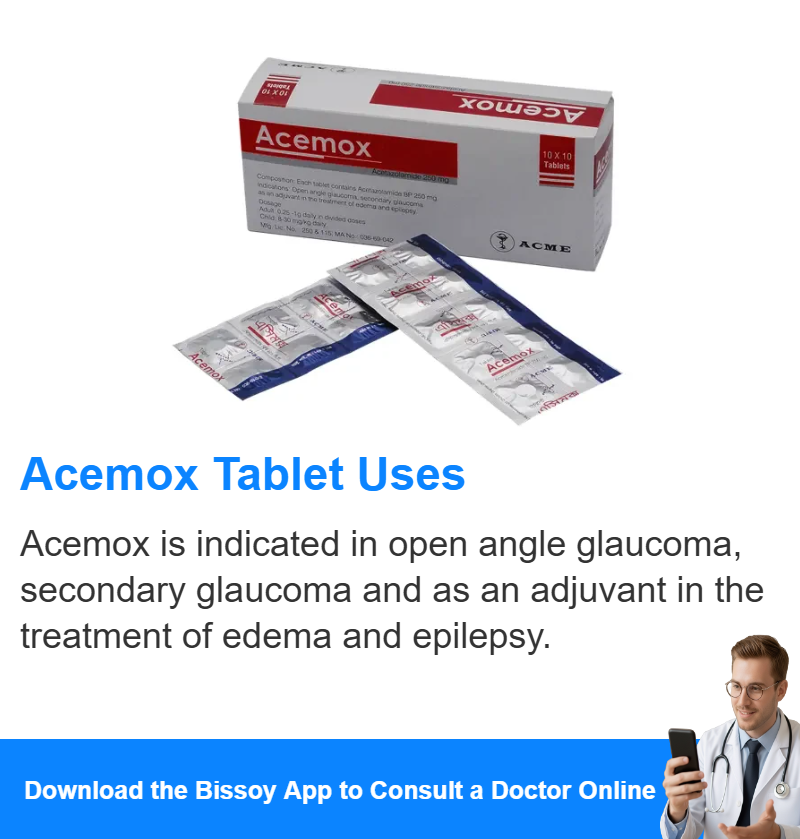
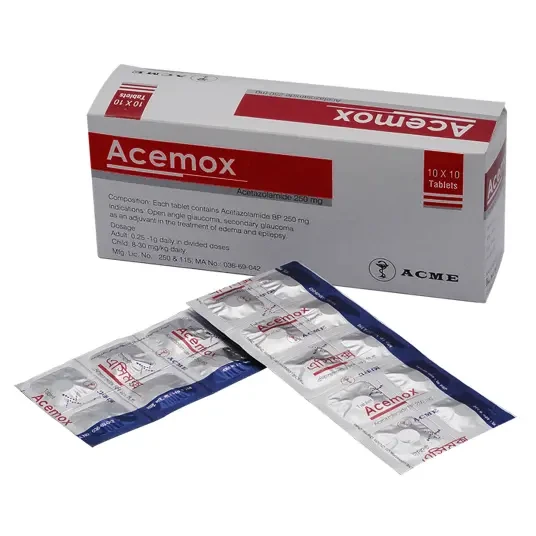
1. What is Acemox Tablet 250 mg?
Acemox Tablet 250 mg is a prescription medication classified as a carbonic anhydrase inhibitor. It is used to treat conditions such as glaucoma, altitude sickness, epilepsy, and certain types of edema by altering the body’s acid-base balance and reducing fluid buildup. It’s available under brand names like Diamox or as a generic in tablet or injectable form.
2. What class of drug is Acemox Tablet 250 mg?
Acemox Tablet 250 mg belongs to the carbonic anhydrase inhibitor class. It works by inhibiting the enzyme carbonic anhydrase, which reduces bicarbonate production, leading to effects like diuresis (increased urine output), decreased intraocular pressure, and changes in blood pH.
3. How does Acemox Tablet 250 mg work?
Acemox Tablet 250 mg inhibits carbonic anhydrase, an enzyme that facilitates the conversion of carbon dioxide and water into bicarbonate and hydrogen ions. By blocking this process, it:
- Reduces fluid production in the eye (for glaucoma).
- Increases urine output (for edema).
- Alters blood pH to prevent altitude sickness or control seizures.
Its effects depend on the condition being treated.
4. What conditions does Acemox Tablet 250 mg treat?
It is used for:
- Glaucoma: Lowers intraocular pressure in open-angle or acute angle-closure glaucoma.
- Altitude sickness: Prevents or treats symptoms like headache and nausea.
- Edema: Reduces fluid retention in heart failure or drug-induced swelling.
- Epilepsy: Adjunct treatment for certain seizures (e.g., absence seizures).
It may also have off-label uses.
5. Is Acemox Tablet 250 mg used for anything other than these conditions?
Yes, off-label uses include treating periodic paralysis (to stabilize muscle function), idiopathic intracranial hypertension (to reduce cerebrospinal fluid pressure), and occasionally as a diuretic in specific metabolic conditions like respiratory alkalosis.
6. How is Acemox Tablet 250 mg taken?
It’s taken orally as tablets (125 mg or 250 mg) or, less commonly, via intravenous (IV) injection for emergencies (e.g., acute glaucoma). It’s typically taken 1–4 times daily, depending on the condition, with or without food.
7. What is the typical dosage for adults?
Dosage varies by condition:
- Glaucoma: 250 mg 1–4 times daily.
- Altitude sickness: 125–250 mg twice daily, starting 1–2 days before ascent.
- Edema: 250–375 mg once daily.
- Epilepsy: 8–30 mg/kg/day, divided into doses.
Maximum daily dose is usually 1 gram.
8. What is the dosage for children?
For children, it’s weight-based:
- Epilepsy: 8–30 mg/kg/day, divided into 2–4 doses.
- Glaucoma: 5–10 mg/kg/dose every 6 hours.
A doctor adjusts based on response and tolerance.
9. Can Acemox Tablet 250 mg be taken with food?
Yes, it can be taken with or without food. Taking it with food may reduce stomach upset, a common side effect, though it doesn’t affect absorption significantly.
10. What should I do if I miss a dose?
If you miss a dose, take it as soon as you remember unless it’s close to the next dose. Skip it if it’s almost time for the next one, and don’t double up, as this could increase side effects like drowsiness or acidosis.
11. How quickly does Acemox Tablet 250 mg work?
It acts within 1–2 hours for oral tablets, with peak effects in 2–4 hours. For altitude sickness, benefits may be felt within hours; for glaucoma, pressure reduction starts soon after dosing. IV forms work faster (within minutes).
12. What are the common side effects?
Common side effects include:
- Tingling: Numbness or pins-and-needles in hands/feet.
- Fatigue: Drowsiness or tiredness.
- Taste changes: Metallic taste, especially with carbonated drinks.
- Increased urination: Due to diuretic effect.
These often lessen with time.
13. What are the serious side effects?
Serious side effects include:
- Metabolic acidosis: Symptoms like rapid breathing or confusion.
- Allergic reactions: Rash, swelling, or breathing difficulty.
- Kidney stones: Painful urination or blood in urine.
- Blood disorders: Unusual bruising or infections.
Seek immediate medical help if these occur.
14. Why does Acemox Tablet 250 mg cause tingling?
Tingling (paresthesia) results from changes in blood pH and electrolyte shifts (e.g., potassium loss) due to carbonic anhydrase inhibition. It’s usually harmless and temporary but can be bothersome.
15. Can Acemox Tablet 250 mg cause allergic reactions?
Yes, especially in those allergic to sulfa drugs, as Acemox Tablet 250 mg is a sulfonamide. Reactions range from rash to severe anaphylaxis. Avoid it if you have a sulfa allergy unless benefits outweigh risks.
16. Who should not take Acemox Tablet 250 mg?
It’s contraindicated for:
- Sulfa allergy: High reaction risk.
- Severe kidney/liver disease: Impaired clearance increases toxicity.
- Low sodium/potassium: Worsens electrolyte imbalance.
Caution is needed in these cases.
17. Is Acemox Tablet 250 mg safe during pregnancy?
It’s Category C—animal studies show fetal risk (e.g., limb defects), but human data are limited. It’s used only if benefits outweigh risks, such as in severe glaucoma. Consult a doctor.
18. Can I take Acemox Tablet 250 mg while breastfeeding?
It passes into breast milk in small amounts. While no major harm is reported, it’s best to consult a doctor, as it could affect the infant’s acid-base balance.
19. Does Acemox Tablet 250 mg interact with other medications?
Yes, it interacts with:
- Aspirin: Increases toxicity risk (e.g., acidosis).
- Diuretics: Enhances potassium loss.
- Anticonvulsants: May alter levels (e.g., phenytoin).
Inform your doctor of all drugs you’re taking.
20. Can I drink alcohol while taking Acemox Tablet 250 mg?
Alcohol doesn’t directly interact, but it may worsen side effects like drowsiness or dehydration, especially at altitude. Limit intake to avoid complications.
21. Does Acemox Tablet 250 mg cause weight gain?
No, it’s a diuretic and may cause weight loss from fluid reduction. Weight gain isn’t a typical effect.
22. Can Acemox Tablet 250 mg be taken at night?
Yes, but frequent urination may disrupt sleep. For altitude sickness, daytime dosing (e.g., morning and afternoon) is common to align with activity.
23. How long do I need to take Acemox Tablet 250 mg?
Duration varies:
- Altitude sickness: 1–2 days before ascent until descent.
- Glaucoma: Long-term or until surgery.
- Edema: Short-term, often a few days.
Follow your doctor’s plan.
24. Can Acemox Tablet 250 mg be stopped suddenly?
Stopping is usually safe but depends on the condition. For glaucoma, abrupt cessation may raise eye pressure; taper off under medical guidance if needed.
25. Does Acemox Tablet 250 mg affect blood sugar?
It doesn’t directly affect blood sugar, but metabolic acidosis could complicate diabetes management. Monitor levels if diabetic.
26. Can Acemox Tablet 250 mg cause kidney stones?
Yes, it increases urine alkalinity, raising the risk of calcium phosphate stones, especially with long-term use. Staying hydrated helps prevent this.
27. What should I avoid while taking Acemox Tablet 250 mg?
Avoid:
- Dehydration: Increases stone risk.
- High-dose aspirin: Toxicity risk.
- Strenuous activity without acclimatization: If at altitude.
28. Can Acemox Tablet 250 mg cause fatigue?
Yes, fatigue or drowsiness is common due to its effects on blood pH and electrolytes, especially early in treatment.
29. Is Acemox Tablet 250 mg safe for elderly patients?
Yes, but the elderly may need lower doses due to reduced kidney function, which affects drug clearance. Monitoring is essential.
30. Does Acemox Tablet 250 mg affect the liver?
Rarely, it may cause mild liver enzyme elevations, but significant damage is uncommon unless liver disease pre-exists.
31. Can Acemox Tablet 250 mg be used in children?
Yes, for epilepsy or glaucoma, with weight-based dosing (e.g., 5–30 mg/kg/day). It’s less common for altitude sickness in kids.
32. What’s the maximum dose of Acemox Tablet 250 mg?
The maximum is typically 1 gram (1000 mg) daily, divided into doses, though higher doses are rare and require monitoring.
33. Can Acemox Tablet 250 mg cause dizziness?
Yes, dizziness may occur due to electrolyte shifts or dehydration, especially at altitude or with high doses.
34. How is Acemox Tablet 250 mg different from other diuretics?
Unlike loop diuretics (e.g., furosemide), it’s a weak diuretic and acts by inhibiting carbonic anhydrase, affecting bicarbonate rather than sodium directly. It’s more targeted for glaucoma or altitude sickness than general fluid removal.
35. Can Acemox Tablet 250 mg prevent altitude sickness?
Yes, it’s the gold standard for prevention, reducing symptoms by speeding acclimatization through pH changes that stimulate breathing.
36. Does Acemox Tablet 250 mg affect cholesterol?
No, it has no impact on cholesterol levels.
37. Can Acemox Tablet 250 mg be taken with other diuretics?
Yes, but it increases potassium loss risk when combined with drugs like furosemide. Electrolyte monitoring is needed.
38. What tests should I get while on Acemox Tablet 250 mg?
For long-term use, check:
- Electrolytes: Potassium, sodium, bicarbonate.
- Kidney function: Creatinine.
- Blood pH: To detect acidosis.
39. Can Acemox Tablet 250 mg cause depression?
It’s not a common side effect, but fatigue or mood changes might be mistaken for depression. Report persistent issues to a doctor.
40. Is Acemox Tablet 250 mg addictive?
No, it’s not addictive or habit-forming.
41. Can Acemox Tablet 250 mg be crushed?
Yes, tablets can be crushed if swallowing is difficult, though a bitter taste may result. Check with a pharmacist.
42. Does Acemox Tablet 250 mg cause hair loss?
No, hair loss isn’t a reported side effect.
43. Can Acemox Tablet 250 mg be used for migraines?
It’s not a standard migraine treatment but may help in rare cases linked to altitude or intracranial pressure.
44. What’s the half-life of Acemox Tablet 250 mg?
Its half-life is 2–6 hours, longer with kidney impairment, requiring dose adjustments.
45. Can Acemox Tablet 250 mg cause a rash?
Yes, a rash may signal a sulfa allergy or, rarely, a severe reaction like Stevens-Johnson syndrome. Stop use and seek help if severe.
46. Does Acemox Tablet 250 mg affect exercise?
It may cause fatigue or tingling, impacting exercise, especially at altitude. Hydration helps mitigate this.
47. Can Acemox Tablet 250 mg be taken with aspirin?
Yes, but high-dose aspirin increases toxicity risk (e.g., acidosis, confusion). Low doses are usually safe.
48. Is Acemox Tablet 250 mg expensive?
As a generic, it’s affordable, often $10–$30 for a month’s supply, depending on dose and region.
49. Can Acemox Tablet 250 mg cause stomach pain?
Yes, mild stomach upset or nausea can occur, especially without food. Taking it with meals may help.
50. How should Acemox Tablet 250 mg be stored?
Store at room temperature (15–30°C or 59–86°F), away from moisture and heat. Keep out of reach of children.