Abdorin Syrup 10 mg/5 ml Introduction

Dicycloverine hydrochloride is an anticholinergic drug used for the treatment of irritable bowel syndrome and other gastrointestinal (GI) disorders such as abdominal cramping and spasms. It works by blocking the smooth muscle-stabilizing muscarinic acetylcholine receptors in the gut, which can help to alleviate abdominal distress. Dicycloverine hydrochloride is available in both tablet and liquid forms and is usually taken orally at least three times daily.

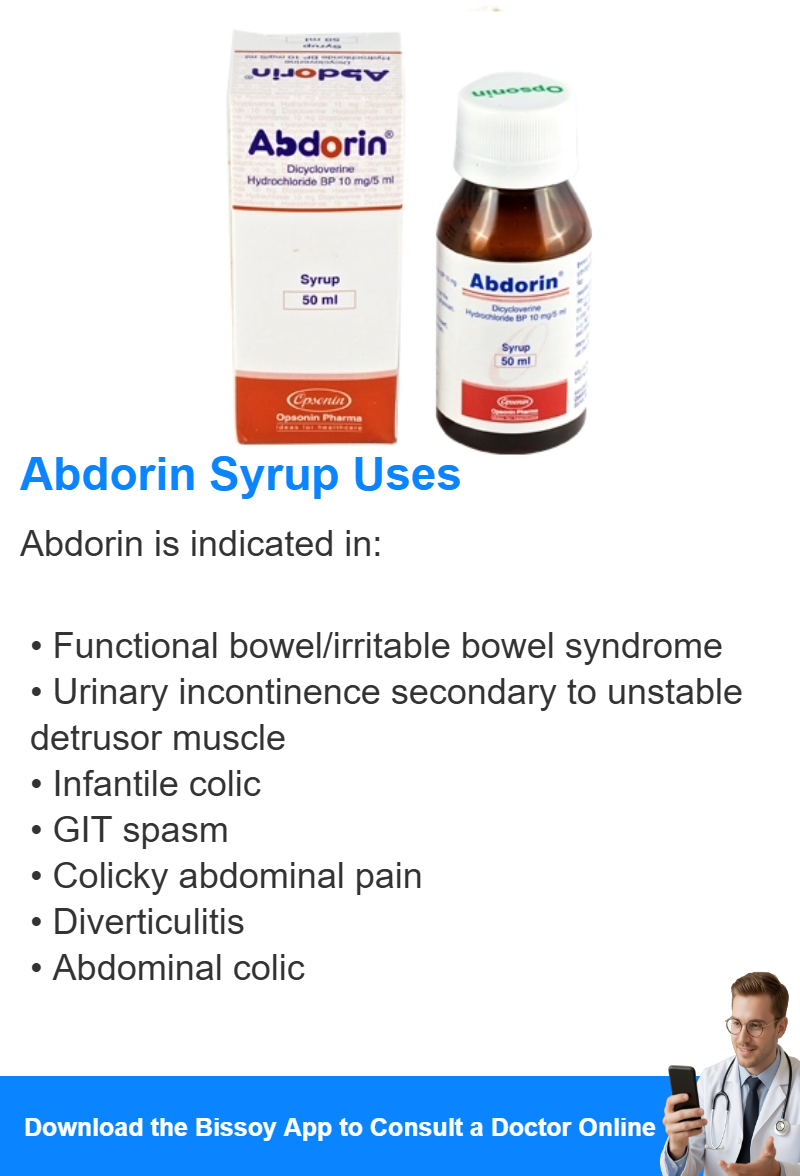
Uses

Dicycloverine hydrochloride is primarily used to treat irritable bowel syndrome (IBS), abdominal cramping, and abdominal spasms associated with IBS. In addition, it can be used to treat symptoms of intestinal gas, including bloating, pain, and excessive flatulence. Additionally, dicycloverine hydrochloride can be used to reduce nausea and vomiting caused by medications, and it may also be prescribed to treat bladder spasms after abdominal surgery.
Brand Name Abdorin
Type Syrup
Weight 10 mg/5 ml
Generic Dicycloverine Hydrochloride
Manufacturer Opsonin Pharma Ltd.
Available in English বাংলা

Mechanism of Action

Dicycloverine hydrochloride is an anticholinergic drug which works by blocking the nerve impulses in the parasympathetic nervous system, causing the muscles of the bowel to relax. This helps relieve abdominal cramping and spasms associated with irritable bowel syndrome and other gastrointestinal issues.

How Long Does it Take to Work?

The onset of action of dicycloverine hydrochloride is typically within 30 minutes to 1 hour after oral administration. The effects can last as long as eight hours.

Absorption

Dicycloverine hydrochloride is rapidly and completely absorbed after oral administration, with peak plasma concentrations occurring within 2 to 4 hours.

Route of Elimination

Dicycloverine hydrochloride is mainly eliminated via the urine.

Dosage

For oral dosage forms:
  • Adults:10 to 20 mg three times a day.
  • Children over 6 months of age: 5 to 10 mg three times a day.
For injectable dosage form:
  • Adults: Intramuscular injection. Not for intravenous use. The recommended intramuscular dose is 80 mg daily (in 4 equally divided doses).
Oral dicycloverine Hydrochloride should be started as soon as possible and the intramuscular form should not be used for periods longer than 1 or 2 days.

Children: Dose must be determined by the doctor. The recommended adult dosage for dicycloverine hydrochloride is 20 to 40 mg three times daily. The initial dosage for infants aged 6 months to 2 years is 10 mg three times daily. The initial dosage for children aged 2 to 12 years is 20 mg three times daily. The dosage for patients over 12 years of age and adults should be determined by a doctor based on the severity of the patient's condition.
Administration

Dicycloverine hydrochloride should be taken orally, usually three times daily. The tablets can be taken with or without food.

Side Effects

Common side effects of dicycloverine hydrochloride include dry mouth, blurred vision, constipation, difficulty urinating, drowsiness, and dizziness.

Toxicity

In an overdose, dicycloverine hydrochloride can cause severe adverse reactions such as severe drowsiness, confusion, abnormal heart rhythms, and severe depression. If an overdose is suspected, seek medical attention immediately.

Precautions

Dicycloverine hydrochloride should be used with caution in patients with underlying conditions such as an overactive thyroid, glaucoma, difficulty urinating, kidney or liver disease, or an enlarged prostate. It should also be used with caution in elderly patients, as they may be more sensitive to the side effects of the medication.

Interactions

Dicycloverine hydrochloride may interact with other medications, including anticholinergics, antidepressants, antihistamines, and narcotics. It may also interact with certain herbal products, vitamins, and dietary supplements.

Disease Interactions

Dicycloverine hydrochloride can interact with other underlying conditions, such as abnormal heart rhythms, glaucoma, enlarged prostate, kidney or liver disease, ulcerative colitis, and psoriasis. Patients with any of these conditions should consult their doctor before taking dicycloverine hydrochloride.

Drug Interactions

Dicycloverine hydrochloride can interact with other medications, such as anticholinergics, antidepressants, antihistamines, narcotics, sedatives, and antispasmodics. Patients taking any of these medications should discuss the risks and benefits of taking this medication with their doctor.

Food Interactions

Dicycloverine hydrochloride can interact with certain foods, including citrus fruits, coffee, tea, caffeinated beverages, and alcohol. Patients should limit their intake of these foods and beverages to reduce the risk of side effects.

Pregnancy Use

Dicycloverine hydrochloride should not be used during pregnancy unless deemed necessary by a doctor. It is important to discuss the potential risks and benefits of taking this medication while pregnant with your doctor.

Lactation Use

Dicycloverine hydrochloride is not recommended for use in breastfeeding women. If necessary, your doctor should carefully weigh the potential risks and benefits of taking this medication while breastfeeding.

Acute Overdose

An acute overdose of dicycloverine hydrochloride may cause severe adverse reactions. Seek medical attention immediately if an overdose is suspected.

Contraindications

Dicycloverine hydrochloride should not be used in patients with rare hereditary problems of galactose intolerance, lapp lactase deficiency, or glucose-galactose malabsorption. It should also not be used in patients with an allergy to dicycloverine hydrochloride, or any of the other ingredients in the medication.

Use Direction

Dicycloverine hydrochloride should be taken orally, usually three times daily. The tablets can be taken with or without food.

Storage Conditions

Dicycloverine hydrochloride tablets should be stored at room temperature, away from excess humidity, heat, and light. The liquid form should be stored in the refrigerator, tightly sealed, and away from light.

Volume of Distribution

The volume of distribution of dicycloverine hydrochloride is 0.6 to 0.7L/kg.

Half-Life

The half-life of dicycloverine hydrochloride is approximately 6.3 hours.

Clearance

The clearance of dicycloverine hydrochloride is approximately 8.8 mL/minute/kg.

See in details version Abdorin Syrup 10 mg/5 ml also Abdorin Syrup 10 mg/5 ml in bangla

Social card

Uses

Some Frequently Asked Questions About Abdorin Syrup 10 mg/5 ml

1. What is Abdorin Syrup 10 mg/5 ml?

Abdorin Syrup 10 mg/5 ml (also known as Dicyclomine) is an antispasmodic drug used to relieve muscle spasms in the gastrointestinal tract.

2. What is Dicycloverine used for?

It is mainly used to treat irritable bowel syndrome (IBS) and other conditions that cause intestinal spasms.

3. How does Dicycloverine work?

It works by relaxing the smooth muscles in the gut, reducing cramping and pain.

4. Is Dicycloverine an anticholinergic?

Yes, it is an anticholinergic and antispasmodic agent.

5. What are the brand names of Dicycloverine?

Common brand names include Bentyl, Kolanticon, and Dicyclomine Hydrochloride.

6. How is Dicycloverine administered?

It is available in oral tablets, capsules, and syrup, as well as an injectable form.

7. What is the usual dosage for adults?

Typically, 10–20 mg is taken 3–4 times daily.

8. Can children take Dicycloverine?

It is not recommended for infants under 6 months due to potential serious side effects.

9. Can pregnant women take Dicycloverine?

It should only be used during pregnancy if clearly necessary and prescribed by a doctor.

10. Can breastfeeding mothers take Dicycloverine?

It is generally not recommended for breastfeeding mothers as it can pass into breast milk.

11. How long does Dicycloverine take to work?

It usually starts working within 1 to 2 hours after administration.

12. How long does the effect of Dicycloverine last?

The effects typically last for about 4 to 6 hours.

13. What are the common side effects of Dicycloverine?

  • Dry mouth
  • Dizziness
  • Blurred vision
  • Nausea
  • Constipation

14. What are the serious side effects of Dicycloverine?

  • Hallucinations
  • Severe dizziness
  • Difficulty urinating
  • Irregular heartbeat
  • Severe allergic reactions

15. Can Dicycloverine cause drowsiness?

Yes, drowsiness is a possible side effect, so caution is advised when driving or operating machinery.

16. Can Dicycloverine cause addiction?

No, it does not have addictive properties.

17. Can Dicycloverine be taken on an empty stomach?

Yes, but it is usually taken with or after food to reduce stomach discomfort.

18. Can I drink alcohol while taking Dicycloverine?

It is best to avoid alcohol as it can increase drowsiness and dizziness.

19. What should I do if I miss a dose?

Take it as soon as you remember, but skip it if it's almost time for the next dose. Do not double the dose.

20. What should I do in case of an overdose?

Seek emergency medical attention if you experience confusion, hallucinations, rapid heartbeat, or difficulty breathing.

21. Can I take Dicycloverine with painkillers?

Yes, but consult a doctor before combining it with other medications.

22. Can I take Dicycloverine with antacids?

Yes, but take them separately as antacids may reduce its effectiveness.

23. Can I take Dicycloverine for menstrual cramps?

It is not commonly used for menstrual cramps, but a doctor may prescribe it if needed.

24. Can Dicycloverine be taken for acid reflux?

No, it is not used for acid reflux or heartburn.

25. Does Dicycloverine help with bloating?

Yes, it may reduce bloating caused by intestinal spasms.

26. Can Dicycloverine be taken long-term?

It is usually prescribed for short-term use unless directed otherwise by a doctor.

27. Is Dicycloverine a muscle relaxant?

Yes, it relaxes smooth muscles in the digestive tract.

28. Can Dicycloverine help with nausea?

It may help if nausea is caused by intestinal spasms.

29. Can I take Dicycloverine every day?

Yes, if prescribed by a doctor for ongoing treatment.

30. Can Dicycloverine cause constipation?

Yes, constipation is a possible side effect.

31. Can Dicycloverine cause diarrhea?

Diarrhea is not a common side effect, but it may occur in some people.

32. Can Dicycloverine cause a dry mouth?

Yes, dry mouth is a common side effect.

33. Can Dicycloverine cause anxiety?

Anxiety is not a common side effect, but in rare cases, it may cause nervousness or restlessness.

34. Can Dicycloverine cause vision problems?

Yes, it can cause blurred vision in some patients.

35. Can Dicycloverine be used for gallbladder pain?

It is sometimes used for gallbladder spasms, but consult a doctor before use.

36. Can Dicycloverine be taken before or after meals?

It is usually taken after meals.

37. Can Dicycloverine cause increased heart rate?

Yes, an increased heart rate (tachycardia) is a possible side effect.

38. Can Dicycloverine be taken with probiotics?

Yes, it can be taken with probiotics for gut health.

39. Is Dicycloverine available over-the-counter?

In most countries, it requires a prescription.

40. Can Dicycloverine be given to elderly patients?

Yes, but with caution due to the risk of side effects.

41. Can Dicycloverine be used for food poisoning?

No, it does not treat infections caused by food poisoning.

42. Can Dicycloverine be taken with antibiotics?

Yes, but only if prescribed by a doctor.

43. Can Dicycloverine be stopped suddenly?

Yes, but consult a doctor before stopping.

44. Does Dicycloverine cure IBS?

No, but it helps manage symptoms.

45. How should Dicycloverine be stored?

Store at room temperature, away from moisture and direct sunlight.

*** Taking medicines without doctor's advice can cause long-term problems.
Dr. Prabal Bhattacharyya

Dr. Prabal Bhattacharyya

Orthopedics (Bone, Joint, Arthritis, Injury) & Trauma Surgeon

Orthopedics Doctor in Chittagong
Call Doctor
Dr. Kazi Fouzia Afrin

Dr. Kazi Fouzia Afrin

Asthma, Chest Diseases & TB Specialist

Chest Doctor in Dhaka
Call Doctor
Related Medicines