Introduction
A naturally occurring furocoumarin compound found in several species of plants, including Psoralea corylifolia. It is a photoactive substance that forms DNA adducts in the presence of ultraviolet A irradiation.
Uses
Methoxsalen is a furocoumarin used to treat psoriasis and vitiligo.
For the treatment of psoriasis and vitiligo
Associated Conditions
Pharmacodynamics
Methoxsalen selectively inhibits the synthesis of deoxyribonucleic acid (DNA). The guanine and cytosine content correlates with the degree of Methoxsalen-induced cross-linking. At high concentrations of the drug, cellular RNA and protein synthesis are also suppressed.
Mechanism of Action
After activation it binds preferentially to the guanine and cytosine moieties of DNA, leading to cross-linking of DNA, thus inhibiting DNA synthesis and function.
Route of Elimination
In both mice and man, methoxsalen is rapidly metabolized. Approximately 95% of the drug is excreted as a series of metabolites in the urine within 24 hours (Pathak et al. 1977).
Half Life
Approximately 2 hours
Food Interactions
- Take with food. Take this medication with food or milk.
Dosage
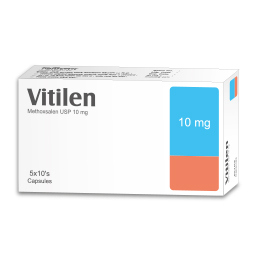
Vitiligo therapy: Two Methoxsalen capsules (10 mg each) in one dose taken with milk or food two to four hours before ultraviolet light exposure.
Light exposure: The exposure time to sunlight should comply with the following guide:
- Initial exposure: Light-15 min, Medium-20 min, Dark-25 min
- Second exposure: Light-20 min, Medium-25 min, Dark-30 min
- Third exposure: Light-25 min, Medium-30 min, Dark-35 min
- Fourth exposure: Light-30 min, Medium-35 min, Dark-40 min
Psoriasis therapy: The Methoxsalen capsules should be taken 2 hours before UVA exposure with some food or milk, according to the following table:
- <30 kg body weight: 10 mg
- 30-50 kg body weight: 20 mg
- 51-65 kg body weight: 30 mg
- 66-80 kg body weight: 40 mg
- 81-90 kg body weight: 50 mg
- 91-115 kg body weight: 60 mg
- >115 kg body weight: 70 mg
Pigmentation may begin after a few weeks but significant repigmentation may require 6 to 9 months of treatment. Periodic re-treatment may be necessary to retain all of the new pigment. Idiopathic vitiligo is reversible but not equally reversible in every patient. Treatment must be individualized. Repigmentation will vary in completeness, time of onset, and duration. Repigmentation occurs more rapidly in fleshy areas such as face, abdomen, and buttocks and less rapidly over less fleshy areas such as the dorsum of the hands or feet.