Introduction
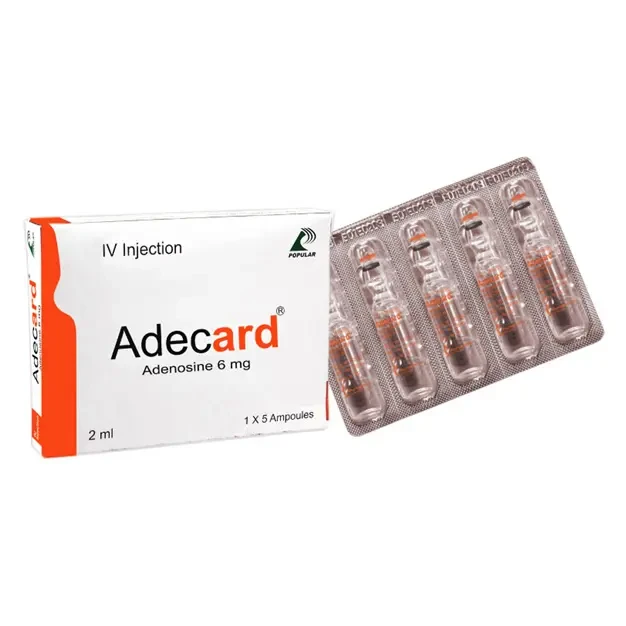
Adenosine is an endogenous nucleoside used in the treatment of paroxysmal supraventricular tachycardia (PSVT) and as a pharmacologic stress agent for myocardial perfusion imaging. It produces transient atrioventricular (AV) nodal block and coronary vasodilation, making it useful for both diagnostic and therapeutic purposes.
Due to its extremely short half-life, adenosine has a rapid onset and brief duration of action, allowing quick restoration of normal heart rhythm in patients with supraventricular tachycardia.
Uses
Adenosine is a medication used in myocardial perfusion scintigraphy and to treat supraventricular tachycardia.
Adenosine is indicated as an adjunct to thallium-201 in myocardial perfusion scintigraphy in patients unable to adequately exercise. It is also indicated to convert sinus rhythm of paroxysmal supraventricular tachycardia.
Associated Conditions
Pharmacodynamics
Adenosine is indicated as an adjunct to thallium-201 in myocardial perfusion scintigraphy and also indicated for conversion of sinus rhythm of paroxysmal supraventricular tachycardia. Adenosine has a short duration of action as the half life is 12,13 Patients should be counselled regarding the risk of cardiovascular side effects, bronchoconstriction, seizures, and hypersensitivity.
Mechanism of Action
Agonism of adenosine receptors A1 and A2 reduces conduction time in the atrioventricular node of the heart. Conduction time is decreased by inducing potassium efflux and inhibiting calcium influx through channels in nerve cells, leading to hyperpolarization and and increased threshold for calcium dependent action potentials. Decreased conduction time leads to an antiarrhythmic effect. Inhibition of calcium influx, reduces the activity of adenylate cyclase, relaxing vascular smooth muscle. Relaxed vascular smooth muscle leads to increased blood flow through normal coronary arteries but not stenotic arteries, allowing thallium-201 to be more readily uptaken in normal coronary arteries.
Absorption
Data regarding the absorption of adenosine are not readily available.
Volume of Distribution
Data regarding the volume of distribution of adenosine are not readily available.
Protein Binding
Adenosine is bound to albumin in plasma, however data regarding the extent of binding are not readily available.
Route of Elimination
Adenosine is predominantly eliminated in the urine as uric acid.
Half Life
The half life of adenosine in blood is less than 10 seconds.
Clearance
Data regarding the clearance of adenosine are not readily available.
Toxicity
Patients experiencing an overdose of adenosine may present with asystole, heart block, or cardiac ischemia; though the effects are generally short lived. Patients experiencing an overdose should be treated with symptomatic and supportive care, which may include a slow intravenous injection of theophylline.
The LD50 in mice is >20 g/kg subcutaneously, 500mg/kg intraperitoneally, and 39.6 µg/kg subcutaneously.[L32048]
Food Interactions
- Avoid caffeine. Caffeine may antagonise the activity of adenosine.
Dosage
- Initial dose: 6 mg given as rapid IV bolus (administered over 1-2 second period).
- Repeat administration: If the first dose does not result in elimination of the supraventricular tachycardia within 1-2 minutes, 12 mg should be given as rapid intravenous bolus. This 12 mg dose may be repeated for second time if required.
- Body weight < 50 kg: Initial dose - 0.05 to 0.1 mg/kg as a rapid IV bolus given either centrally or peripherally. A saline flush should follow.
- Body weight > 50 kg: The adult dose is recommended. Doses greater than 12 mg are not recommended for adult and pediatric patients.
Repeat administration: If conversion of PSVT does not occur within 1-2 minutes, additional bolus injections of adenosine can be administered at incrementally higher doses, increasing the amount given by 0.05 to 0.1 mg/kg. A saline flush should follow. This process should continue until sinus rhythm is established or a maximum single dose of 0.3 mg/kg is used.